
Why Tracking Your Gym Progress is a Game-Changer
How to track gym progress is simpler than you think. Here are the most effective methods:
- Log your workouts – Record exercises, sets, reps, and weight lifted after each session
- Take progress photos – Capture front, side, and back views every 4-6 weeks in consistent lighting
- Measure your body – Track key areas like waist, hips, chest, and arms weekly or bi-weekly
- Monitor performance – Note improvements in strength, endurance, and exercise form
- Track how you feel – Record energy levels, sleep quality, and overall wellbeing
You’ve been showing up to the gym consistently. You’re putting in the work. But here’s the question that keeps nagging you: are you actually making progress?
Without tracking, it’s nearly impossible to know. Your workouts might feel great, but feelings alone don’t tell you if you’re getting stronger, losing fat, or building muscle. The simple act of tracking your gym progress transforms guesswork into results.
The American Council on Exercise confirms that workout logs boost accountability and help prevent plateaus by showing exactly when and how to progress. When you track your lifts, measurements, or even just how you feel, you create a roadmap. You can see what’s working, what’s not, and where to adjust.
Tracking also fuels motivation. Looking back at where you started—whether it’s the weight you lifted, the photos you took, or the measurements you recorded—gives you tangible proof that your hard work is paying off. Those small wins add up fast.
I’m Pleasant Lewis JMAC, and in over 40 years in the fitness industry, I’ve seen countless members transform their results simply by learning how to track gym progress consistently. Whether you prefer a simple notebook or a sophisticated app, the key is making tracking a habit that fits your lifestyle.
Boosts Motivation and Accountability
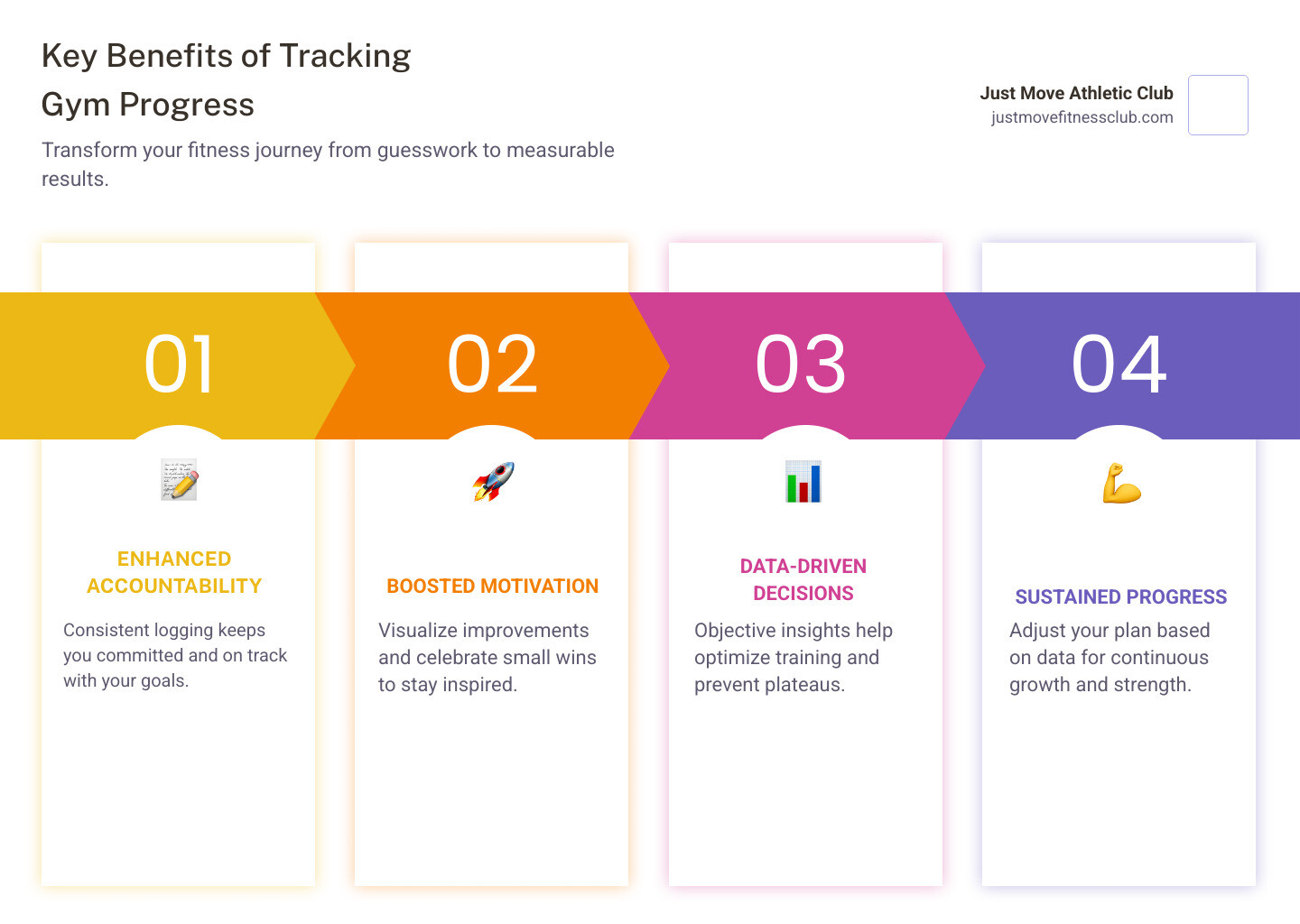
One of the most powerful aspects of tracking your gym progress is the incredible boost it gives to your motivation and accountability. When you diligently record your workouts and other fitness markers, you create a visual and tangible record of your journey. This isn’t just about numbers on a page; it’s about seeing how far you’ve come.
Imagine looking back at your first week of workouts and comparing them to your current performance. You’ll see increased weights, more reps, or faster times. This tangible proof of hard work reinforces your commitment and reminds you why you started in the first place. It turns abstract goals into concrete achievements, making it easier to stay focused, especially on days when motivation might be flagging. As James Clear, author of Atomic Habits, suggests, deciding who you want to be and then proving it to yourself with small wins is key to sustained success. Tracking provides those small wins daily, weekly, and monthly.
Beyond personal motivation, tracking also improves accountability. Whether you’re sharing your progress with a friend, a personal trainer, or even just committing it to your journal, the act of recording your efforts holds you to a higher standard. It makes it harder to skip a session or make excuses when you have a clear record of your aspirations and efforts. For an extra layer of support, the power of group fitness and community can also significantly boost your accountability.
Provides Objective Data for Smarter Training
Guessing at your progress is like driving without a map – you might get somewhere, but it’s unlikely to be your intended destination. This is where objective data comes in. By consistently tracking your gym progress, we gain invaluable insights into what’s truly happening with our bodies and our training. This data identifies our strengths, highlights areas where we need to improve, and provides the foundation for making informed decisions about our training plan.
For instance, if you’re consistently hitting your target reps and sets with ease on a particular exercise, your data tells us it’s time for progressive overload – perhaps increasing the weight, adding more reps, or reducing rest times. Conversely, if you notice a consistent drop in performance or feel excessively fatigued, your tracking log can signal potential overtraining or a need to adjust recovery. This data-driven approach helps maximize efficiency, ensuring every minute we spend in the gym is moving us closer to our goals. As the experts at PVL Canada note, your fitness success is directly correlated to your data recording, emphasizing that progressive overload is the key principle for continuous improvement.
Working with a personal trainer at Just Move Athletic Club can further improve this. They can analyze your tracked data, interpret trends, and help you fine-tune your approach, making informed decisions about when to increase intensity, change exercises, or modify rest periods. This collaboration ensures your plan is always optimized for your current capabilities and long-term aspirations.
What to Track: Key Metrics for Measurable Results
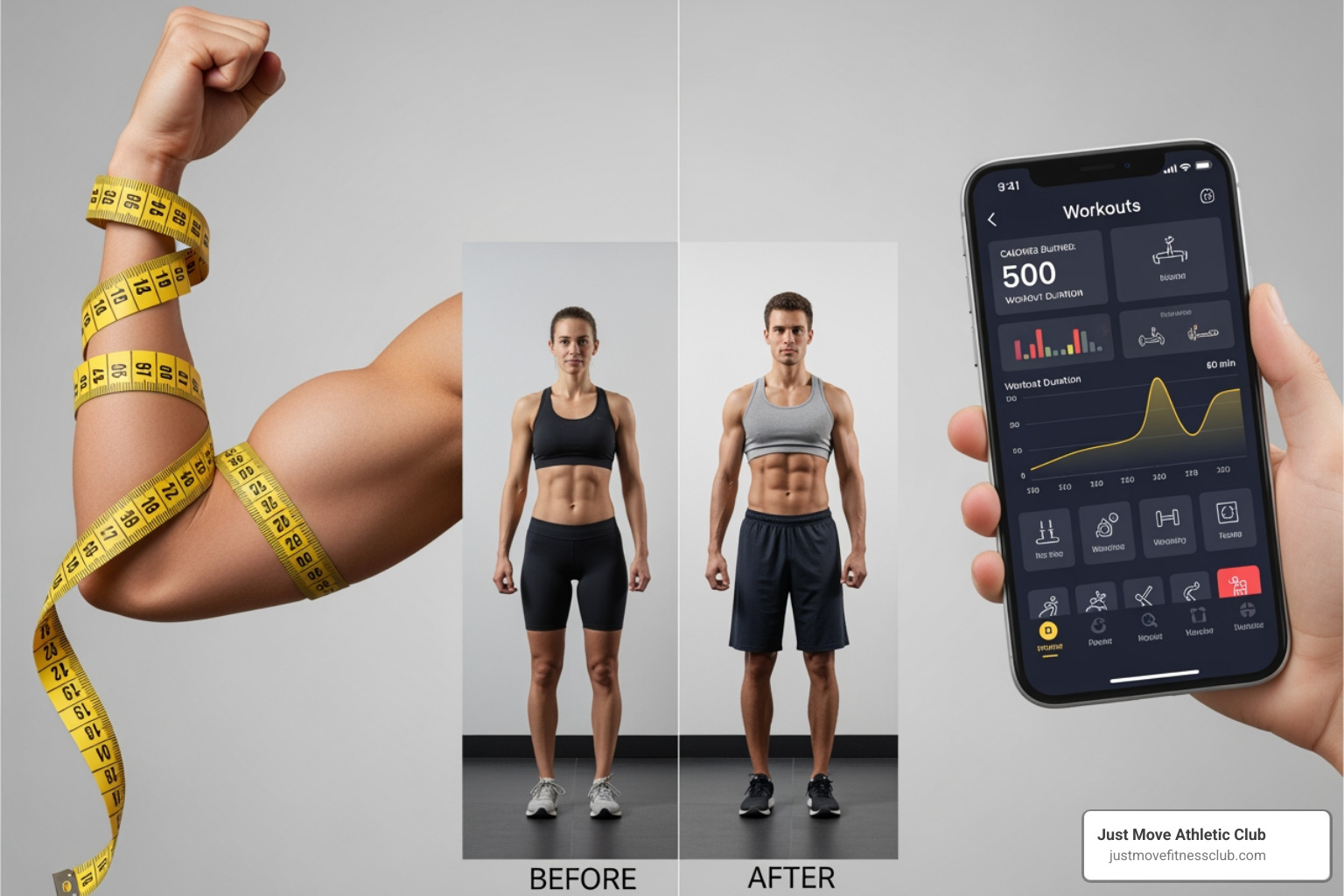
Understanding how to track gym progress means looking at the complete picture, not just one isolated number. Think of it like assembling a puzzle—each piece matters. Performance metrics show what you’re capable of, body composition reveals physical changes, and subjective feedback tells you how you feel day-to-day. Together, these three elements create a comprehensive view of your fitness journey.
Performance Metrics: The Foundation of How to Track Gym Progress
If you want to see real gains in the gym, tracking your performance metrics is where it all begins. This is your workout blueprint, and the details matter.
Start by logging which exercises you’re doing, including any variations. A barbell squat hits your body differently than a dumbbell squat, and tracking these specifics helps you identify what’s working best for your goals.
Next comes the foundation: sets, reps, and weight lifted. For strength training, write down exactly how many sets you completed, how many repetitions you performed, and how much weight you used. If you’re doing cardio, note the duration, distance, and intensity instead. The magic here is something called progressive overload—gradually increasing the demands on your body over time. Maybe you start by squatting 100 pounds for 10 reps. Your next session, you aim for 12 reps at that same weight. Once you hit 15 reps comfortably, you bump the weight to 105 pounds and work back up from 10 reps. This steady progression is how you increase strength in the gym.
Don’t overlook rest periods between sets. The time you spend recovering directly impacts your performance. For heavy strength work (1-6 reps), you typically need 3-5 minutes of rest. Moderate compound lifts (5-10 reps) benefit from 2-3 minutes, while lighter accessory exercises might only need 1.5-2 minutes. Logging these rest times ensures you’re giving your muscles adequate recovery.
Finally, track your RPE (Rate of Perceived Exertion). This is a 1-10 scale measuring how hard each set felt. A 10 means you hit complete failure, while a 6 feels very easy. An RPE of 8 means you probably had two more reps left in the tank. This subjective measure is incredibly valuable—it helps you train hard enough to make progress without constantly grinding yourself into exhaustion. Most of your training should hover around an RPE of 7-8 for optimal results and recovery.
These performance details create a clear record of your strength and endurance gains, giving you concrete proof that you’re moving forward.
Body Composition: Seeing Changes Beyond the Scale
Let’s be honest—the scale can be a liar. Your weight can swing 2 to 6 pounds in a single day because of water retention from salty foods, extra carbs, alcohol, or even your menstrual cycle. Plus, muscle is denser than fat, so you might be getting leaner and stronger while the scale barely budges or even climbs a bit. This is exactly why tracking body composition matters so much.
Body measurements give you the truth the scale won’t tell. Grab a flexible measuring tape and track your waist, hips, chest, arms (around the fullest part of your biceps), and thighs. Consistency is crucial here—measure in the exact same spot every time, in the same position. Wrap the tape around the fullest part of your chest, mark that spot mentally, and measure there each time. Check in weekly or bi-weekly to catch changes the scale misses. For an extra health indicator, you can calculate your waist-to-hip ratio.
Progress photos might feel awkward at first, but they’re one of the most motivating tracking methods you’ll ever use. Take front, side, and back photos every 4-6 weeks. Here’s the trick: same lighting, same time of day (morning before eating works best), and same minimal clothing like swimwear or athletic shorts and a sports bra. When you compare photos from two months apart, you’ll often see dramatic differences in muscle definition and fat loss that you’d never notice day-to-day.
For a more detailed picture, professional body fat percentage measurements are worth their weight in gold. At Just Move Athletic Club, our Fit3D Pro Body Scanner gives you precise, non-invasive data on your body fat percentage, lean mass, and even how your body shape changes over time. This technology delivers objective insights far beyond what any bathroom scale can offer.
And don’t underestimate the power of clothing fit. Pay attention to how your favorite jeans or that one shirt fits. When they start feeling looser or you comfortably drop a size, that’s real-world feedback that often feels more meaningful than any number on a chart.
The scale isn’t the enemy, but it’s definitely not telling you the whole story. These body composition methods reveal what’s really happening with your physique.
Subjective Feedback: How You Feel Matters
Numbers and photos are great, but they don’t capture everything. How you feel matters just as much as what the data shows. Research from the National Institutes of Health confirms that subjective wellbeing is directly connected to training success. Ignoring how your body and mind feel can lead straight to burnout or injury.
Track your energy levels throughout the day. Are you bouncing through your afternoon, or dragging yourself from task to task? Improved energy is one of the clearest signs you’re making progress. Notice your mood too—do you feel uplifted and clear-headed after workouts, or irritable and sluggish? Exercise naturally boosts mood and mental clarity, so these shifts matter.
Sleep quality deserves your attention because it’s foundational for recovery and performance. Are you sleeping soundly and waking refreshed, or tossing and turning all night? Some post-workout soreness is normal and even welcome, but excessive or persistent soreness signals that you might be overdoing it or need more recovery time.
Many people find it helpful to log their daily readiness—simply note if you feel “bad,” “average,” or “excellent” before your workout. This helps you understand how yesterday’s stress, sleep, or nutrition affects today’s performance. A quick note like “left knee was bothering me during squats” or “didn’t sleep well last night” can explain why your numbers dipped that day.
These benefits you can’t see in the mirror are powerful indicators of your overall health and fitness. They remind you that this journey isn’t just about appearance—it’s about feeling better, having more stamina, and living a higher quality of life.
How to Track Gym Progress: Tools and Methods
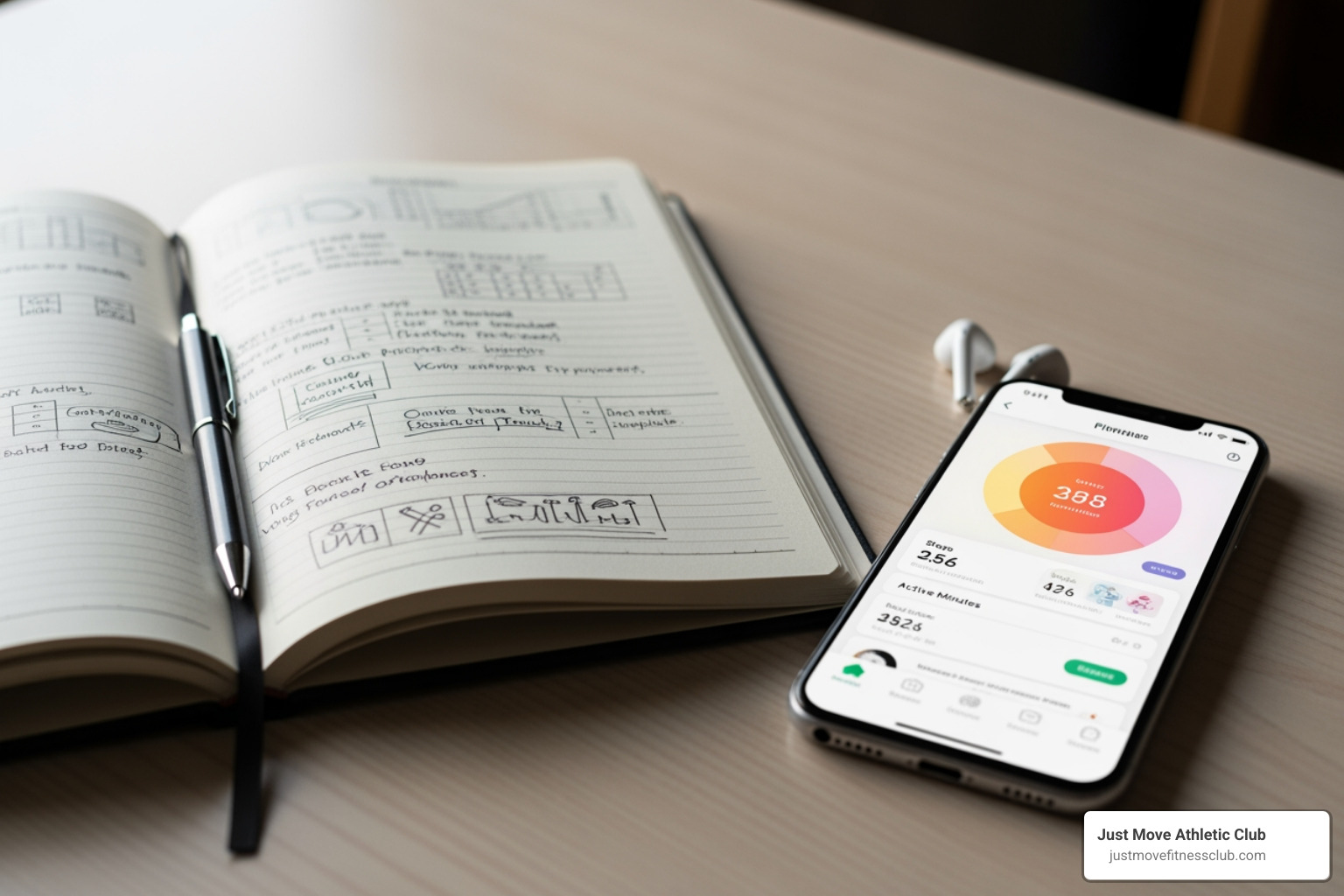
Now that we know what to track, let’s explore how to track it. The good news is there’s a method for everyone, whether you’re a tech-savvy individual or prefer the simplicity of pen and paper. The secret isn’t finding the “perfect” tool—it’s finding the one you’ll actually use consistently.
Using a Fitness Journal or App
When it comes to how to track gym progress, both traditional fitness journals and modern apps can be incredibly effective. The best choice really comes down to what fits naturally into your lifestyle and which method you’ll stick with long-term.
Digital apps offer some fantastic advantages. They automatically calculate trends and visualize your progress with charts and graphs, making it easy to see improvements over time. Your data is secure and backed up in the cloud, so you’ll never lose months of hard work. Many apps can even suggest when to increase weight based on your logged performance. Popular options like Hevy, Fitnotes, and Strongly are specifically designed for strength training and make logging quick and intuitive.
However, apps aren’t perfect for everyone. They can sometimes feel complex with too many features, and there’s always the risk of your phone battery dying mid-workout. Some people also find that having their phone out during training creates distractions—it’s too tempting to check notifications or scroll through social media when you should be focusing on your next set.
Physical journals, on the other hand, offer beautiful simplicity. There’s something satisfying about writing down your lifts with pen and paper. It keeps you focused without digital distractions, and you don’t need to worry about battery life or learning new software. Many fitness enthusiasts swear by their notebooks, finding the tactile act of writing helps them remember their workouts better.
The downside? Manual entry takes more time, and if you lose your notebook or it gets damaged, your data goes with it. Journals also won’t automatically show you trends or remind you when it’s time to progress your lifts—you’ll need to review and analyze your own data.
At the end of the day, the right tool is the one that feels effortless to use. Some members at Just Move Athletic Club love tracking everything on their phones between sets, while others prefer jotting notes in a small notebook they keep in their gym bag. You might even find a hybrid approach works best—using an app for the detailed data but keeping quick notes on paper during your workout to transfer later.
Taking Effective Progress Photos and Measurements
Visual tracking through photos and measurements can be incredibly motivating, but consistency is absolutely key to getting accurate comparisons. A photo taken in the morning with harsh overhead lighting will look drastically different from one taken in the evening with soft, flattering light—even if your body hasn’t changed at all.
For progress photos, choose a specific time that works for your schedule, ideally first thing in the morning before eating or drinking. This minimizes variables like bloating or water retention that can affect how you look. Find a spot in your home with consistent lighting—natural light from a window works great, or use the same room with the same artificial lighting each time. Wear the same minimal clothing (like athletic shorts and a sports bra, or swimwear) so you can clearly see your body’s changes.
Take three photos from different angles: front, side, and back. You might feel awkward at first, but these photos become incredibly valuable. Stand in the same position with the same posture, and try to relax your muscles naturally rather than flexing. Set a reminder to retake these photos every 4-6 weeks. When you look back after a few months, the visual difference can be stunning—even when the scale hasn’t moved much.
For body measurements, grab a flexible measuring tape and measure key areas: your waist (at the narrowest point or at your belly button), hips (at the widest point), chest (around the fullest part), and arms (around the thickest part of your bicep). Some people also track thighs and calves. The critical part is measuring in the exact same spot each time. A good trick is to take a photo of where you place the tape, so you can replicate it perfectly next time.
Measure weekly or bi-weekly, and always do it at the same time of day. Morning measurements tend to be most consistent since you haven’t eaten yet and your body is in a more neutral state. Write down these numbers in your journal or app alongside your workout data.
For those who want highly detailed body composition tracking, our Fit3D Pro Body Scanner at Just Move Athletic Club takes the guesswork out of measurements entirely. It provides precise, objective data about your body fat percentage, lean mass, and even tracks subtle changes in your body shape over time—all without the margin for human error that comes with manual measuring.
This isn’t about judgment or perfection. It’s about having a clear, honest picture of where you started and celebrating how far you’ve come. Taking that first set of photos requires courage, but it’s one of the most powerful steps you can take in your fitness journey. A holistic fitness approach recognizes that true progress happens when we track multiple aspects of our health and wellbeing, not just one isolated metric.