
Why a Beginner HIIT Workout is Your Fast Track to Fitness
A Beginner HIIT workout is a time-efficient exercise method that alternates short bursts of intense activity with recovery periods—perfect for those new to fitness. Here’s what you need to know:
Quick Answer: Best Beginner HIIT Workouts
- 15-Minute Bodyweight Circuit: Jumping jacks, squats, push-ups (30 sec work, 30 sec rest)
- 20-Minute Treadmill Intervals: Alternate 1 min fast walk with 2 min recovery
- Low-Impact Routine: Marching, glute bridges, wall push-ups (40 sec work, 20 sec rest)
- Stationary Bike Session: 30 sec high resistance, 60 sec low resistance
- Single Dumbbell Circuit: Goblet squats, rows, lunges (45 sec work, 15 sec rest)
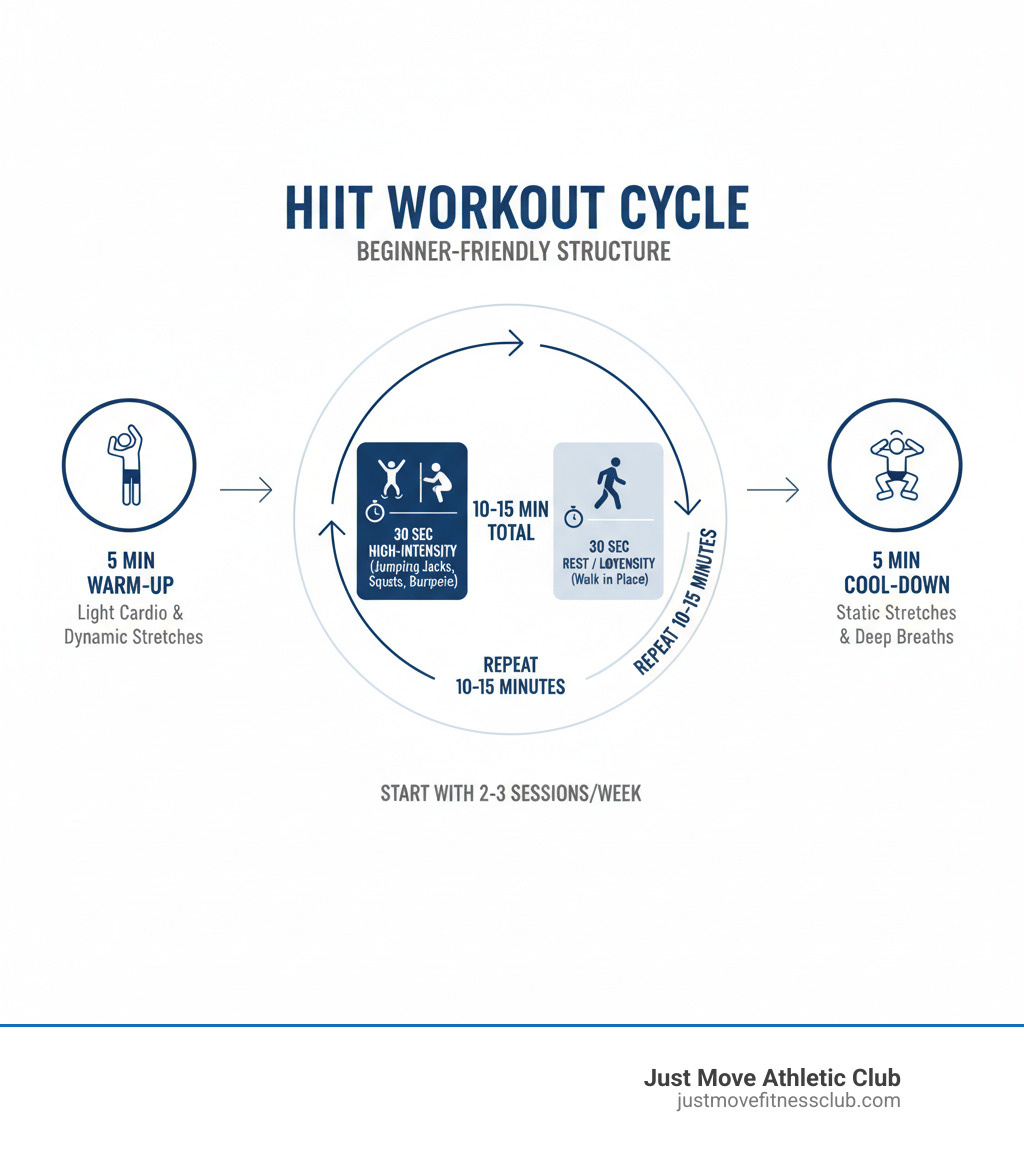
Start with 2-3 sessions per week and always warm up for 5-10 minutes first.
Heard the term “HIIT” and thought it sounded too intense? The truth is, High-Intensity Interval Training doesn’t have to be scary. In fact, it’s one of the most flexible and effective ways to get fit, burning more calories per minute than steady-state cardio. You can see results in as little as 15 minutes a session, without needing fancy equipment or hours of free time.
As the founder of Just Move Athletic Clubs with over 40 years in the fitness industry, I’ve seen how accessible Beginner HIIT workouts are for people at any fitness level. Let’s break down what HIIT is, why it works, and how you can start with simple workouts that fit your life.
What is HIIT and Why is it Perfect for Beginners?
High-Intensity Interval Training (HIIT) involves short bursts of intense activity followed by brief recovery periods. Think of it as doing jumping jacks at your top speed for 30 seconds, then walking in place for 30 seconds to recover, and repeating. It’s a simple but powerful concept.
The science behind HIIT’s effectiveness shows it can burn more calories in less time than traditional cardio. This is due to a metabolic boost called Excess Post-exercise Oxygen Consumption (EPOC), where your body continues to burn calories for hours after your workout. For busy schedules, the time efficiency is a game-changer; a complete session can take just 15-30 minutes. Plus, you can start with just your bodyweight, making it accessible anywhere. For more on the benefits of an active lifestyle, see our article on Fitness Isn’t Just About Looks: 10 Benefits You Can’t See in the Mirror.
The Science-Backed Benefits
A Beginner HIIT workout offers a wide range of health improvements:
- Improves Aerobic and Anaerobic Fitness: HIIT builds both endurance (how long you can go) and power (how hard you can push), making everyday activities easier.
- Aids in Weight Loss: The combination of in-workout calorie burn and the EPOC after-effect is highly effective for fat reduction, particularly stubborn abdominal fat.
- Boosts Cardiovascular Health: Research shows HIIT improves blood pressure, insulin sensitivity, and VO2 max (your body’s oxygen efficiency) more effectively than moderate cardio. HIIT’s impact on cardiometabolic health is well-documented.
- Improves Mood: The post-workout endorphin rush can help manage stress and reduce anxiety.
- Promotes Consistency: Short, varied, and effective workouts are easier to stick with, which is the true key to long-term fitness.
Why It’s Not as Intimidating as It Sounds
The term “high-intensity” can be daunting, but it’s entirely relative. Here’s why a Beginner HIIT workout is so accessible:
- It’s Scalable: “Maximum effort” is your maximum. For a beginner, this could be a brisk walk; for an athlete, it might be a sprint. You work at your own level.
- Short Intervals are Manageable: Pushing hard for 30 seconds is mentally easier than facing a 45-minute jog. You can do almost anything for a short burst.
- It’s Engaging: The constant change between work and rest keeps your mind occupied and the workout interesting.
If you’re nervous about starting, our Top Tips for Getting Started on Your Fitness Journey: A Beginner’s Guide can help you begin with confidence.
Getting Started: Your Pre-Workout Checklist
Before you jump into your first Beginner HIIT workout, a little preparation ensures you stay safe and get the most out of your effort. If you have any health concerns or haven’t exercised in a while, it’s always wise to check with your doctor first.
Keep these principles in mind:
- Listen to your body: Differentiate between the discomfort of hard work and sharp, prohibitive pain. If something hurts, stop or modify the exercise.
- Prioritize proper form: Master the correct technique for each movement before adding speed or intensity. Good form prevents injury and builds a strong foundation.
- Watch for overtraining: More isn’t always better. Constant exhaustion, poor sleep, or irritability can be signs you need more rest.
For more tips on starting confidently, check out our guide on How to Get Started Without Feeling Overwhelmed.
The Essential Warm-Up
Never skip your warm-up. A proper 5-10 minute warm-up for a Beginner HIIT workout is crucial for preventing injury and improving performance. It gradually raises your heart rate and prepares your muscles and joints for intense work.
- Light Cardio (3-5 minutes): Start with easy movements like jogging in place, high knees, or butt kicks to get your blood flowing.
- Dynamic Stretches (3-5 minutes): Move your joints through their full range of motion. Try arm circles, leg swings (front-to-back and side-to-side), torso twists, and inchworms. For more ideas, check out this guide on dynamic stretches.

The Crucial Cool-Down
Equally important is the cool-down. A 5-10 minute cool-down helps your heart rate return to normal gradually, aids recovery, and can reduce muscle soreness.
- Easy Movement (2-3 minutes): Walk around slowly or march in place until your breathing normalizes.
- Static Stretches (3-5 minutes): Hold each stretch for 30-60 seconds, focusing on the muscles you worked. Key stretches include a quad stretch, hamstring stretch, calf stretch, and chest stretch. This three-stretch series from ACE is a great, simple routine.
Equipment: What You Really Need
The best part about a Beginner HIIT workout is that you can start with just your own bodyweight. Exercises like squats, push-ups, and planks are highly effective. As you progress, you might consider adding a few simple tools:
- Essentials: Comfortable athletic shoes and a water bottle.
- Optional Add-ons: An exercise mat, a light pair of dumbbells or resistance bands, and a kettlebell can add variety and challenge to your workouts.
5 Simple and Effective Beginner HIIT Workouts
Here are five Beginner HIIT workouts designed to be accessible and effective. Focus on proper form first, then gradually increase your speed. Your goal is to give your best effort, not to be perfect. These routines use functional movements that build practical strength, a concept you can explore in The Importance of Functional Training in Everyday Life.
Remember to perform a 5-minute warm-up before each workout and a 5-minute cool-down afterward.
1. The 15-Minute Bodyweight Beginner HIIT Workout
No equipment needed for this routine, making it perfect for home or travel.
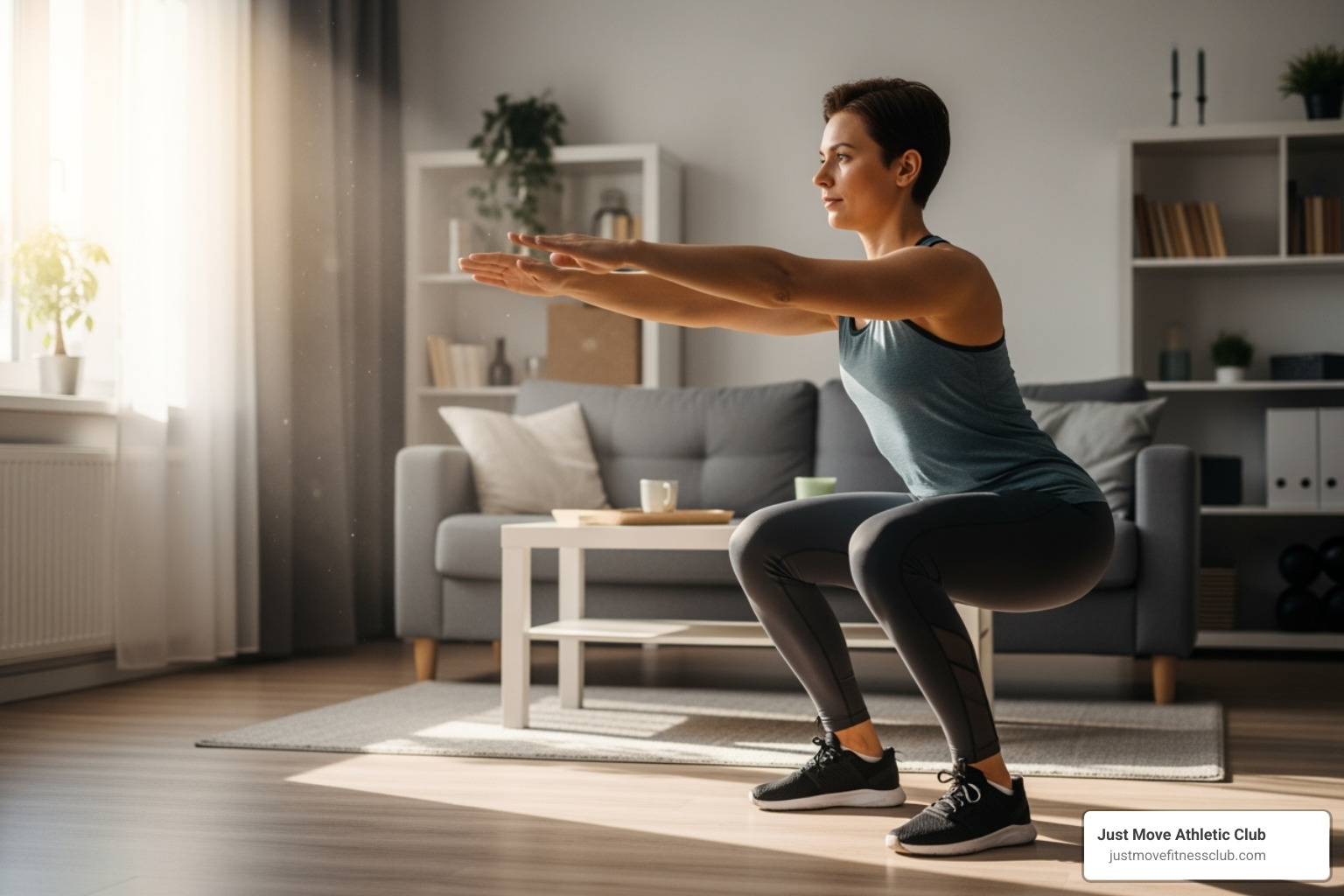
- Structure: Perform each exercise for 30 seconds, followed by 30 seconds of rest. Complete 3 rounds, resting 1 minute between rounds.
- Jumping Jacks: For a low-impact version, step one foot out to the side at a time.
- Bodyweight Squats: With feet shoulder-width apart, lower your hips as if sitting in a chair, keeping your chest up.
- Push-ups: Perform on your knees or toes, keeping your body in a straight line.
- Mountain Climbers: In a plank position, bring your knees toward your chest alternately.
- Plank: Hold a straight line from head to heels, engaging your core. Modify by dropping to your knees.
2. The 20-Minute Treadmill Beginner HIIT Workout
The treadmill is great for controlled interval training. Adjust speeds to match your fitness level.
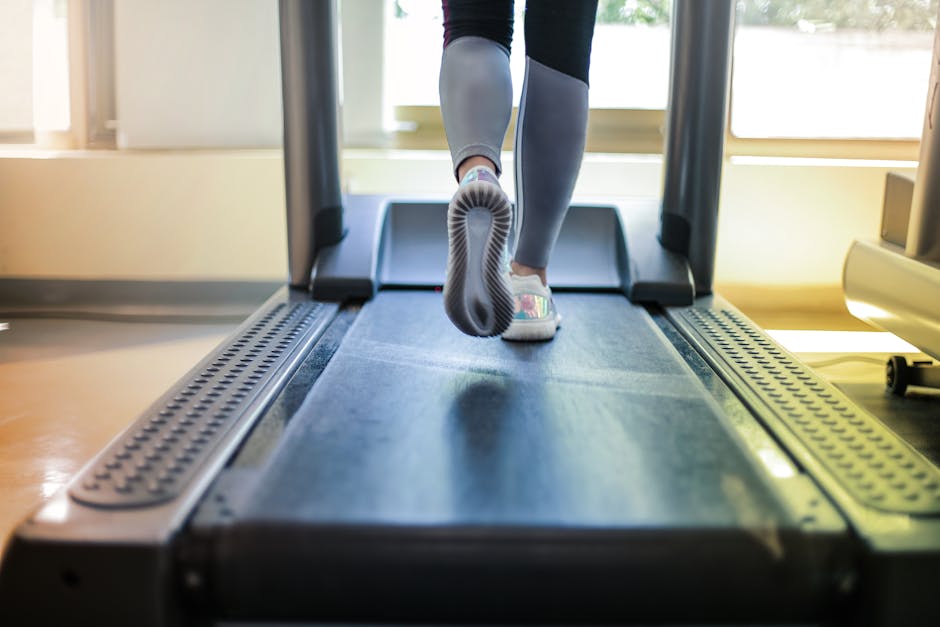
- Structure: After a 5-minute warm-up walk, alternate between 1 minute of work and 2 minutes of recovery for 6 cycles. Finish with a 3-minute cool-down walk.
- Work Interval (1 min): Brisk walk or light jog (Speed 3.5-4.5 mph, Incline 1.0-2.0%).
- Recovery Interval (2 min): Easy walk (Speed 2.5-3.0 mph, Incline 0.0%).
For more cardio ideas, check out Cardio Isn’t Just Treadmills: Fun Ways to Get Your Heart Pumping.
3. The Low-Impact HIIT Routine (Knee-Friendly)
This routine is gentle on the joints but still delivers an intense workout. No jumping required.
- Structure: Perform each exercise for 40 seconds, followed by 20 seconds of rest. Complete 3 rounds, resting 1 minute between rounds.
- High Knee March: March in place, driving your knees high toward your chest and pumping your arms.
- Glute Bridges: Lie on your back with knees bent and lift your hips, squeezing your glutes at the top.
- Wall Push-ups: Stand facing a wall and perform a push-up motion against it.
- Lateral Step-Outs: From a standing position, step one foot out to the side, tap the ground, and return. Alternate sides.
- Arm Circles: Extend arms to the sides and make large, controlled circles forward, then backward.
4. The Stationary Bike Sesh
A stationary bike provides a fantastic, low-impact HIIT option.
- Structure: After a 5-minute warm-up, alternate between 30 seconds of work and 60 seconds of recovery for 10 rounds. Finish with a 5-minute cool-down.
- Work (30 sec): Increase resistance (level 7-10) and pedal fast (RPM 90-110+).
- Recover (60 sec): Decrease resistance (level 3-5) and pedal at an easy pace (RPM 60-80).
5. The Single Dumbbell Circuit
One dumbbell is all you need for this strength-focused HIIT workout.
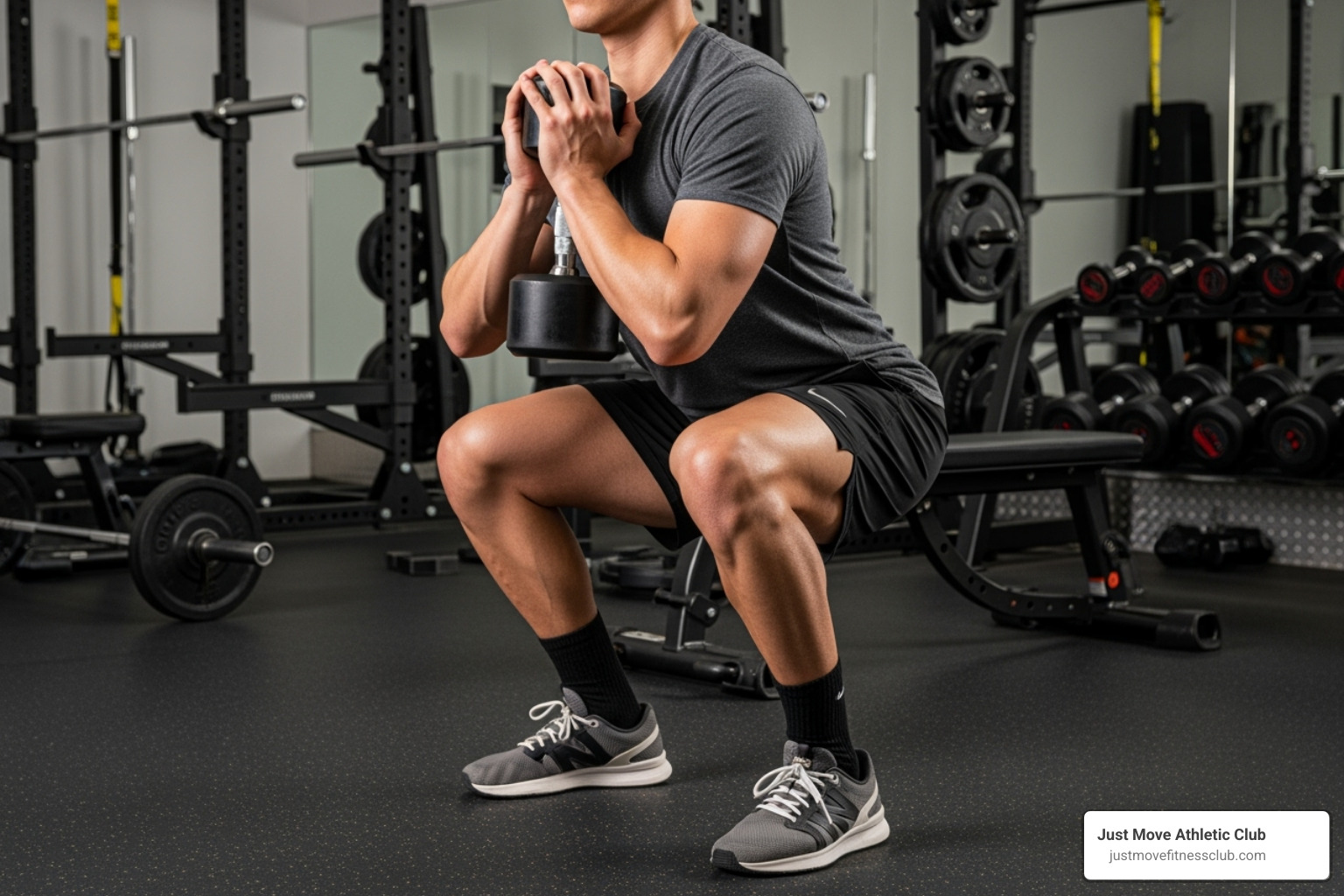
- Structure: Perform each exercise for 45 seconds, followed by 15 seconds of rest. Complete 3 rounds, resting 1 minute between rounds.
- Goblet Squats: Hold one dumbbell vertically against your chest and perform a squat.
- Dumbbell Rows (Single Arm): Hinge at your hips with a flat back. Pull the dumbbell toward your hip. Switch arms halfway through or each round.
- Reverse Lunges (Alternating): Hold the dumbbell and step one foot back into a lunge. Alternate legs.
- Overhead Press (Single Arm): Press the dumbbell from shoulder height directly overhead. Switch arms halfway through or each round.
These workouts are a great starting point for building strength. For more, see our article on Beginner Workout for Muscle Growth.
How to Structure and Progress Your HIIT Routine
Consistency and smart progression are key to long-term success with your Beginner HIIT workout. To avoid plateaus, you’ll use the principle of progressive overload, which means gradually increasing the challenge. This is done by adjusting the FIT Principle: Frequency (how often), Intensity (how hard), and Time (how long).
Tracking your workouts in a simple notebook can help you see your progress and decide when to level up. For more on creating a sustainable plan, see our guide on How to Build a Balanced Workout Routine.
Finding Your Perfect Work-to-Rest Ratio
The work-to-rest ratio is the rhythm of your workout. For beginners, a 1:2 or 1:3 ratio (e.g., 30 seconds of work, 60-90 seconds of rest) is ideal. This ensures you recover enough to give a true high-intensity effort in each interval.
| Fitness Level | Work-to-Rest Ratio | Example (Work:Rest) | Key Focus |
|---|---|---|---|
| Beginner | 1:2 or 1:3 | 30 seconds : 60 seconds | Learning form, building endurance, safe recovery |
| Intermediate | 1:1 | 30 seconds : 30 seconds | Increasing intensity, maintaining effort |
| Advanced | 2:1 | 45 seconds : 22 seconds | Maximum effort, minimal recovery |
To gauge your effort, use the Rate of Perceived Exertion (RPE) scale. On a scale of 1-10, your work intervals should feel like a 7-9 (breathing hard, unable to hold a conversation), while your recovery should be a 4-5.
How Often Should You Do HIIT?
Because HIIT is so effective, it’s tempting to do it daily. Please don’t. Your body gets stronger during rest, not during the workout. Overtraining increases injury risk and leads to burnout.
For a Beginner HIIT workout, aim for 2-3 non-consecutive days per week. This gives your body at least one full day to recover and rebuild between sessions. On off days, focus on active recovery like walking or gentle stretching.
Level Up: How to Make Your Workouts More Challenging
When your current routine starts to feel manageable, it’s time to progress. Make one small change at a time and never sacrifice form for intensity.
- Adjust Your Ratio: Decrease your rest time (e.g., move from 1:2 to 1:1.5).
- Add Resistance: Use dumbbells, resistance bands, or even a loaded backpack to make bodyweight exercises harder.
- Increase Speed or Incline: On a treadmill or bike, go a little faster or increase the resistance/incline during work intervals.
- Choose More Complex Exercises: Swap squats for jump squats or knee push-ups for full push-ups.
- Add More Rounds: If you’re comfortably finishing three rounds, try adding a fourth.
For more strategies on reaching your goals, check out our guide on how to Achieve Fitness Goals.
Frequently Asked Questions about HIIT for Beginners
Starting a new routine comes with questions. Here are answers to the most common inquiries we get about Beginner HIIT workouts.
How long should a beginner HIIT workout be?
Start with 10-15 minutes of total workout time, not including your warm-up and cool-down. This is the sweet spot for learning proper form and building a fitness base without overdoing it. Quality is more important than quantity. As you get stronger, you can gradually increase the duration to 20-30 minutes.
Can I do HIIT every day as a beginner?
No. HIIT is very demanding, and your body needs time to recover and get stronger. We strongly recommend 2-3 HIIT sessions per week on non-consecutive days. On your off days, focus on active recovery like walking or stretching. This prevents burnout and reduces injury risk.
What if I can’t do a certain exercise?
That’s completely normal! The goal is to keep moving, not to be perfect. Every exercise in a Beginner HIIT workout can be modified or substituted.
- For Push-ups: Do them on your knees or against a wall.
- For Jumping Jacks: Do step-out jacks (stepping one foot out at a time) to reduce impact.
- For Mountain Climbers: Slow them down or hold a plank instead.
Focus on what you can do with good form. Progress will come with consistency.
Start Your Fitness Spark Today
You now have the tools to start your fitness journey with a Beginner HIIT workout. You’ve learned that HIIT is an accessible, time-efficient, and powerful way to boost your heart health, build strength, and improve your mood. The journey to better health starts with a single step—or a single squat.
Remember to start slow, prioritize form, and stay consistent. Two to three sessions a week is all it takes to spark real change. Your only competition is who you were yesterday.
At Just Move Athletic Club in Lakeland and Winter Haven, we specialize in creating custom fitness experiences for all levels. Our expert trainers can guide you, and we use advanced tools to provide detailed insights that track your progress beyond the scale.
If you’re looking for a supportive community and a program that matches your goals, we’re here to help. Ready to stop thinking and start doing? Get a personalized fitness program to guide your journey at Just Move Athletic Club. Let’s get moving—together.