
Why Beginner Body Weight Training is Your Best Starting Point
Beginner body weight workouts are exercises that use only your own body as resistance—no fancy equipment, and no excuses needed.
Quick Answer: What You Need to Know About Beginner Bodyweight Workouts
- What they are: Exercises using your body as resistance (squats, push-ups, planks).
- Key benefits: Build strength, improve mobility, work out anywhere, and it’s completely free.
- How often: 2-3 times per week with rest days in between.
- Results timeline: Feel stronger in 2-4 weeks; see visible changes in 8-12 weeks.
- Can you build muscle: Yes—research shows muscle growth happens without weights when you challenge your muscles properly.
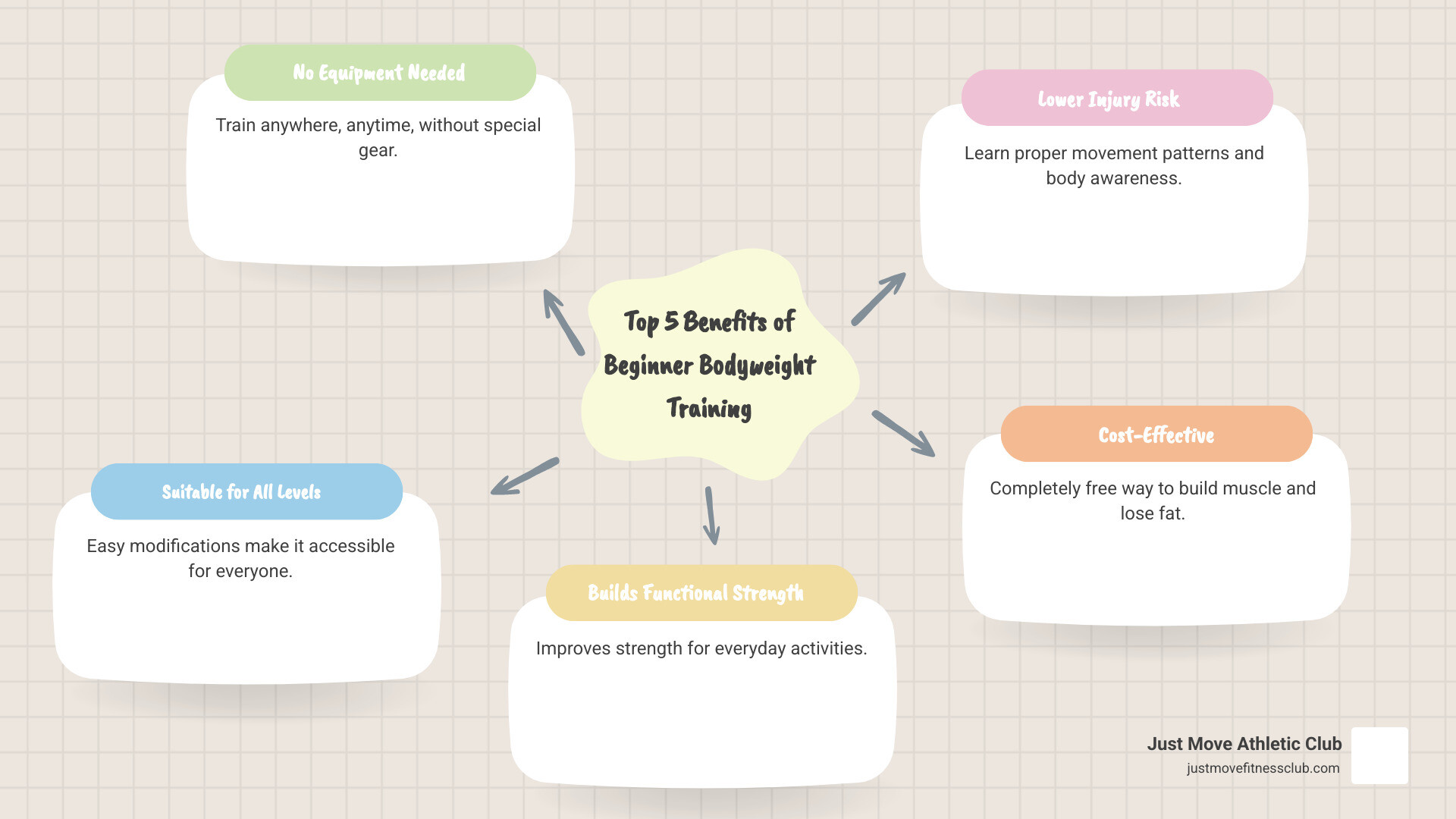
Contrary to popular belief, you don’t need expensive equipment to start a fitness routine. Bodyweight training is powerful because it’s accessible. You can start today in your living room. It builds body awareness, teaches proper movement patterns, and creates a foundation that lowers your risk of injury as you progress. Whether you’re looking to lose weight, build strength, or just feel better, bodyweight exercises offer a proven path forward.
I’m Pleasant Lewis, founder of Just Move Athletic Clubs. With over 40 years in the fitness industry, I’ve seen countless members transform their lives by starting with beginner body weight exercises. The key is to start where you are and build from there.
Why Bodyweight Training is a Powerful Start
Your body is an incredibly powerful training tool. When we talk about beginner body weight training, we mean using your own body as resistance—pushing against the floor in a push-up, working against gravity in a squat, or creating tension in a plank. It’s simple but highly effective.
Can You Really Build Muscle Without Weights?
The answer is yes. A 2020 study in BMC Public Health found that untrained adults in a 12-week bodyweight program saw significant increases in muscle size and strength. Research consistently shows that muscle growth is possible without external weights, as long as you sufficiently challenge your muscles. The key is progressive challenge, which a good bodyweight program provides.
Why Bodyweight Training Works So Well for Beginners
Bodyweight exercises teach you how to move well. Without heavy weights, you can focus on proper form, building a foundation of body awareness that lowers your risk of injury as you progress. These workouts are also completely cost-effective and can be done anywhere, removing common barriers to getting started.
These exercises build strength for everyday life. Practicing squats, lunges, and push-ups means you’re mastering fundamental movements. This is functional training, which translates to daily activities like carrying groceries or playing with your kids. Best of all, bodyweight exercises are adaptable. If a push-up is too hard, start on your knees. If a squat is too easy, slow it down. You can start at your level and progress at your own pace.
The Hidden Benefits
At Just Move Athletic Club, we know the real magic happens beyond the mirror. Consistent bodyweight training helps you build muscle and lose fat, but it also improves sleep, boosts confidence, and gives you more energy. These are the benefits you can’t see in the mirror that often matter most. Your body has everything you need to get stronger and build a foundation for lifelong fitness.
The Fundamental Bodyweight Exercises for Beginners
To start your beginner body weight journey, focus on these foundational movements. Proper form is crucial for building strength safely and preventing injury. If you have health concerns, consulting a fitness professional is always a smart move.
Upper Body Exercises
These exercises build the muscles you use for pushing and lifting in daily life.
-
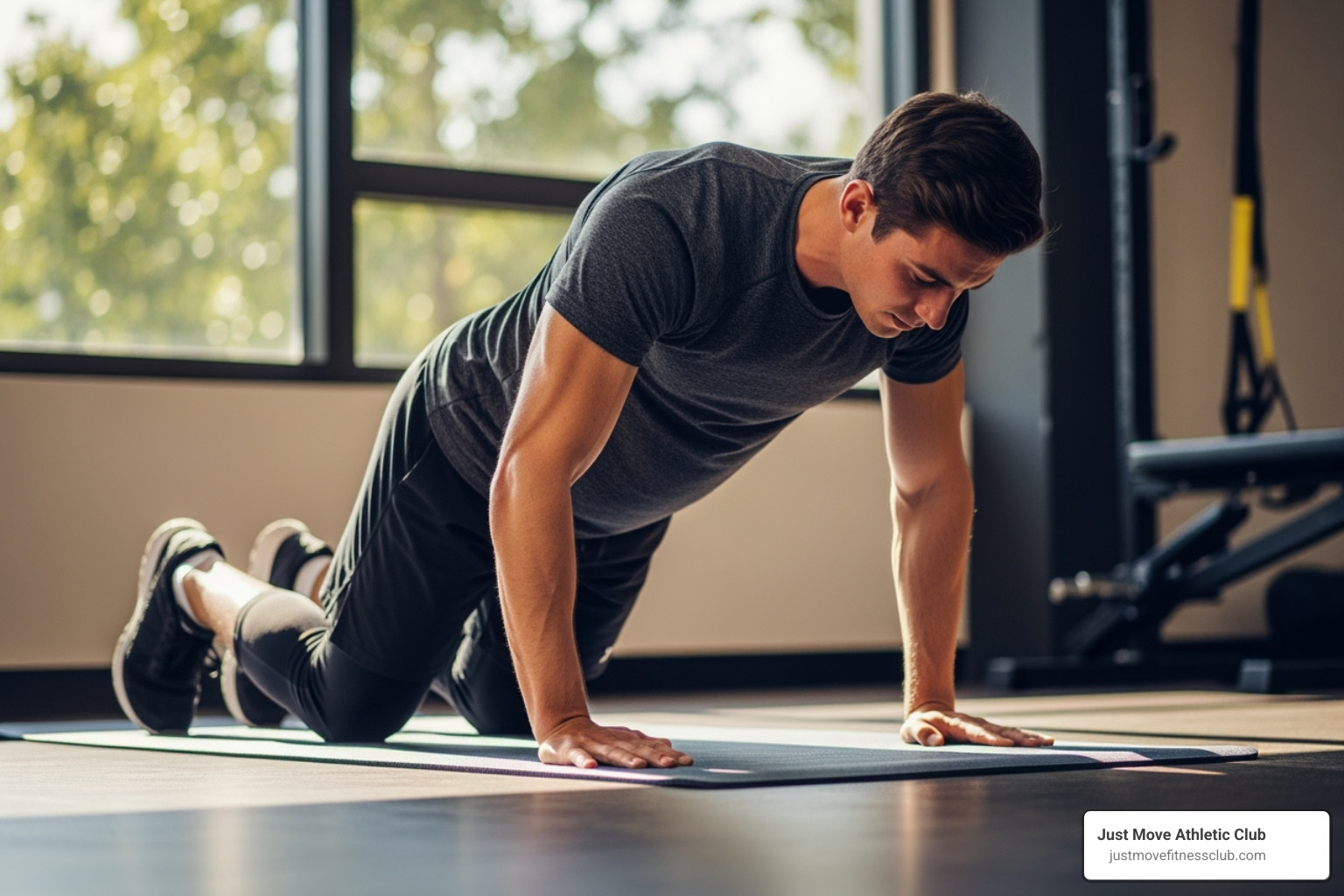
Push-ups: Works your chest, shoulders, and triceps. Start with wall push-ups, then progress to knee push-ups, and finally full push-ups. Keep your elbows at a 45-degree angle to your body, not flared out, to protect your shoulders.
-
Rows: The perfect complement to push-ups, working your back and biceps for better posture. For doorway rows, grip a sturdy doorframe at chest height, lean back, and pull your chest toward the doorway by squeezing your shoulder blades. For a greater challenge, try table rows by lying under a stable table and pulling your chest toward the edge.
-
Chair Dips: Excellent for your triceps. Sit on the edge of a sturdy chair, hands gripping the edge beside your hips. Slide your hips forward and lower yourself by bending your elbows, keeping them tucked in. Lower until your upper arms are about parallel to the floor.
-
Plank: While a core exercise, it also builds upper body strength. Start on your forearms and knees (knee plank) or toes (full plank), forming a straight line from your head to your knees/heels. Keep your core tight and prevent your hips from sagging or rising.
Lower Body Exercises
Your legs are your foundation. Working these large muscles also burns significant calories.
-
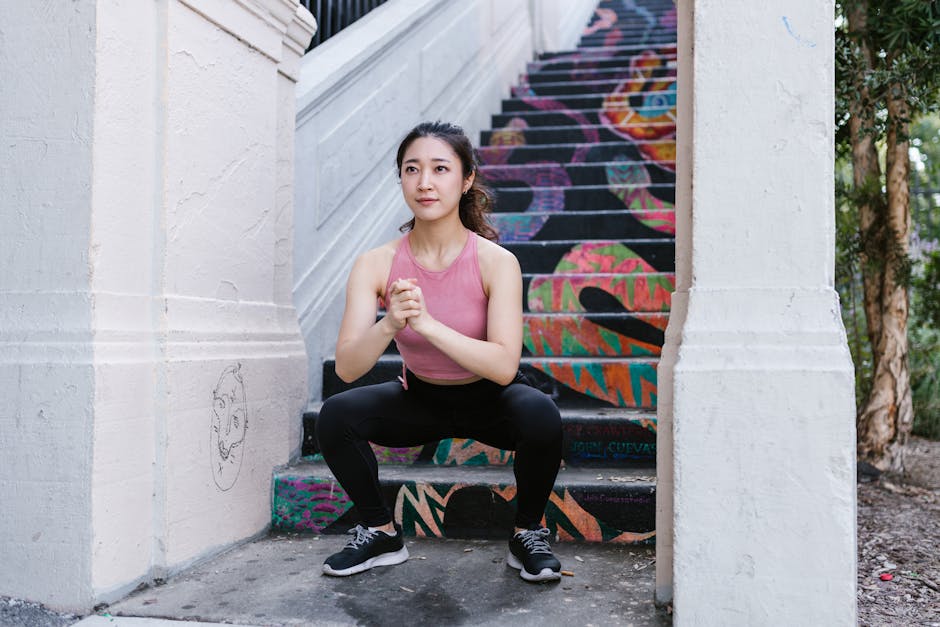
Bodyweight Squats: Stand with feet shoulder-width apart. Push your hips back as if sitting in a chair, lowering until your thighs are parallel to the floor. Keep your chest up and push through your heels to stand. Ensure your knees track over your feet and don’t collapse inward.
-
Lunges: Build single-leg strength and balance. Reverse lunges are easier on the knees: step one leg back, lowering until both knees are at 90-degree angles. Keep your front knee over your ankle. Push off the back foot to return to standing.
-
Glute Bridges: Target your glutes and hamstrings. Lie on your back with knees bent and feet flat on the floor. Lift your hips until your body forms a straight line from shoulders to knees. Squeeze your glutes at the top before lowering with control.
-
Calf Raises: Stand tall and rise onto the balls of your feet, holding for a moment at the top before slowly lowering. Hold a wall for balance if needed.
Core Exercises
A strong core protects your spine and improves movement efficiency.
-
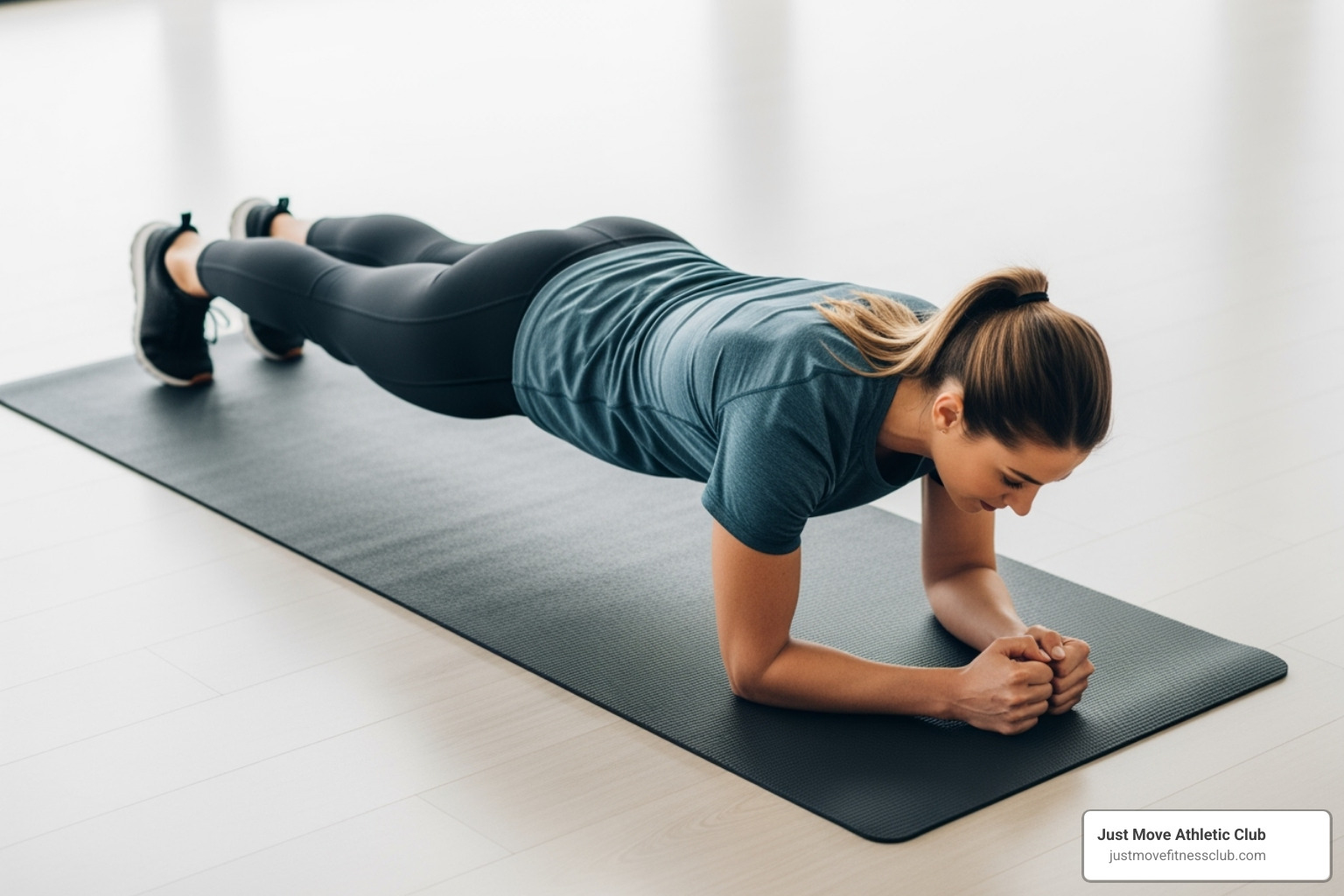
Plank: An essential core stabilizer. Remember to breathe and keep your body in a straight line.
-
Side Planks: Target your obliques. Lie on your side, propped on one forearm with your elbow under your shoulder. Lift your hips to form a straight line from head to heels.
-
Dead Bug: Lie on your back with arms toward the ceiling and knees bent at 90 degrees over your hips. Slowly lower your opposite arm and leg toward the floor, keeping your lower back pressed down. Return to the start and switch sides.
-
Bird Dog: Start on all fours. Extend your opposite arm and leg, keeping your back flat and hips level. Move slowly and deliberately.
-
Mountain Climbers: A cardio and core challenge. From a high plank position, drive one knee toward your chest, then quickly switch legs as if running in place. Keep your hips stable and back flat.
Your First Beginner Body Weight Workout Routine
Let’s put the fundamental movements into action. A full-body circuit is efficient and ensures all major muscle groups are worked. For a deeper dive into structuring workouts, see our guide on How to Build a Balanced Workout Routine. A balanced routine includes pushing, pulling, squatting, and core stability movements to build functional strength and prevent injury.
The 20-Minute Beginner Circuit
This realistic circuit takes about 20 minutes. Aim to do it 2-4 times a week on non-consecutive days.
Warm-up (5 minutes): Start with light cardio like marching in place or jumping jacks, followed by arm circles and leg swings.
The Circuit:
- 10 Bodyweight Squats
- 10 Knee Push-ups (or your current variation)
- 20 Lunges (10 per leg)
- 10 Doorway Rows
- 30-second Plank (knee or full)
- 30 Jumping Jacks (or walking jacks)
Perform each exercise back-to-back. After completing all six, rest for 60 seconds. Repeat the circuit for 3 rounds total.
Cool-down (5 minutes): Finish with stretching the muscles you just worked to improve flexibility and aid recovery.
Rest days are when your muscles repair and grow stronger. Light activity like walking on off-days, known as active recovery, is beneficial.
How to Progress Your Beginner Body Weight Training
Once the circuit becomes comfortable, it’s time to apply the progressive overload principle: consistently challenging your muscles to do more.
- Increase reps or sets: Aim for 11-12 reps instead of 10. Once you can do 3 sets of 15, try a harder variation.
- Decrease rest: Shorten your rest between circuits from 60 seconds to 45, then 30.
- Slow down the movement: Increase time under tension by slowing the lowering (eccentric) phase of an exercise. Research shows this boosts strength gains.
- Graduate to harder variations: Move from knee push-ups to full push-ups, or from squats to single-leg variations.
Bodyweight Training and Weight Loss
While bodyweight training builds muscle and burns calories, nutrition is about 80% of weight loss success. Lasting results come from combining exercise with a caloric deficit (eating fewer calories than you burn). You can’t out-train a poor diet.
Building muscle boosts your metabolism, as muscle tissue burns more calories at rest than fat. For best results, combine your workouts with a balanced diet. Learn more in our guide, Fuel Your Fitness: The Role of Nutrition in Your Workout Routine. Bodyweight training builds the engine; proper nutrition provides the fuel.
Frequently Asked Questions about Beginner Bodyweight Training
Here are answers to some of the most common questions we hear from beginners at Just Move Athletic Club.
How often should a beginner do bodyweight workouts?
Aim for 2-3 structured beginner body weight workouts per week. Your muscles need about 48 hours to recover and rebuild between strength sessions, which is when they get stronger. Taking rest days is a smart part of the training process. If you’re still very sore after two days, take an extra day to recover.
How soon will I see results from bodyweight training?
You’ll likely start feeling stronger within 2-4 weeks, noticing that exercises feel more manageable. Visible changes, such as muscle definition or clothes fitting differently, typically appear around the 8-12 week mark. Consistency is the most critical factor for seeing results, along with a supportive diet.
Can I do bodyweight exercises every day?
It’s not recommended for full-body strength training, as your body needs rest to repair muscle fibers. Instead, use your off-days for active recovery, such as a gentle walk, light stretching, or yoga. These activities keep you moving without over-straining recovering muscles. Skipping rest days increases your risk of burnout, injury, and progress plateaus. Listen to your body and prioritize recovery.
What’s Next? Advancing Your Fitness Journey
As you master the basics of beginner body weight training, you’ll feel stronger, more confident, and ready for the next challenge. Your body will be ready to grow, and there’s always another level to reach with bodyweight exercises.
To keep progressing, you can increase your workout duration by adding another round to your circuit or holding planks longer. You can also explore advanced variations, like moving from regular push-ups to decline push-ups, or from squats to single-leg versions like Bulgarian split squats. Each progression keeps your muscles adapting and growing.
Eventually, you may want to add weights. After building a solid foundation with bodyweight exercises, introducing dumbbells or kettlebells can open new avenues for strength development. Our guide on Beginner Workout for Muscle Growth can help with that transition.
Tracking your progress is incredibly motivating. Noting your reps, sets, and how exercises feel will show you how far you’ve come. At Just Move Athletic Club, we use the Fit3D Pro Body Scanner to provide a detailed, objective analysis of your body’s changes, including muscle gain and fat loss. This data, combined with our expert coaching, ensures you’re moving efficiently toward your goals.
Whether you’re just starting out in Lakeland, North Lakeland, South Lakeland, Winter Haven, or Havendale, Florida, we’re here to support your journey. We provide custom fitness experiences to help you achieve your personal best.
Just keep moving. Your body is capable of amazing things. Start your fitness journey with us today and let’s see what you can achieve!