
Why Yoga from Beginner to Advanced is a Journey Worth Taking
The journey of yoga from beginner to advanced is a transformative experience for the 300 million people practicing worldwide. Whether you’re new to the mat or deepening your practice, understanding the progression is key.
Here’s what your yoga progression looks like:
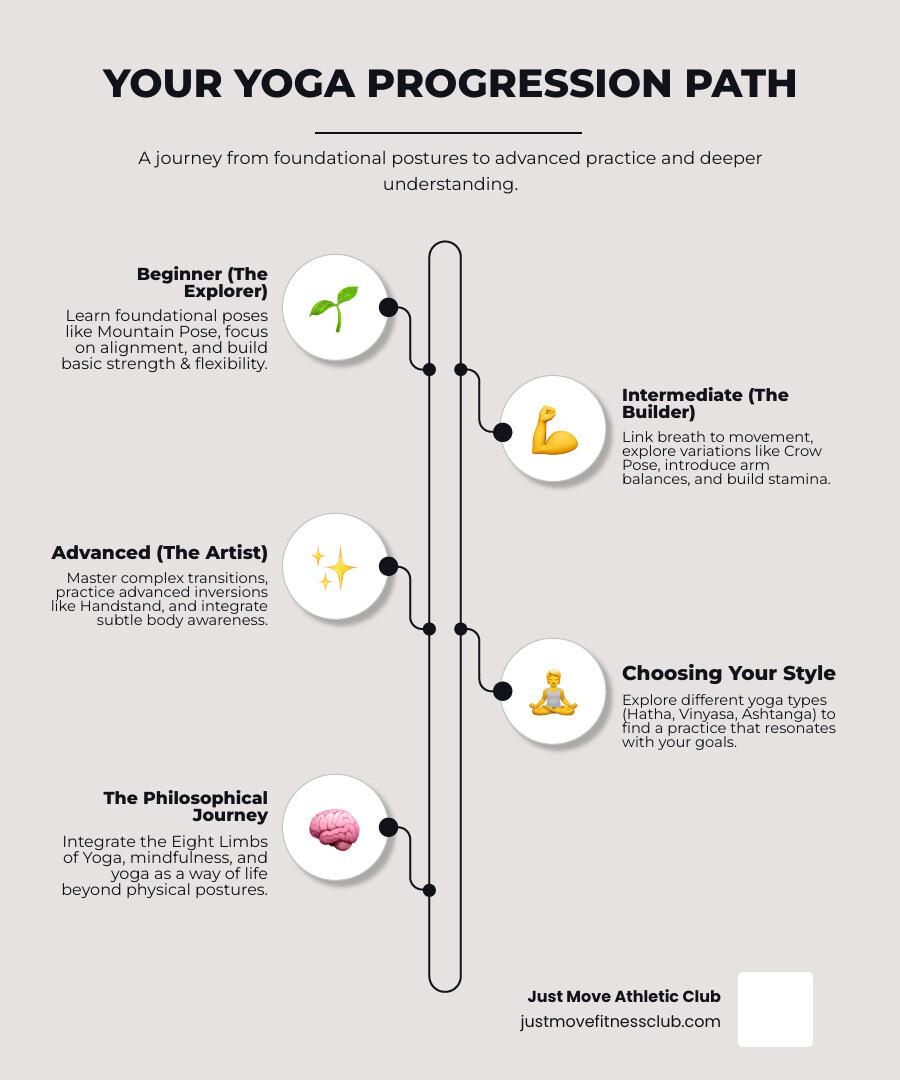
- Beginner (Level 1): Learn foundational poses, focus on alignment, and use props for support.
- Intermediate (Level 2): Link breath to movement, explore pose variations, and build stamina.
- Advanced (Level 3+): Master complex transitions, practice advanced inversions, and integrate yoga philosophy.
The beauty of yoga is that it’s for every body. Flexibility isn’t a prerequisite; it’s a result of practice. What matters is consistency and meeting yourself where you are. Research shows yoga improves flexibility, reduces stress, and builds strength, but its true power lies in connecting mind, body, and breath for a sense of peace that extends beyond the mat.
I’m Pleasant Lewis JMAC, founder of Just Move Athletic Clubs. With over 40 years in fitness, I’ve seen countless members transform their lives through a thoughtful approach to yoga from beginner to advanced. Our mission is to create welcoming spaces where everyone feels empowered to grow.
What’s Your Yoga Level? Understanding the Foundations
The journey of yoga from beginner to advanced is not about achieving perfect poses, but about building awareness and practicing consistently without judgment. At Just Move Athletic Club, we meet you where you are. Think of it as exploring a landscape rather than climbing a ladder. The key is honest self-assessment: Are you comfortable with basic movements? Do you understand alignment cues? Can you sync breath with movement? Even advanced yogis return to fundamentals, as there’s always something new to find in the “simple” poses.
Beginner (Level 1): The Explorer
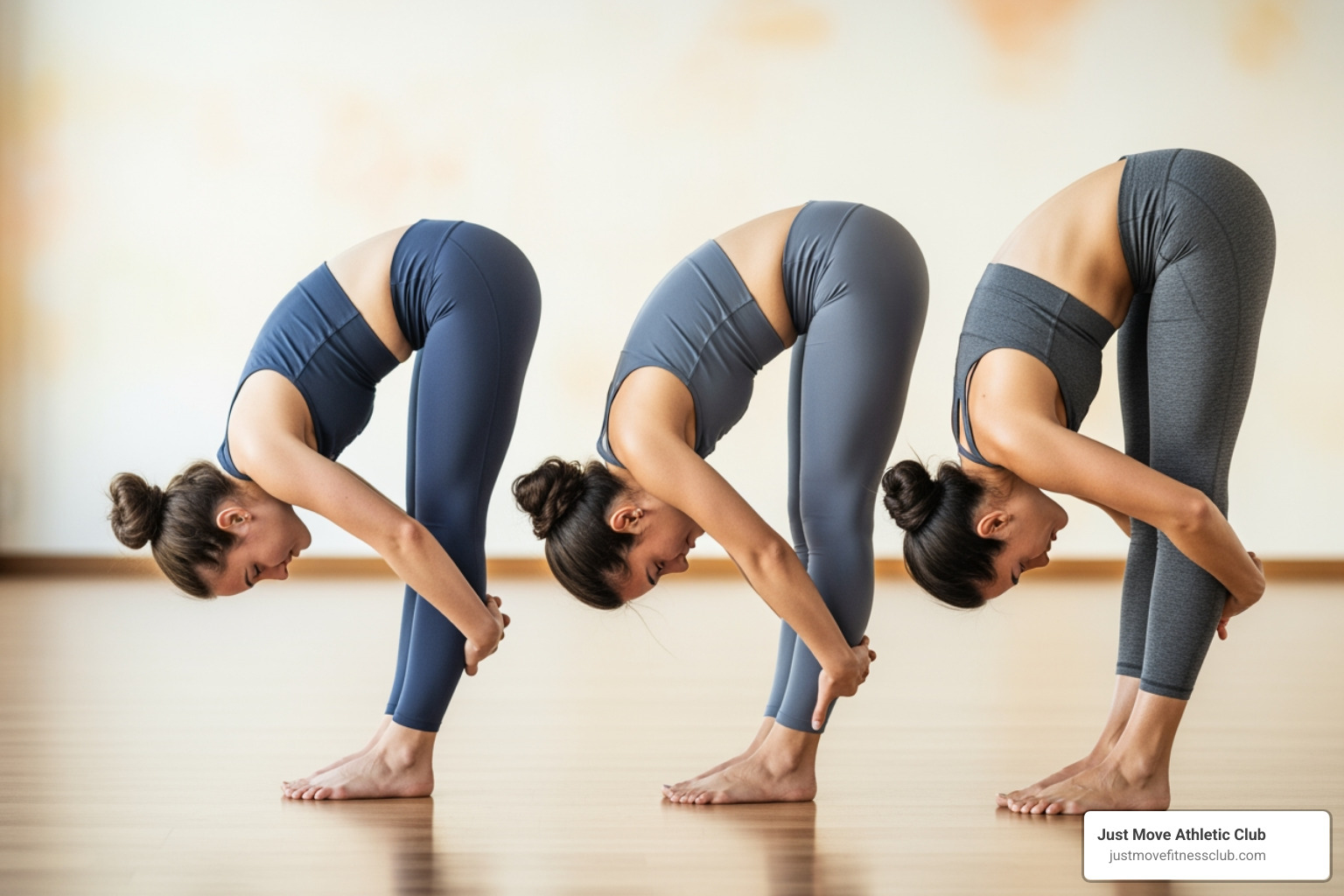
Welcome to the adventure! Beginner yoga is about exploration. You’ll learn foundational poses, find proper alignment for safety, and connect movement with breath. Poses are held for a few breaths to gradually build strength and flexibility. Props like blocks and straps are your best friends, helping you access poses safely. Classes move at a slower pace with clear, detailed instruction, so you understand the what and the why. This foundation is crucial for progressing safely, a principle we also cover in our guide on How to Get Started Without Feeling Overwhelmed.
Intermediate (Level 2): The Builder
Once you’re comfortable with the basics, you’re ready to build. Intermediate yoga links breath to movement in flowing sequences (Vinyasa), increasing your stamina and balance. You’ll explore variations of familiar poses and begin preparing for arm balances and inversions by building core strength. The pace is faster, with fewer alignment cues, as you’re expected to have more body awareness. You’ll hold poses longer and challenge your strength in new ways. This level is about building confidence and understanding how poses connect into a larger flow.
Advanced (Level 3+): The Artist
For practitioners with significant strength, flexibility, and a deep understanding of yoga principles, the advanced level is about artistry. This stage challenges you with complex transitions, advanced inversions like handstands, deep backbends, and intricate arm balances. It demands exceptional body control and a strong breath connection. These classes integrate more philosophical aspects, focusing on mastering subtle body awareness to create graceful movement. Advanced yoga isn’t just about physical feats; it’s about mental perseverance and integrating the practice as a whole—physical, mental, and spiritual.
The Beginner’s Journey: Building a Strong and Safe Foundation
Starting your yoga from beginner to advanced journey requires a solid foundation. The beginner stage is all about building muscle memory, understanding proper form, and keeping your body safe. Patience is your superpower; there’s no rush to “master” anything. The journey itself is where the magic happens. At Just Move Athletic Club, we’ve seen how yoga transforms lives, improving how you feel in your body and connect your breath to movement. As we explored in our Why Yoga Should Be Part of Your Fitness Routine article, yoga is a game-changer for overall well-being.
Essential Beginner Poses and Sequences
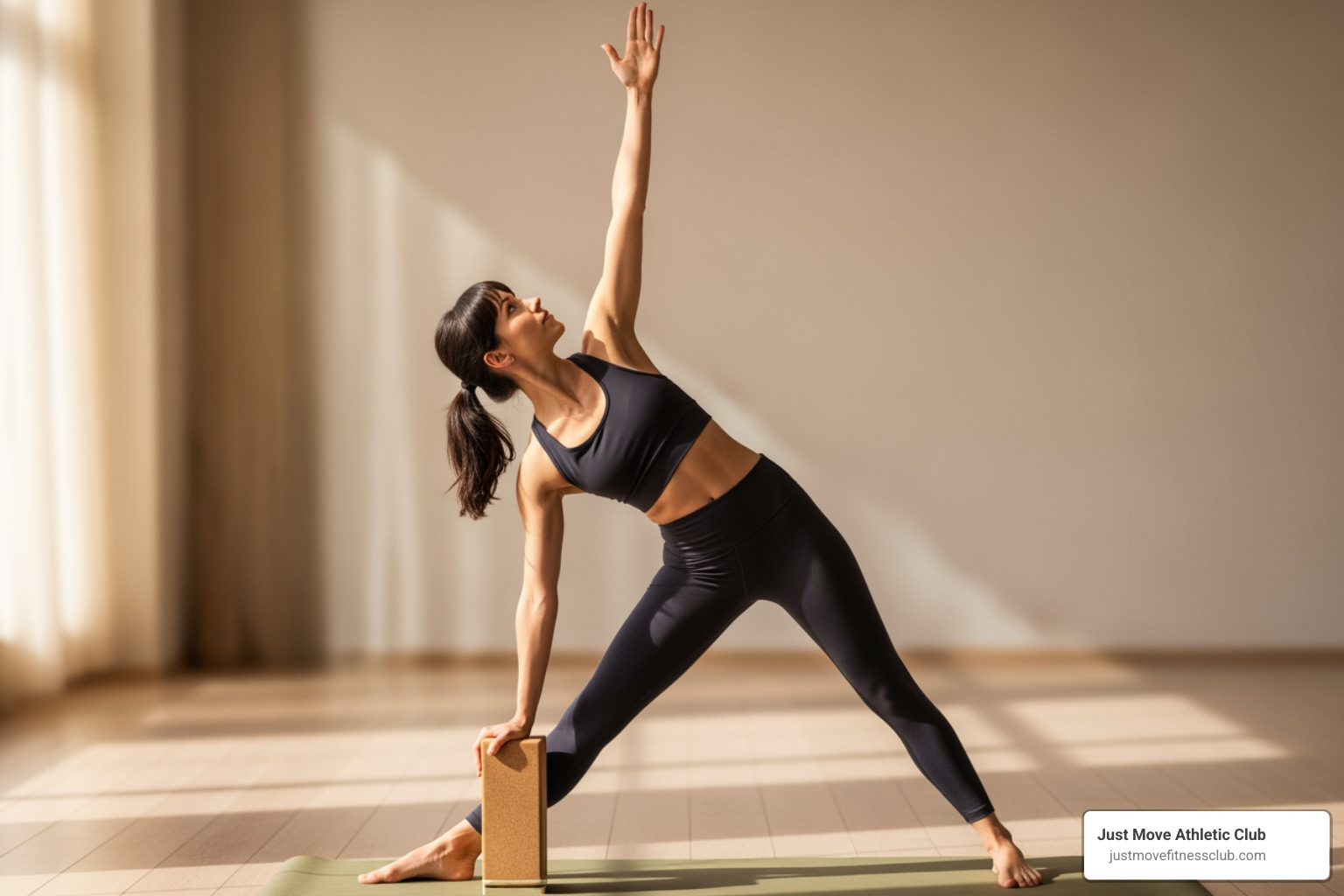
Master these foundational poses, your yoga alphabet, to build your practice.
- Mountain Pose (Tadasana): Teaches proper posture and grounding, the starting point for all practices.
- Cat-Cow Pose: A gentle flow on all fours that wakes up the spine and connects breath to movement.
- Downward-Facing Dog: An iconic inverted “V” shape that stretches the entire body and calms the nervous system.
- Warrior I & II: Builds strength, stamina, and focus. Warrior I is a powerful forward-facing lunge, while Warrior II opens to the side with grace.
- Child’s Pose: Your sanctuary for rest. This gentle forward fold calms the mind and stretches the back and hips.
- Bridge Pose: Strengthens your back, glutes, and hamstrings while opening your chest.
The Sun Salutation A sequence links several of these poses into a rhythmic flow, perfect for energizing the body and focusing the mind.
Benefits for the Beginner’s Body and Mind
The benefits of yoga appear quickly. You’ll notice improved flexibility and, often first, significant stress reduction as mindful movement calms the nervous system. You’ll build functional strength, especially in your core, which improves posture on and off the mat. Many find relief from chronic pain, particularly in the lower back. Yoga can also boost your immune system, increase energy during the day, and promote deeper sleep at night. The regular yoga practice offers a whole host of benefits for your entire system.
Safety First: Tips for Starting Your Practice
Your safety is paramount. Progressing sustainably means respecting your body from day one.
- Listen to your body: This is the golden rule. Never push into sharp pain. Discomfort is normal; pain is a signal to stop.
- Use props liberally: Blocks, straps, and blankets are tools to help you find proper alignment and make poses accessible.
- Find a qualified teacher: An instructor provides crucial alignment cues and modifications. Explore our Free Yoga Classes Lakeland FL to experience our approach.
- Warm-up properly: Prepare your muscles and joints to prevent injury.
- Practice on an empty stomach: Twists and inversions are more comfortable this way.
The goal is to practice mindfully and consistently, building a foundation that will support your yoga from beginner to advanced journey for years.
The Intermediate Path: Deepening Your Practice and Flow
Moving past the beginner stage, your practice becomes more dynamic and flowing. This intermediate path is where you connect poses into a Vinyasa flow, creating a moving meditation that is both physically demanding and mentally exhilarating. You’ll explore deeper stretches, more complex balances, and the initial stages of arm balances and inversions. It’s an exciting phase where you feel your body’s power and grace. At Just Move Athletic Club, the community aspect is key, as we believe in [The Power of Group Fitness: How Community Helps You Crush Your Goals](https://justmovefitnessclub.com/blog/the-power-of-group-fitness-how-community-helps-you-crush-your-goals/).
How to progress your yoga from beginner to advanced
Progression is a mindful evolution, not a race. Here’s how to move forward:
- Be consistent: Aim for 3-4 practices a week. Regular, shorter sessions are more effective than sporadic long ones.
- Try new classes: A different intermediate class or instructor can offer a new perspective that makes a challenging pose click.
- Master transitions: Focus on moving smoothly and with control between poses. This is a hallmark of an evolving practice.
- Hold poses longer: As your strength grows, extend your hold time from three breaths to five or more to deepen the benefits.
- Explore workshops: Specialized sessions on arm balances, inversions, or philosophy can accelerate your learning.
- Revisit basics: Returning to foundational poses refines alignment and reconnects you with the essence of your practice.
- Consider personalized guidance: Our
[What a Personal Trainer Can Do For Your Progress (Even If You're Not a Beginner)](https://justmovefitnessclub.com/blog/what-a-personal-trainer-can-do-for-your-progress-even-if-you're-not-a-beginner/)services can provide custom guidance to help you meet your goals.
Key Intermediate Poses and Flows
Intermediate poses ask for more balance, strength, and courage.
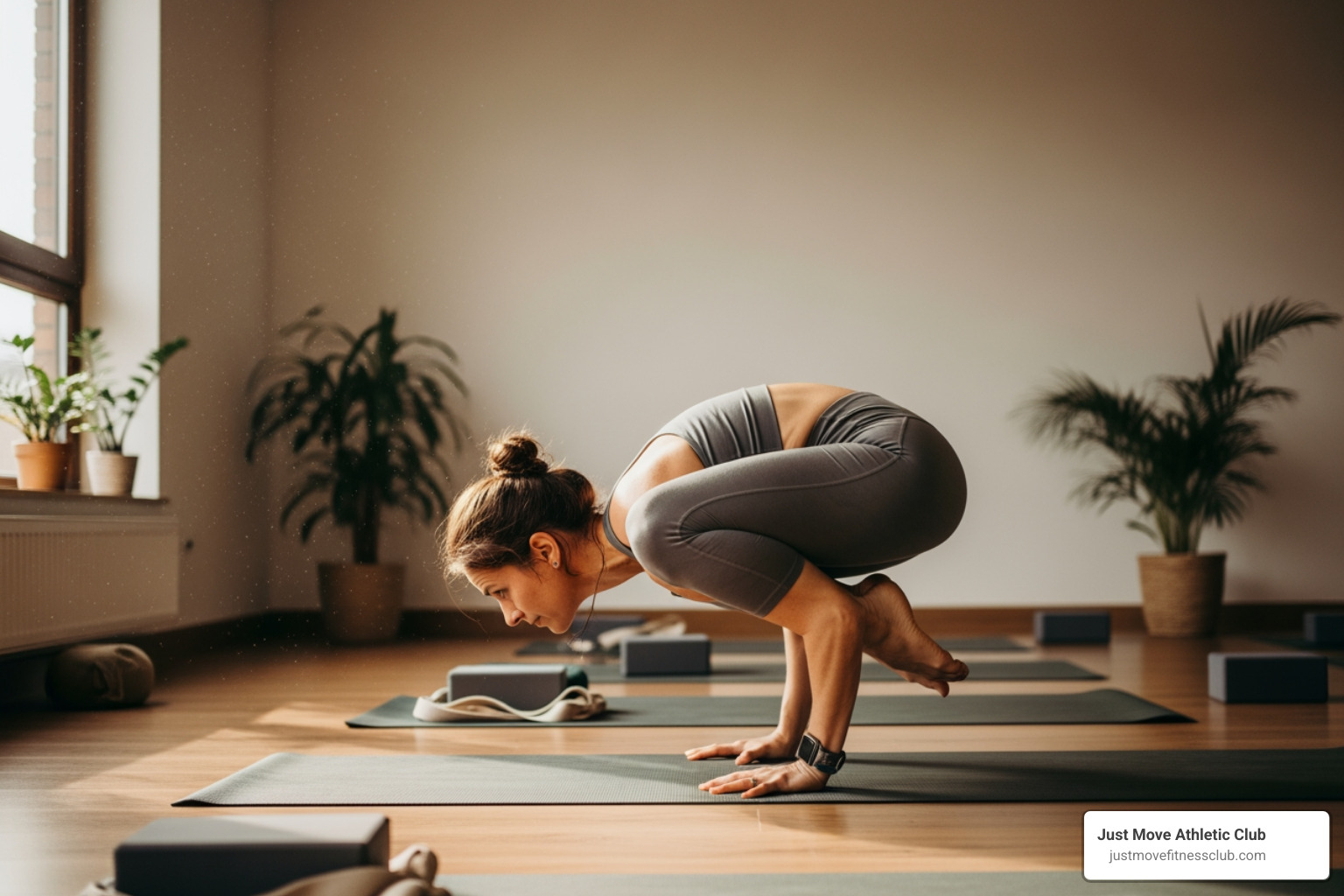
- Crow Pose (Bakasana): Often the first arm balance students learn, it’s a rite of passage that builds core strength, stability, and focus.
- Half Moon Pose (Ardha Chandrasana): A standing balance that opens the hips and tests your focus, teaching you to blend strength with flexibility.
- Wheel Pose (Urdhva Dhanurasana): A deep, energizing backbend that opens the chest and shoulders. It requires careful warm-up and preparation.
- Headstand preparation: Poses like Dolphin Pose (on your forearms) build the necessary shoulder and core strength for inversions in a more accessible way.
- Wild Thing (Camatkarasana): A joyful, heart-opening backbend that celebrates freedom of movement and reminds us that yoga can be playful.
The Evolving Role of Breathwork (Pranayama)
On the intermediate path, breath control (pranayama) becomes more specific.
- Ujjayi Breath (“Victorious Breath”): This audible breath, sounding like ocean waves, regulates body temperature and focuses the mind during flowing sequences.
- Alternate Nostril Breathing (Nadi Shodhana): A calming technique that balances the nervous system, reduces stress, and improves concentration.
- Breath of Fire (Kapalabhati): An energizing technique of short, forceful exhales that cleanses the body and clears the mind.
As you progress in your yoga from beginner to advanced journey, breathwork integrates into every movement, becoming an anchor in challenging poses and a tool to deepen stretches. This integration transforms your practice from a series of poses into a true mind-body connection.
Your Roadmap for Yoga from Beginner to Advanced
The journey of yoga from beginner to advanced is a personal adventure, not a competition. We encourage you to accept your unique path, celebrating every milestone. Finding your style is a crucial part of this roadmap. Different yoga traditions suit different goals and personalities. Just as we emphasize in our [How to Build a Balanced Workout Routine](https://justmovefitnessclub.com/blog/how-to-build-a-balanced-workout-routine/), a balanced approach is key to a sustainable practice.
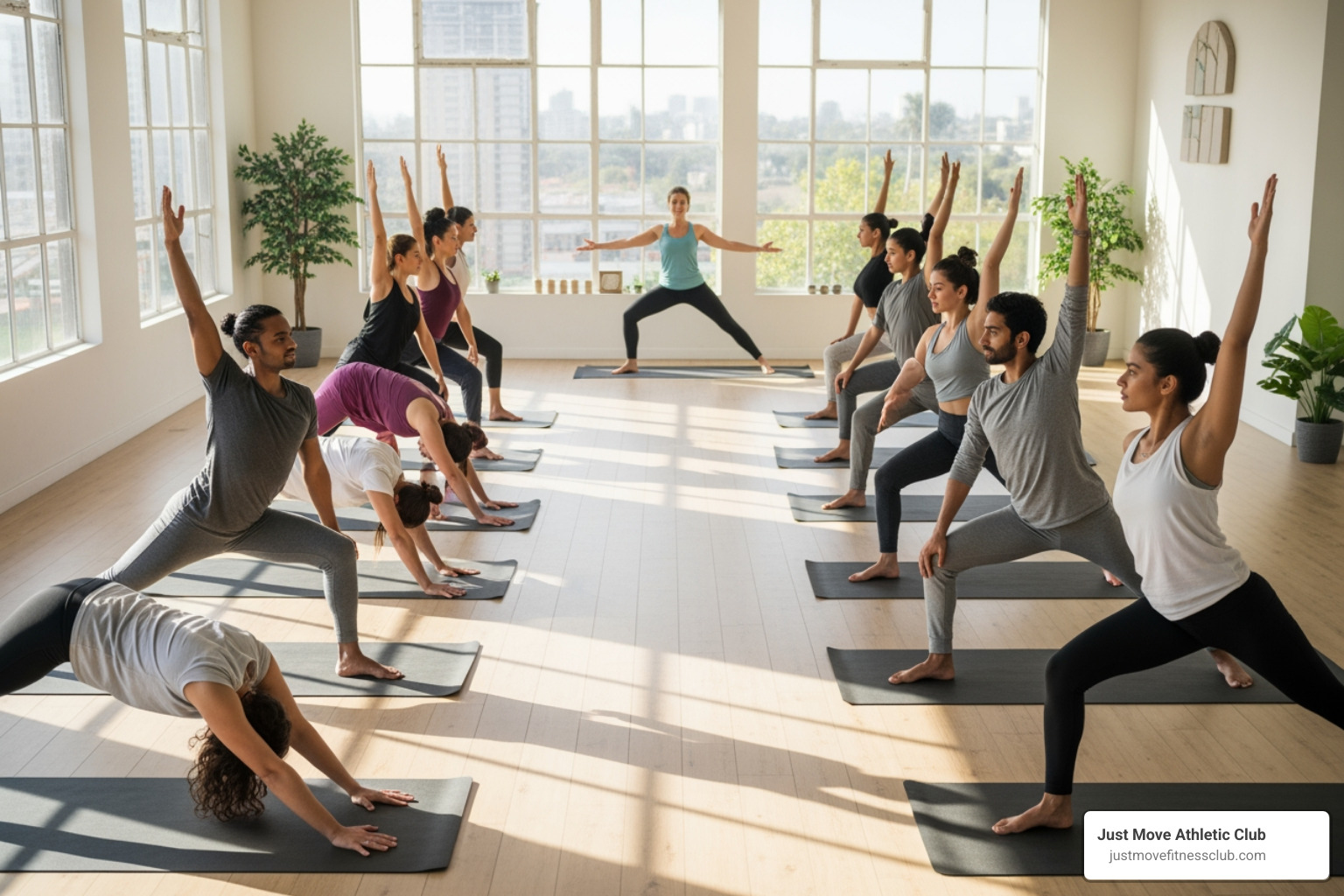
Choosing Your Style: How Different Yoga Types Fit Your Level
The world of yoga is vast. Here’s a look at some popular styles:
- Hatha Yoga: The foundation of most styles. It’s slower-paced, focusing on basic poses and alignment, making it perfect for beginners.
- Vinyasa Yoga: Links breath to movement in a dynamic, dance-like flow. It’s faster-paced and loved by those who enjoy continuous movement.
- Ashtanga Yoga: Follows a specific, set sequence of physically demanding poses. It’s suited for those with some yoga experience who appreciate structure and repetition.
- Iyengar Yoga: Focuses on precision and alignment, using props extensively to help students achieve proper form. It’s excellent for all levels, especially beginners.
- Restorative Yoga: A gentle style using props to support the body in passive poses held for several minutes, promoting deep relaxation. It’s accessible to everyone.
The Philosophical Journey of Yoga from Beginner to Advanced
Beyond the physical, yoga is a profound philosophical system. As your practice deepens, the focus shifts inward. The core of this journey is the Eight Limbs of Yoga, which includes ethical guidelines (Yamas and Niyamas), physical postures (Asana), and breath control (Pranayama). The later limbs guide you toward deeper states of concentration and meditation. As your yoga from beginner to advanced journey unfolds, the physical practice becomes a tool to cultivate mindfulness and self-awareness, evolving into a [Holistic Fitness Approach](https://justmovefitnessclub.com/blog/holistic-fitness-approach/).
Safety Considerations for All Levels
No matter your level, safety is your top priority. Most yoga injuries are preventable with a mindful approach.
- Honor your limits: Your body’s capabilities vary daily. Listen to its wisdom and avoid ego-driven practice.
- Focus on proper alignment: Correct form protects your joints and spine, especially in complex poses.
- Use props wisely: Props are intelligent tools to support your practice, not a sign of weakness.
- Listen to your teacher and modify: A qualified instructor offers safe guidance and modifications. Always choose the variation that feels right for your body.
- Communicate about injuries: Inform your instructor of any pre-existing conditions so they can offer specific guidance. Our
[Functional Fitness: How to Train for Real Life](https://justmovefitnessclub.com/blog/functional-fitness-how-to-train-for-real-life/)philosophy applies here: we train for your real body.
A safe practice is a sustainable one, allowing you to experience yoga’s transformative power over time.
Frequently Asked Questions about Yoga Progression
We hear these questions all the time from our members in Lakeland and Winter Haven navigating their yoga from beginner to advanced journey. Here are some clear answers to common concerns.
How do I know when I’m ready to move to the next level?
You’ll likely feel when you’re ready, but here are some clear signs you can move from beginner to intermediate:
- You feel comfortable and stable in foundational poses without constant cues.
- You have a solid understanding of basic alignment and can self-correct.
- Your practice has become consistent, and you feel a desire for a new challenge.
- You can connect your breath to your movement without having to think about it.
- Your teacher recommends you try a more advanced class.
It’s not about perfection, but about feeling safe, confident, and ready to explore.
Can I practice advanced yoga if I’m not flexible?
Absolutely, yes. Flexibility is often a result of yoga, not a prerequisite. Many advanced poses, like handstands and arm balances, demand more strength, stability, and balance than extreme flexibility. Advanced yoga is also about mental focus and breath control—maintaining composure and presence in challenging poses. The philosophical integration of yoga is also an advanced practice that requires no physical flexibility. Focus on building your strengths, and flexibility will improve over time.
How often should I practice yoga to see progress?
Consistency over intensity is the golden rule for your yoga from beginner to advanced journey.
- For beginners, we recommend 2-3 times per week. This gives your body time to adapt and build muscle memory without being overwhelmed.
- For intermediate and advanced practitioners, 4-6 times per week can really deepen your practice. It’s crucial to vary your practice with a mix of vigorous and gentle/restorative classes to avoid burnout.
Even short, focused daily practices of 15-20 minutes can be highly effective. Most importantly, listen to your body’s need for rest. Rest days are when your body integrates the work, repairs muscle, and solidifies your progress.
Conclusion
Your yoga from beginner to advanced journey is a personal path of self-findy and resilience. Some days will feel strong, others will be a struggle, and that is all part of the process. We encourage you to accept every stage with kindness. Celebrate the victories, learn from the wobbles, and appreciate the quiet moments. Your progress is uniquely yours.
At Just Move Athletic Club in Lakeland and Winter Haven, we’ve built a community where everyone feels welcomed and supported. Our instructors understand that the path isn’t a straight line and are here to guide you with modifications, encouragement, and challenges when you’re ready. We offer a variety of classes designed to meet you exactly where you are today.
Ready to take the next step? Explore our Yoga Classes Lakeland Guide to find the perfect class for your level and goals. We can’t wait to see you on the mat. Start your fitness journey with us today!
Remember: progression isn’t a race. It’s about showing up, breathing deeply, and honoring where you are right now. That’s where the real change happens.