
Why Well-Developed Traps Are More Than Just for Show
A huge traps workout starts with understanding the trapezius muscles, which span from your neck to your mid-back. Building them isn’t just about looking powerful—it’s about being powerful. Strong traps improve performance in major lifts like deadlifts, stabilize the shoulder girdle to prevent injury, and counteract the slouching posture from daily life.
Most people only do basic shrugs, neglecting the middle and lower sections that create a three-dimensional look. To build truly impressive traps, you need to target all three parts with a mix of heavy compound lifts and focused isolation work.
Quick Answer: The 4 Essential Exercises for Bigger Traps
- Barbell Rack Pulls – Heavy compound movement for overall mass and thickness
- Dumbbell Shrugs with Forward Lean – Targets upper and middle traps with better isolation
- Face Pulls – Builds middle traps while improving posture and shoulder health
- Y-Raises – Activates often-neglected lower traps for complete development
Training frequency: 2x per week for optimal growth (research shows training each muscle 2-3 times weekly produces 3.1% greater gains than once weekly).
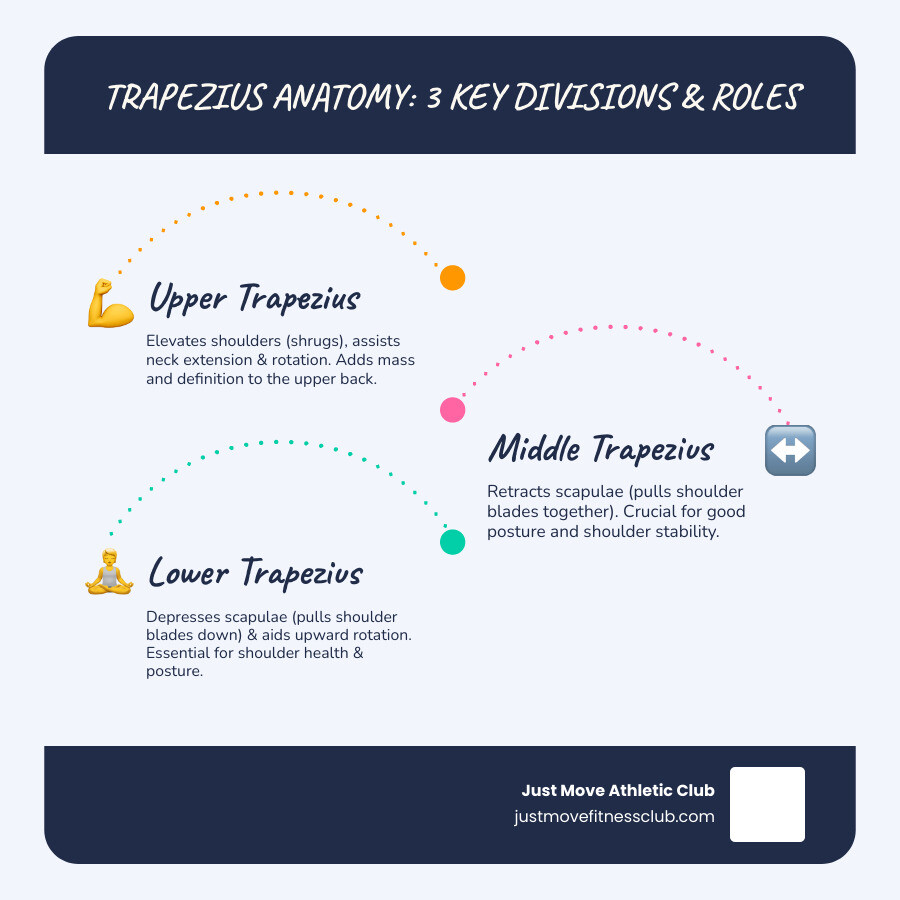
The trapezius is a large muscle broken into three parts, each with a specific function:
- Upper Trapezius: This is the part you see capping your shoulders. It lifts the shoulders (shrugging) and helps move your neck. Developing this area creates the classic “yoked” look.
- Middle Trapezius: Located between your shoulder blades, these muscles pull them back and together (scapular retraction). They are essential for good posture and shoulder stability.
- Lower Trapezius: Extending down your mid-back, these muscles pull the shoulder blades downward. They are often the most neglected but are vital for shoulder health and overhead movements.
Training all three sections is crucial for overall upper body strength, injury prevention, and posture correction. Weak middle and lower traps contribute to rounded shoulders and neck pain. Strengthening them restores balance, pulls your shoulders back, and supports a healthy, functional body.
The 4 Foundational Moves for a Huge Traps Workout
Now that you understand the anatomy, let’s build your traps. A smart strategy hits all three sections of the muscle, not just the upper portion. The key is combining heavy compound movements for mass with targeted isolation work for detail and mind-muscle connection.
This approach ensures you build muscle across the entire trapezius, creating an impressive three-dimensional look. To make this happen, progressive overload is critical. You must consistently challenge your muscles by gradually increasing the weight, reps, or intensity. Without it, your muscles have no reason to grow.
The four exercises below form the foundation of an effective huge traps workout. They use both barbell exercises and dumbbell exercises for varied stimulus, creating a complete program. When added to a balanced workout routine, they will help you build a strong, functional, and impressive physique.
Let’s break down each movement.
1. Barbell Rack Pulls for Overload and Thickness
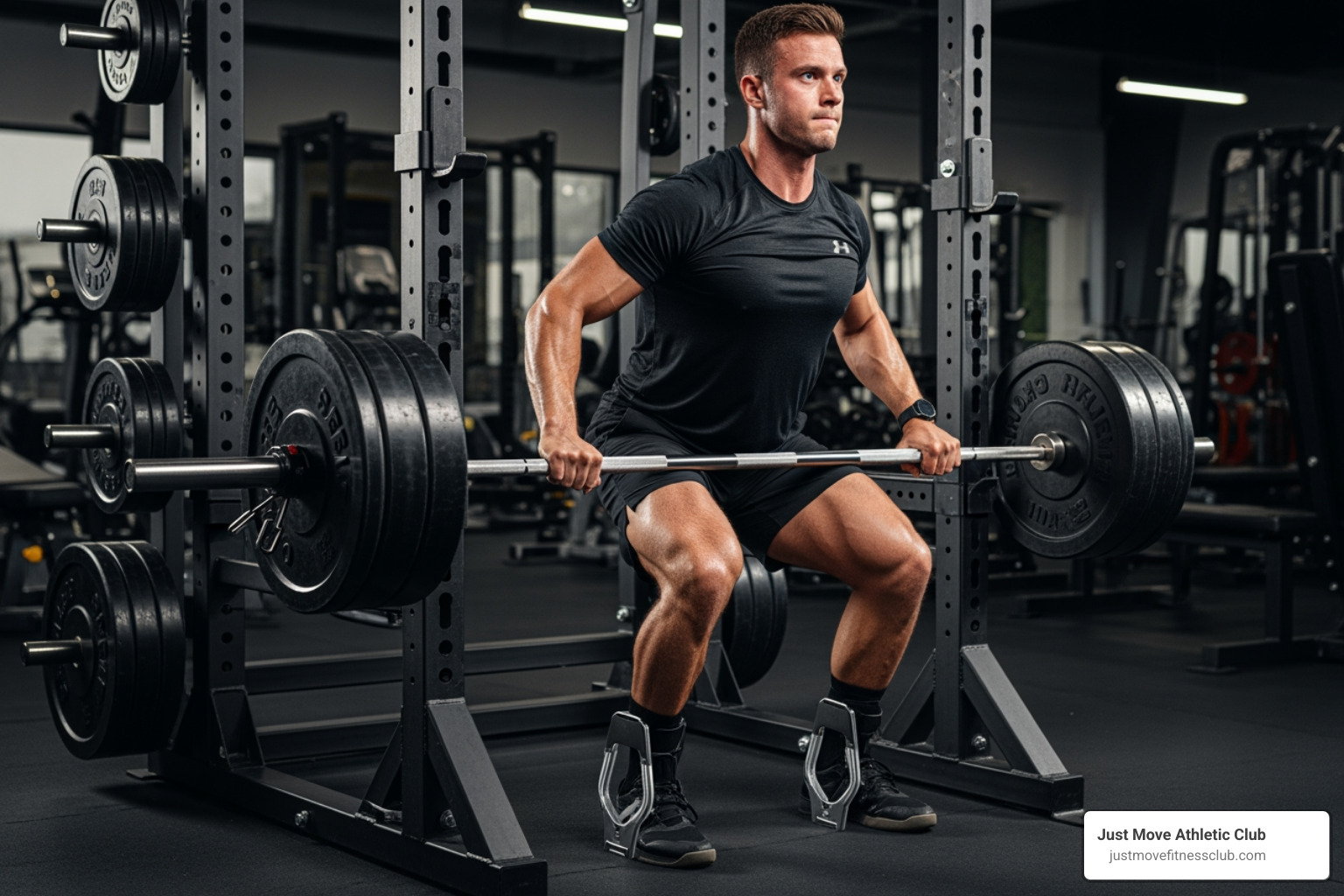
For thick, dense traps, the barbell rack pull is your primary tool. It’s the foundation of a huge traps workout because it allows you to handle incredibly heavy weight, overloading the target muscles more effectively than almost any other exercise.
By setting the barbell on pins in a power rack (just below or at knee height), you shorten the range of motion. This shifts the focus from your lower back and hamstrings to your upper back, especially the upper and middle traps, which do the heavy lifting at the top of the movement. This is how you force them to grow thicker and stronger.
How to Perform Barbell Rack Pulls:
- Set Up: Position the barbell on safety pins in a power rack just below your knees. Stand with feet hip-width apart, shins close to the bar. Grab the bar with an overhand grip slightly wider than your shoulders. Use lifting straps if your grip is a limiting factor.
- Form: Hinge at your hips with a slight knee bend, keeping your back flat, chest up, and shoulders pulled back.
- Execution: Drive through your heels, extending your hips and knees. As the bar rises, powerfully contract your traps, pulling your shoulders back and up in a slight shrug at the top. Imagine squeezing a pencil between your shoulder blades.
- Lower: Lower the weight back to the pins with control. Do not drop it.
Programming: Rack pulls are a strength and mass builder, so stick to heavy weight and lower reps. Aim for 3-4 sets of 5-8 repetitions. This heavy loading creates the mechanical tension needed to Increase Strength in Gym and build a powerful upper back.
2. Dumbbell Shrugs with a Forward Lean

After building a foundation with heavy rack pulls, it’s time to isolate the upper and middle traps. Most people do shrugs standing upright, which primarily hits the upper traps. By adding a slight forward lean of 15-20 degrees, you align the movement with the muscle fibers of the middle traps, engaging them more effectively.
This variation also provides a more stable base for lifting heavy, and using dumbbells helps correct any muscle imbalances between your left and right sides.
How to Perform Dumbbell Shrugs with a Forward Lean:
- Set Up: Grab two heavy dumbbells and stand with feet shoulder-width apart. Lean your torso forward slightly from the hips, keeping your spine neutral.
- Execution: Pull your shoulders up toward your ears and slightly back. This backward component is key to engaging the middle traps.
- Peak Contraction: At the top of the rep, squeeze your traps as hard as possible for one to two seconds. This is where the mind-muscle connection is crucial for growth.
- Lower: Lower the dumbbells slowly, feeling a stretch in your traps at the bottom. Controlling the negative portion of the lift is vital for building muscle.
Programming: For this isolation exercise, focus on time under tension and metabolic stress with higher reps. Aim for 3-4 sets of 10-15 repetitions. The weight should be challenging enough that the last few reps are difficult to complete with good form.
3. Face Pulls for Posture and Mid-Trap Development
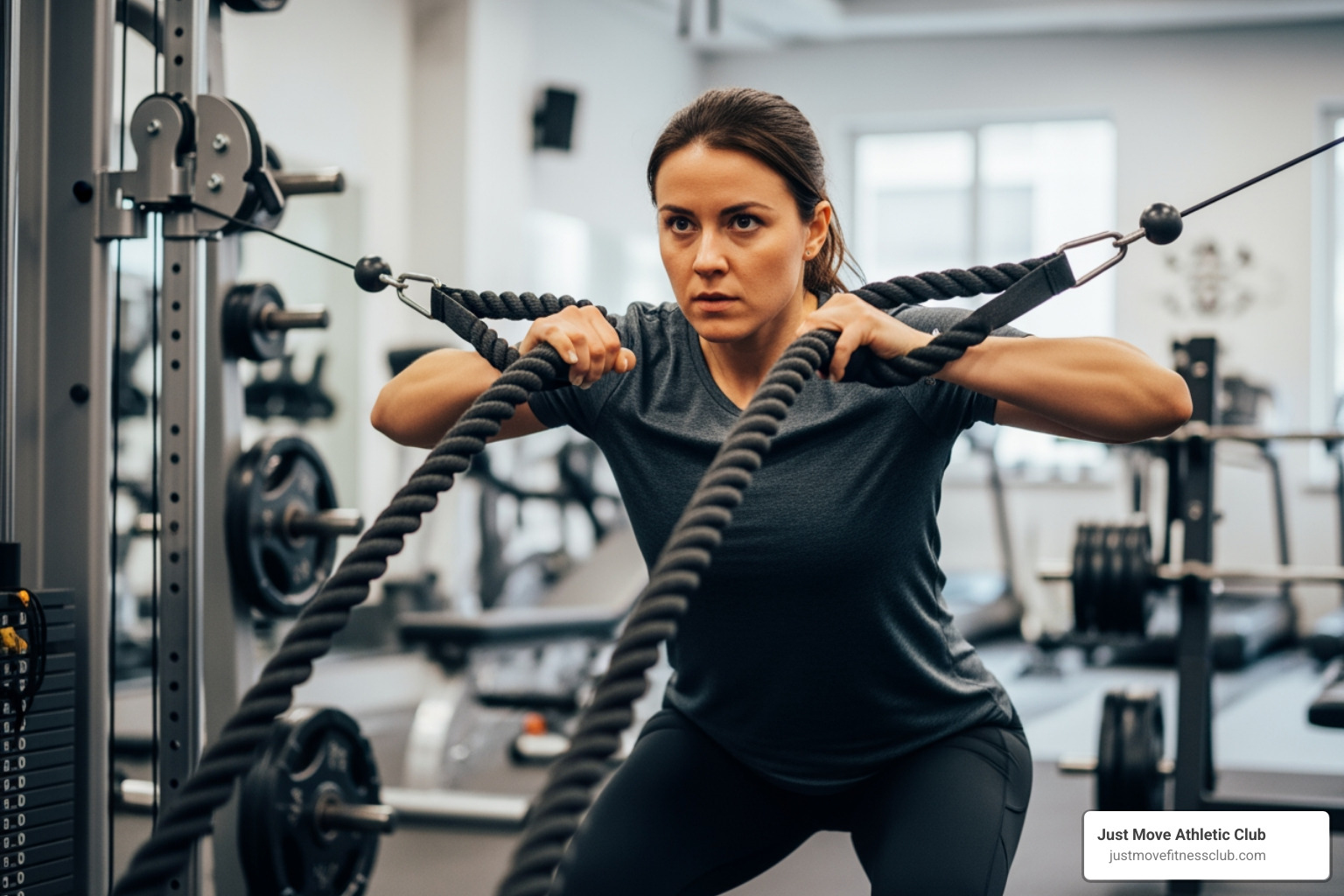
Face pulls are a critical,, exercise in a huge traps workout. While rack pulls and shrugs build the upper traps, face pulls target the middle traps, rear deltoids, and rhomboids. These muscles are responsible for scapular retraction—pulling your shoulder blades back—which is essential for good posture and shoulder health.
Strengthening these muscles helps counteract the rounded-shoulder posture common from sitting at a desk or looking at a phone. This not only builds a thicker upper back but also makes you feel stronger and more upright.
How to Perform Face Pulls:
- Set Up: Attach a rope to a high cable pulley. Grab the rope with both hands, thumbs facing you, and step back to create tension with your arms extended.
- Execution: Pull the rope toward your face, aiming for your nose or forehead. As you pull, focus on squeezing your shoulder blades together. Keep your elbows high and wide, flaring out above your wrists.
- Peak Contraction: Hold the squeeze for a moment at the back, feeling the contraction in your middle traps and rear delts.
- Lower: Slowly extend your arms back to the starting position, resisting the weight. Control is key.
Programming: Focus on quality over heavy weight. Perform 3-4 sets of 12-20 repetitions. The goal is muscle activation and endurance, not setting strength records. This exercise perfectly demonstrates The Importance of Functional Training in Everyday Life, as it builds strength that translates directly to better daily movement and reduced injury risk.
4. Y-Raises for Lower Trap Activation
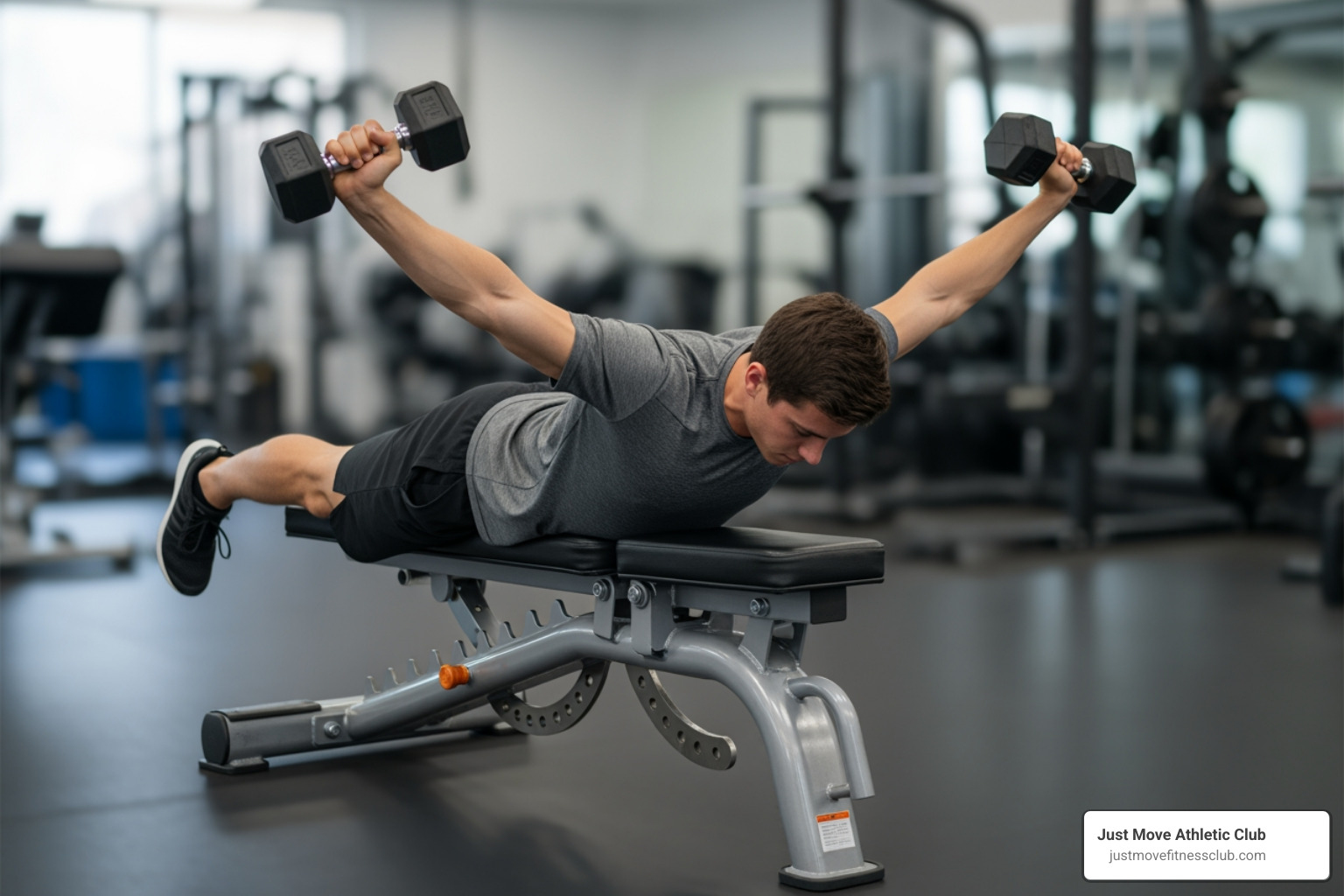
Most trainees completely ignore their lower traps, creating imbalances that can lead to shoulder problems and an incomplete physique. The lower trapezius muscles are vital for pulling the shoulder blades down and stabilizing them during overhead movements. Strong lower traps are non-negotiable for shoulder health and stability.
Y-raises are one of the best exercises to isolate and strengthen this area. Research on Effects of Lower Trapezius Strengthening Exercises confirms that targeting these muscles can improve posture and reduce neck dysfunction.
How to Perform Y-Raises:
- Set Up: Lie face down on an incline bench set at a 30-45 degree angle. Grab a pair of very light dumbbells (1-5 pounds is a great starting point) and let your arms hang toward the floor, palms facing each other.
- Execution: Keeping your arms mostly straight, raise the dumbbells up and out to form a “Y” shape with your body. Focus on squeezing your shoulder blades together and down.
- Peak Contraction: Hold the top position for a moment, feeling a strong contraction in your lower and middle back. Do not arch your lower back.
- Lower: Slowly lower the weights back to the start with full control.
Programming: This is an isolation exercise where form is everything. Aim for 3-4 sets of 15-20 repetitions. Quality matters far more than weight. If you have to use momentum, the weight is too heavy. Focus on the mind-muscle connection to ensure your lower traps are doing the work.
Smart Programming and Common Mistakes to Avoid
The right exercises are only half the battle. Smart programming and avoiding common mistakes are what truly build massive traps. Here’s how to structure your training for maximum growth and what pitfalls to avoid.
Programming Your Huge Traps Workout for Optimal Growth
- Frequency: How often should you train traps? Research from the Journal of Sports Medicine shows that training a muscle group twice per week is superior to once-weekly training for growth. Hit your traps twice per week on non-consecutive days, often as part of your back or upper body workouts.
- Reps and Sets: For heavy compound lifts like rack pulls, use lower reps (5-8 per set) to build strength and density. For isolation moves like face pulls and Y-raises, use higher reps (15-20 per set) to create metabolic stress and improve endurance. Always prioritize a full range of motion.
- Advanced Techniques: To break through plateaus, try drop sets on shrugs (immediately reducing weight and continuing to failure), isometric holds (squeezing at the peak contraction for 3-5 seconds), or supersets (pairing a heavy lift like rack pulls with a corrective move like face pulls). These methods increase intensity and time under tension, forcing new growth. For more ideas, see our Strength and Muscle Building Workout Plan.
Correcting Common Trap Training Mistakes
Even with a great plan, these mistakes can kill your progress. For more on this topic, read our guide on How to Avoid Common Workout Mistakes That Could Lead to Injury.
- Ego Lifting: Using too much weight leads to bouncing and jerking, taking tension off the traps and stressing your joints. Use a weight you can control through a full range of motion.
- Incomplete Range of Motion: Half-reps leave gains on the table. On shrugs, lift your shoulders as high as possible and get a full stretch at the bottom.
- Neglecting Middle and Lower Traps: A routine of only shrugs is incomplete. You must include exercises like face pulls and Y-raises to build a thick, balanced, and healthy upper back.
- Poor Mind-Muscle Connection: Don’t just go through the motions. Actively feel your traps working on every rep. A slight forward lean on shrugs and a hard squeeze on rows and pulls makes a huge difference.
- Ignoring Muscle Imbalances: If one side is weaker, it won’t fix itself. Use unilateral (single-arm) exercises to bring up the lagging side. Our Expert Personal Training Ultimate Guide can help you identify and correct these issues.
Frequently Asked Questions about Building Bigger Traps
Here are answers to some of the most common questions we hear from members about building a powerful upper back.
Why aren’t my traps growing?
If your traps aren’t responding, it’s likely due to one of these factors:
- Inadequate Volume or Intensity: You’re not training them hard or often enough. Ensure you’re applying progressive overload by gradually lifting heavier over time.
- Poor Exercise Selection: Your routine is one-dimensional. If you only do shrugs, you’re missing the middle and lower traps, which are essential for a complete look.
- Insufficient Nutrition: Muscles can’t grow without enough protein and calories. Make sure your diet supports muscle building. Our guide on Fuel Your Fitness The Role of Nutrition in Your Workout Routine can help.
- Poor Form: Using momentum or a limited range of motion takes the stress off the target muscle. Focus on controlled reps and a strong mind-muscle connection.
Can I train traps every day?
No, this is not recommended. Muscle growth happens during recovery, not during training. Overtraining prevents your muscles from repairing and growing stronger. Research on upper body training gains suggests that training a muscle group twice per week is the sweet spot for most people. This provides enough stimulus for growth while allowing adequate time for recovery.
What are the best bodyweight exercises for traps?
You can effectively target your traps without weights, especially the often-neglected middle and lower portions. These are great for home workouts or as part of a warm-up.
- Back Widow: Lie face down with arms in a “Y” shape and lift your arms and chest, squeezing your shoulder blades down and back.
- Angel and Devil: Lie face down and move your arms in a snow angel motion, keeping your shoulder blades retracted.
- Reverse Push-Ups: Lie on your stomach and press your hands into the floor to lift your chest, focusing on the squeeze between your shoulder blades.
- Pull-Up Shrugs: From a dead hang on a pull-up bar, pull your body up a few inches using only your shoulder blades.
These movements are excellent for anyone following a Beginner Workout for Muscle Growth to build foundational strength and body awareness.
Build Your Ultimate Physique
You now have the blueprint for a huge traps workout: four foundational exercises, smart programming, and the knowledge to avoid common mistakes. Building an impressive upper back is about creating a body that is powerful, functional, and healthy.
The keys are simple: consistency in your training, proper nutrition to fuel growth, and smart exercise selection that targets all three sections of the trapezius. Don’t just hammer away at shrugs—build a complete upper back.
The certified personal trainers at Just Move Athletic Club create customized programs for your goals and fitness level. They’ll help you master your form, establish a strong mind-muscle connection, and ensure you’re training effectively.
Just Move Athletic Club provides tools like the Body Composition Scan with its Fit3D Pro Body Scanner, so you can track your muscle mass and posture improvements. Seeing this progress is powerful motivation.
Your traps deserve to be more than an afterthought. With the right plan and environment, you can build a physique that is as strong as it looks.
Ready to transform your upper back? Start your fitness journey with us at Just Move Athletic Club today. We’re here to support you every step of the way.