
Why Women Need a Dedicated Approach to Leg Training
A bodybuilding women’s leg workout requires specific strategies that work with your body’s unique physiology to build strength, shape, and confidence. Strong legs are the foundation of your power, boosting your metabolism and creating the toned, athletic look many women seek.
Key Elements of an Effective Women’s Leg Workout:
- Compound movements (squats, deadlifts, lunges) for maximum muscle activation
- Progressive overload to gradually increase the challenge
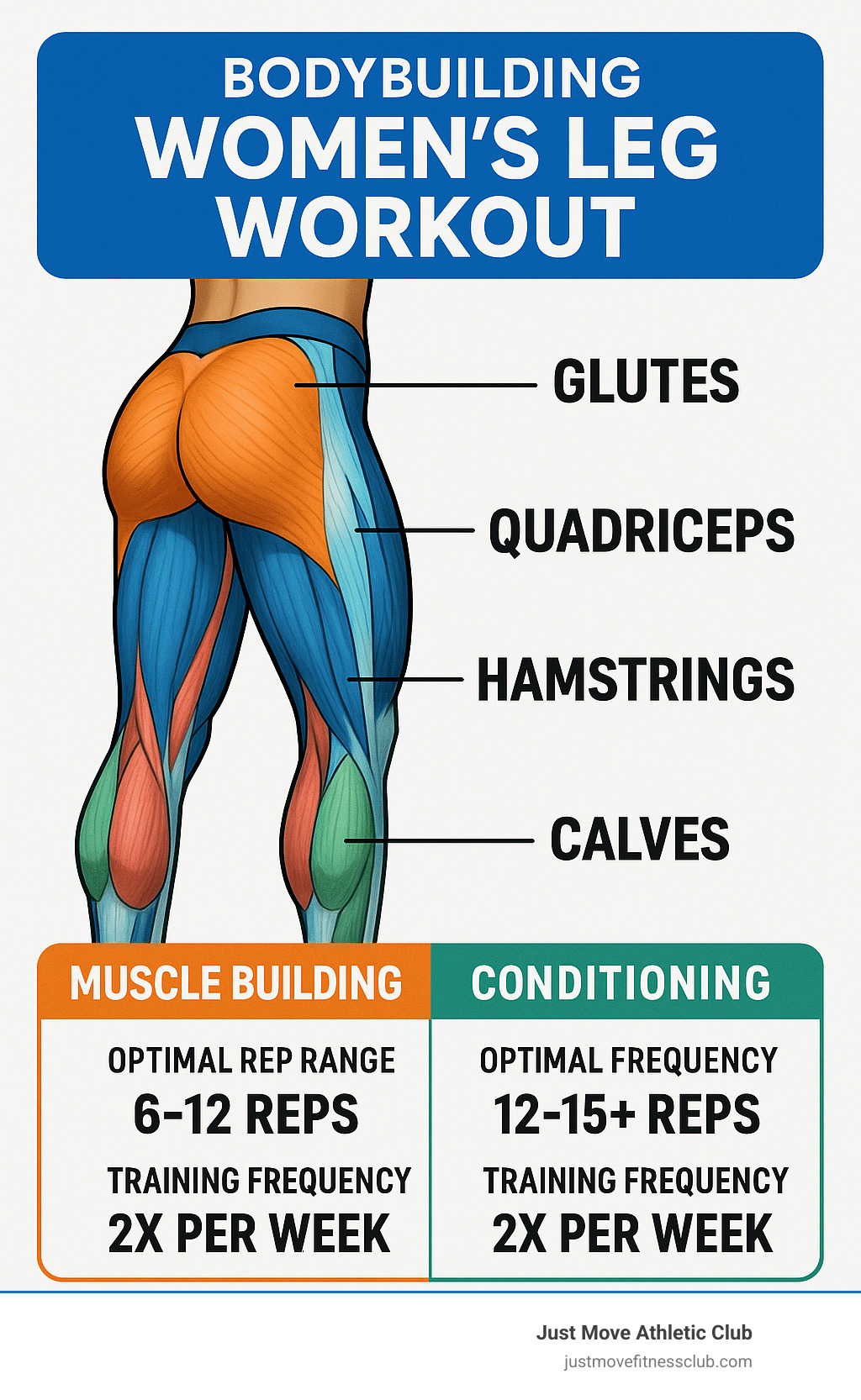
- Training frequency of 2 leg sessions per week for optimal results
- Rep ranges of 6-12 for muscle building and 12-15+ for conditioning
- Proper form over heavy weight to prevent injury
Many women avoid serious leg training, fearing they’ll get “bulky.” This is a myth. Women have only 3-6% of the testosterone men have, making it extremely difficult to build excessive muscle. Instead, you’ll build lean, strong muscle that improves your shape and boosts your metabolism. The key is structuring your training for your specific goals using the right exercises, rep ranges, and progressive overload.
Decades of fitness expertise show that a well-designed leg workout is transformative. With the right guidance and a supportive community, women can achieve results that go far beyond physical appearance.
Handy bodybuilding women’s leg workout terms:
The Science of Building Strong Legs: Key Principles for Women
Understanding the science behind leg training turns random exercises into a strategic plan. Knowing how your muscles work and respond to training makes every rep more purposeful.
Understanding Your Leg Muscles
A well-designed bodybuilding women’s leg workout targets all major muscle groups for balanced strength and an athletic shape.
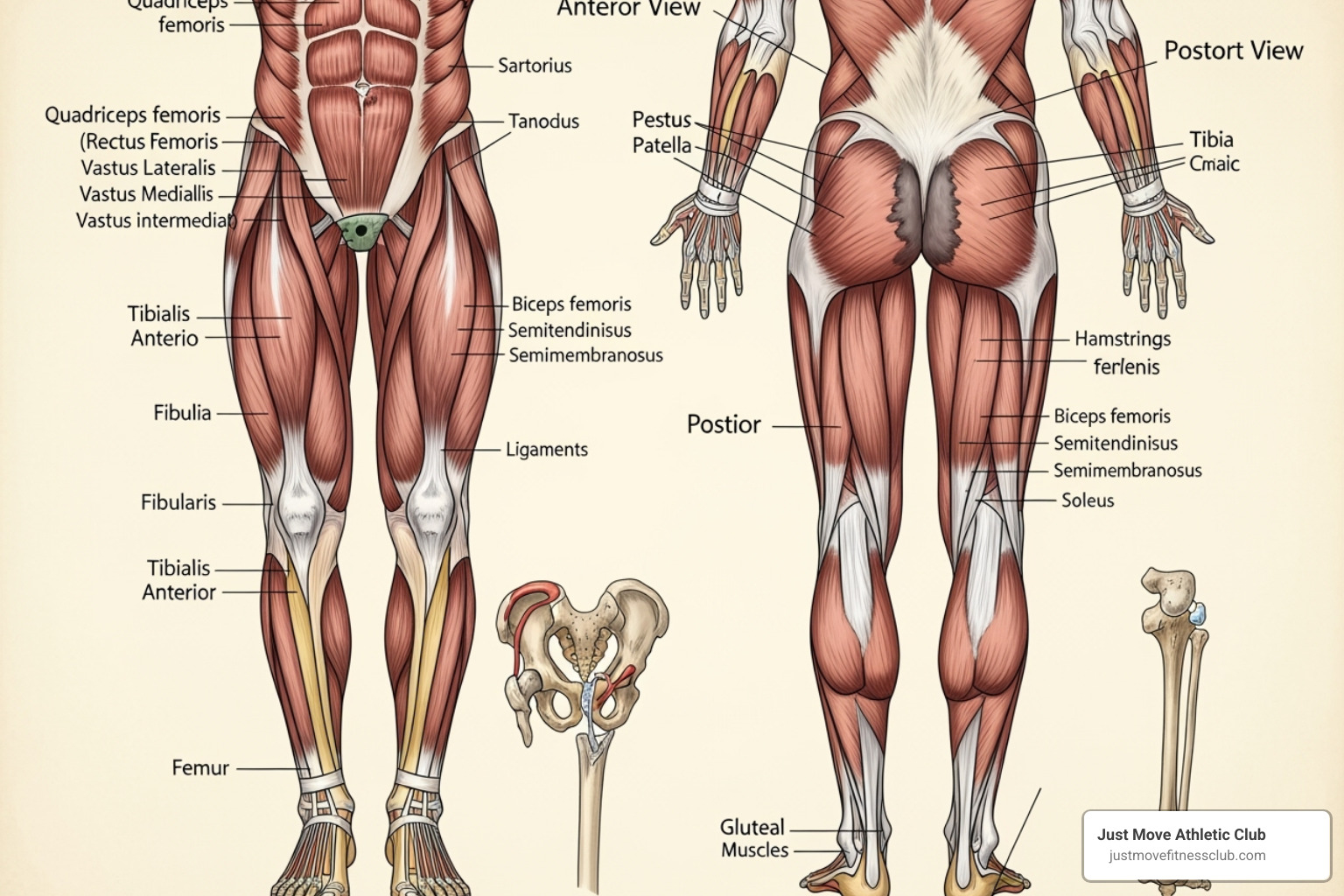
- Quadriceps: The four muscles on the front of your thigh that straighten your knee.
- Hamstrings: The three muscles on the back of your thigh that bend your knee and extend your hip.
- Gluteus Maximus: The largest muscle in your body, powering nearly every lower body movement.
- Calves: The gastrocnemius and soleus muscles that help you push off the ground.
- Adductors & Abductors: The inner and outer thigh muscles that provide stability and control.
Hormones and Muscle Growth: The “Bulky” Myth Debunked
You will not accidentally become bulky from lifting weights. The science is clear: men have testosterone concentration statistics of 240-950 ng/dL, while women have only 8-60 ng/dL. With only 3-6% of the testosterone men have, women’s bodies cannot build extreme muscle mass naturally.
Instead, you’ll develop lean, strong muscle that creates definition and shape. What many call “toning” is simply building muscle while reducing body fat to reveal that shape. This requires strength training and proper nutrition, not avoiding weights. Gaining significant mass requires a large caloric surplus and an intense training program, which is not the goal for most.
The Power of Progressive Overload in a Bodybuilding Women’s Leg Workout
Progressive overload means gradually increasing the challenge to your muscles over time to prevent plateaus. Your muscles adapt and grow stronger in response to these new demands.
- Increase weight: The most direct method. Once you hit your target reps with good form, add a little more weight.
- Add reps or sets: If you’re not ready for more weight, aim for an extra rep or add another set to increase training volume.
- Improve form: Better technique, like deeper squats, increases the challenge on the target muscles.
- Reduce rest times: Shorter rest periods between sets increase workout intensity.
Small, consistent improvements compound over time, ensuring your bodybuilding women’s leg workout continues to deliver results.
Designing Your Ultimate Bodybuilding Women’s Leg Workout
A great leg workout needs a blueprint. Your bodybuilding women’s leg workout should be designed around your goals, whether that’s building muscle, improving conditioning, or both. A structured plan considers exercise selection, training frequency, and volume to ensure you get the results you’re after.
Compound vs. Isolation: The Best of Both Worlds
A complete bodybuilding women’s leg workout combines both compound and isolation movements.
- Compound movements like squats, deadlifts, and lunges are your foundation. They work multiple muscle groups at once, leading to greater muscle activation, higher calorie burn, and functional strength that you can use in daily life.
- Isolation exercises like leg curls, leg extensions, and cable kickbacks are for targeted shaping and definition. They help you focus on specific muscles and develop a strong mind-muscle connection.
For best results, start your workout with heavy compound lifts, then use isolation exercises to finish.
Structuring Your Workout: Size vs. Conditioning
The structure of your workout depends on your primary goal.
- For Muscle Size (Hypertrophy): Focus on heavier weights in the 6-12 rep range. Perform 3-4 sets per exercise and take 60-90 second rest periods to recover for the next heavy set.
- For Conditioning & Fat Loss: Use lighter weights for higher reps, typically 15-20+. Keep rest periods short (30-45 seconds) to maintain an liftd heart rate. This often involves 3-5 sets arranged in circuits or supersets.
Both approaches are effective and can be combined or alternated depending on your goals.
How Often Should You Train Legs?
While recent research on training frequency shows that total weekly training volume is the most critical factor, a practical approach for most women is two leg sessions per week. This schedule allows for sufficient volume to stimulate growth and adequate time for recovery.
Your muscles grow during rest, so aim for at least 48 hours between intense leg workouts. Most importantly, listen to your body. Adjust your training based on your energy levels and recovery.
The Ultimate Exercise Library for Women’s Legs
This is your toolkit for building strong, sculpted legs. A complete bodybuilding women’s leg workout combines different movements to target all muscle groups. Prioritizing proper form over heavy weight is crucial for preventing injury and maximizing results.
Foundational Compound Lifts
These movements are the backbone of your workout, working multiple muscles at once.
- Barbell Back Squat: The king of leg exercises, targeting quads, glutes, hamstrings, and core. Ensure you understand proper back squat form for safety and effectiveness.
- Goblet Squat: A great alternative for learning squat mechanics. Holding a dumbbell at your chest helps maintain an upright torso.
- Romanian Deadlift (RDL): A hip-hinge movement that is fantastic for your hamstrings and glutes. Keep a flat back and focus on pushing your hips back.
- Leg Press: A machine-based exercise that allows you to safely load your legs with less stress on your lower back.
Unilateral Power Moves
Single-leg exercises build balanced strength and correct muscular imbalances.
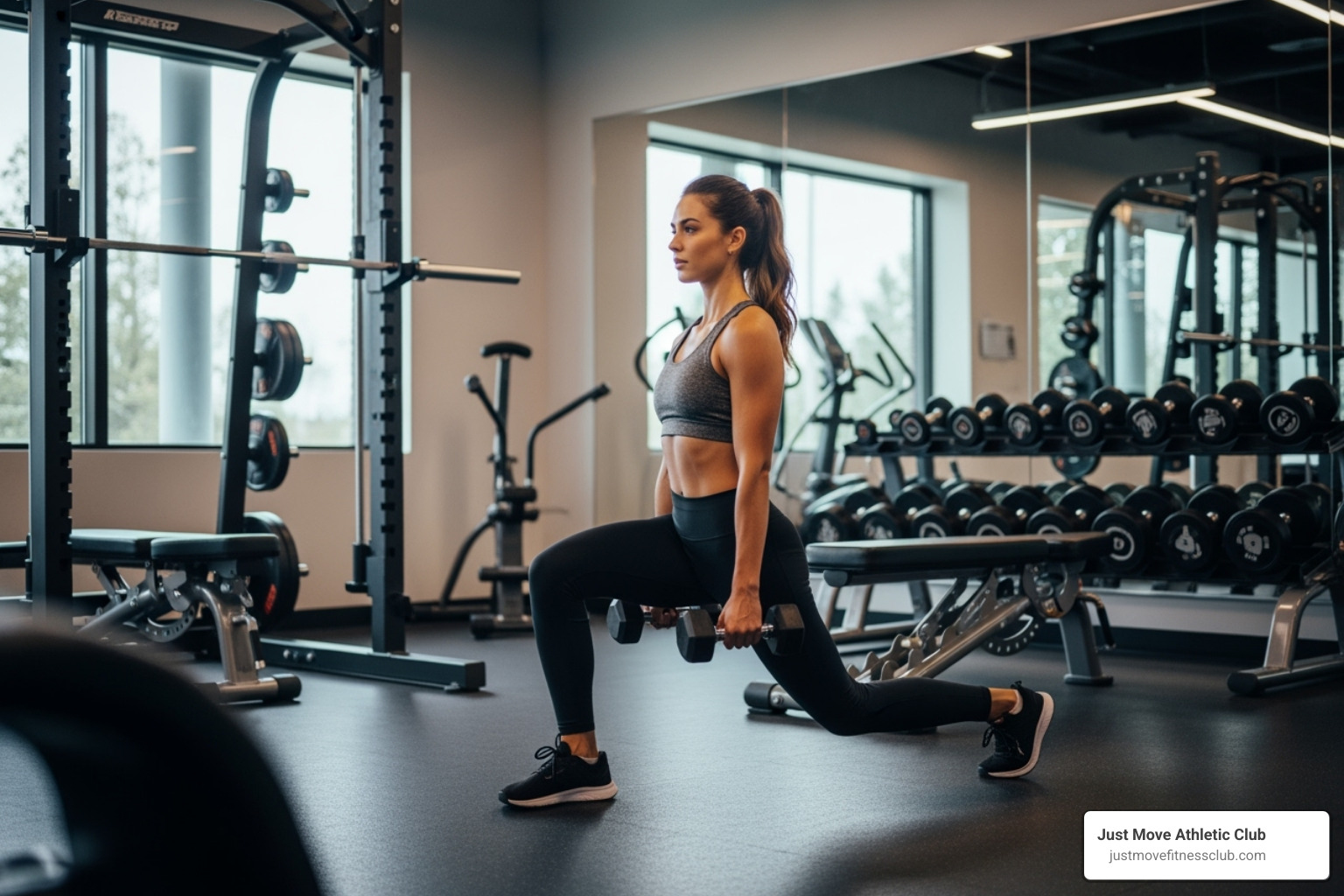
- Walking Lunges: Challenge your balance while working your quads, hamstrings, and glutes. Control the movement for best results.
- Bulgarian Split Squats: An intense exercise for building single-leg strength and stability. Research shows its high effectiveness for muscle activation.
- Step-ups: A functional movement that builds real-world power by mimicking climbing stairs. Drive through your heel as you step up.
- Single-Leg Deadlifts: A test of balance and coordination that builds incredible hamstring strength.
Glute-Focused Finishers
These exercises isolate the glutes for targeted development.
- Barbell Hip Thrust: The top exercise for glute activation. Rest your upper back on a bench and drive your hips up, squeezing your glutes at the top.
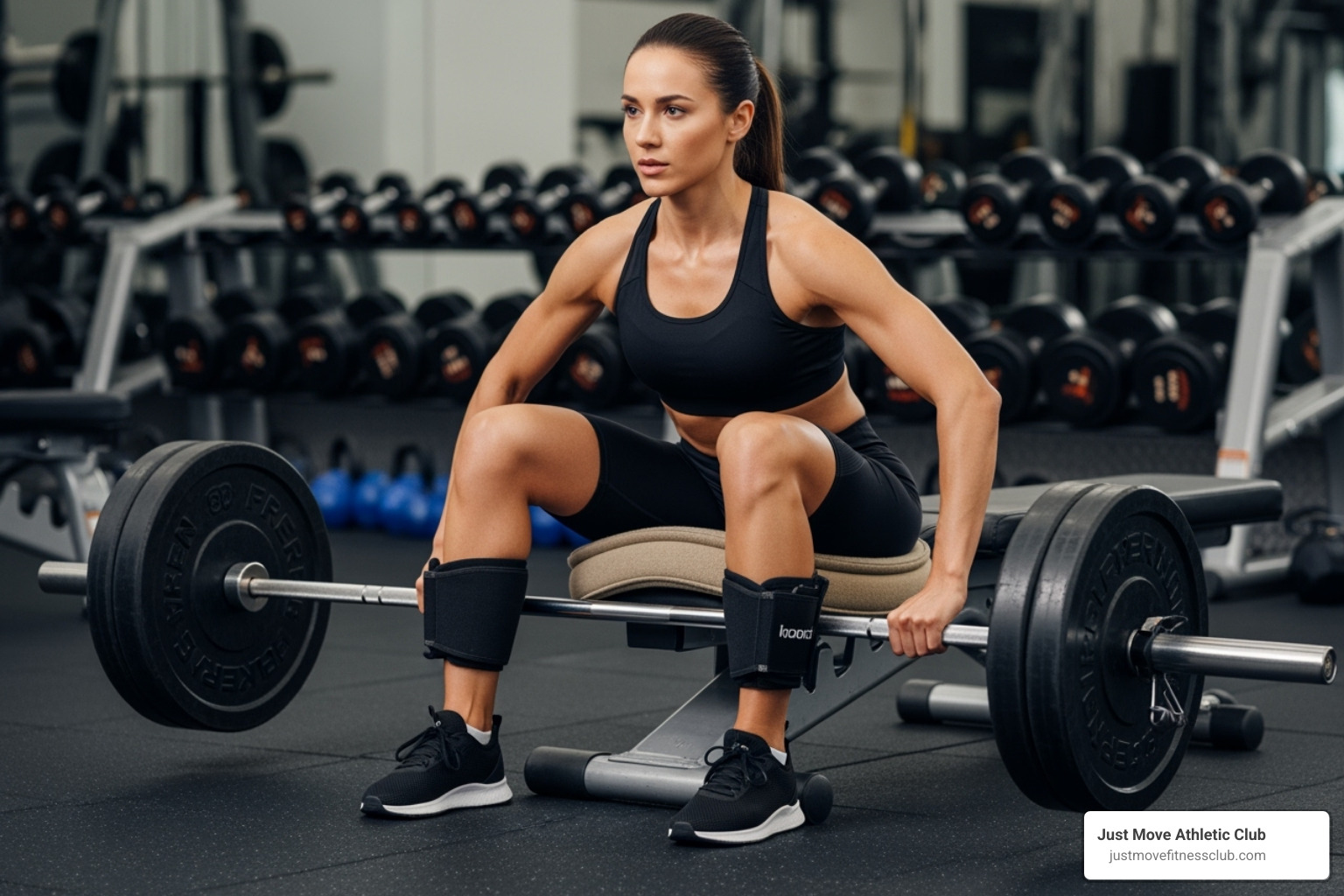
- Glute Bridge: A great bodyweight or weighted alternative to the hip thrust. Lie on your back and lift your hips by squeezing your glutes.
- Cable Kickbacks: Uses constant tension from a cable to precisely isolate the glutes.
Putting It All Together: Sample Workouts & Best Practices
Here is your roadmap to a stronger, more sculpted lower body. These sample bodybuilding women’s leg workout plans can be adapted as you grow stronger.
Sample Bodybuilding Women’s Leg Workout Routines
Beginner Routine (Focus: Mastering Form)
- Goblet Squats: 3 sets of 10-12 reps
- Dumbbell Romanian Deadlifts: 3 sets of 10-12 reps
- Walking Lunges (Bodyweight or Light Dumbbells): 3 sets of 10-12 reps per leg
- Glute Bridges: 3 sets of 12-15 reps
Intermediate Routine (Focus: Increasing Challenge)
- Barbell Back Squat: 4 sets of 6-10 reps
- Leg Press: 3 sets of 8-12 reps
- Bulgarian Split Squats: 3 sets of 8-12 reps per leg
- Leg Curls: 3 sets of 10-12 reps
- Barbell Hip Thrusts: 3 sets of 8-12 reps
Advanced Routine (Focus: Intensity Techniques)
- Heavy Back Squats or Front Squats: 4 sets of 5-8 reps
- Barbell Romanian Deadlifts: 3 sets of 6-10 reps
- Superset: Leg Extensions (3×10-12) with Heavy Walking Lunges (3×10 per leg)
- Superset: Barbell Hip Thrusts (3×8-12) with Cable Kickbacks (3×12-15 per leg)
Essential Warm-Ups and Cool-Downs
Never skip your warm-up and cool-down. They are key to preventing injury and improving recovery.
- Warm-Up: Start with 5 minutes of light cardio (brisk walk, cycling). Follow with dynamic stretches like leg swings, hip circles, and bodyweight squats. Finish with activation exercises like banded glute bridges and lateral walks.
- Cool-Down: Perform static stretches, holding each for 20-30 seconds. Focus on your quads, hamstrings, glutes (figure-four stretch), and calves.
Common Mistakes to Avoid
- Poor Form: Always prioritize perfect form over heavy weight. Good technique creates better results and prevents injury.
- Not Training Hard Enough: The last 2-3 reps of a set should be challenging. If it feels easy, you’re not stimulating muscle growth.
- Skipping Compound Lifts: Don’t just do isolation exercises. Squats, deadlifts, and lunges are essential for building a strong foundation.
- Inconsistency: Regularity is key. Two consistent workouts a week are better than sporadic, intense sessions.
- Neglecting Recovery: Muscles grow during rest. Prioritize sleep, nutrition, and hydration. Recovery is just as important as your training.
Frequently Asked Questions about Women’s Leg Workouts
Let’s clear up some common concerns about bodybuilding women’s leg workout routines.
How do I choose the right weight for my workout?
Choosing the right weight is a skill that improves with practice.
- Find your baseline: Start with a weight you can lift for 12-15 reps with perfect form.
- Train near failure: The last 2-3 reps should feel challenging but be possible to complete with good form.
- Progressively overload: If you can easily do more reps than your target, increase the weight in your next session.
- Prioritize form over ego: Perfect technique with moderate weight is always superior to sloppy form with heavy weight.
What if I don’t have access to gym equipment like dumbbells?
You can still get a great leg workout without a full gym.
- Bodyweight exercises: Squats, lunges, glute bridges, and single-leg deadlifts are highly effective. Increase the difficulty by slowing the tempo or adding pauses.
- Resistance bands: These are affordable, versatile tools for adding resistance to squats, glute bridges, and lateral walks.
- Household items: Get creative with water jugs or a backpack filled with books to use as weights.
Will lifting heavy make my legs bigger instead of toned?
No, this is a common myth. “Toning” is the result of building muscle and reducing body fat, which reveals the muscle’s shape.
As we’ve discussed, women have much lower testosterone levels than men, making it extremely difficult to build large, “bulky” muscles. Lifting heavy is precisely what builds the lean, firm muscle that creates a strong, defined, and “toned” appearance. For most women, a balanced bodybuilding women’s leg workout will result in strong, shapely legs, not bulk.
Conclusion: Build Your Strongest Self
You now have the knowledge to create a powerful bodybuilding women’s leg workout. Building strong, sculpted legs is about science, consistency, and smart training. Remember to build your workouts on a foundation of compound movements, add isolation exercises for shape, and use progressive overload to keep making progress.
Consistency is your secret weapon. A balanced program with proper form, paired with adequate recovery, will deliver lasting results. It’s not about perfection, but about showing up and trusting the process.
To ensure you succeed safely and effectively, consider seeking expert guidance. A qualified trainer can help create a custom fitness experience for your specific goals, whether you’re a beginner or an advanced lifter.
Advanced tools for tracking progress, like body composition scanners, can be a game-changer. They go beyond the scale to show you real changes in your body composition, helping you stay motivated by seeing your muscle development.
You have the tools. Now it’s time to build the strongest, most confident version of yourself.