
Why Finding the Best Gym Routine for Muscle Growth Changes Everything
The best gym routine for muscle growth is built on science-backed principles that create real, lasting change. A random approach in the gym leads to frustration and plateaus, while a structured plan targeting all major muscle groups consistently delivers results.
Key Components of an Optimal Muscle Growth Routine:
- Push/Pull/Legs (PPL) split – trains each muscle group 2x per week
- Progressive overload – gradually increasing weight, reps, or intensity
- 8-12 rep range for hypertrophy (muscle growth)
- Compound exercises like squats, deadlifts, and bench press
- 48+ hours rest between training the same muscle group
- Proper nutrition with adequate protein (1.4g+ per kg bodyweight)
Research shows that muscles need to be worked at least twice per week for meaningful growth, using a combination of mechanical tension, muscle damage, and metabolic stress. This guide breaks down everything you need to build an effective muscle-building program.
I’m Pleasant Lewis, founder of Just Move Athletic Clubs, with over 40 years of experience helping members achieve their fitness goals. I’ve seen how implementing the best gym routine for muscle growth transforms lives and builds lasting results.
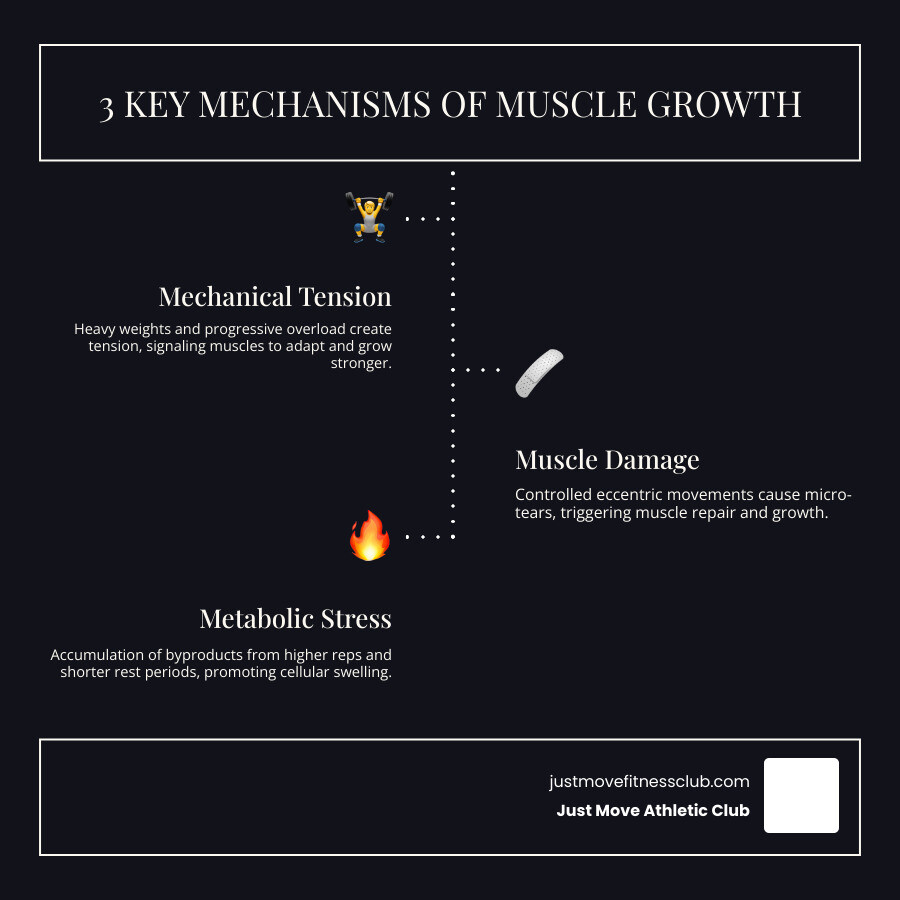
Best gym routine for muscle growth terms made easy:
The Science of Muscle Growth: Key Principles for Success
Muscle growth, or muscle hypertrophy, is your body’s adaptation to resistance training. When you lift weights, you create microscopic tears in your muscle fibers. Your body then repairs these fibers, building them back bigger and stronger to handle future stress. This process relies on consistency to signal to your muscles that they need to adapt permanently.
The key drivers of hypertrophy are mechanical tension, muscle damage, and metabolic stress. Mechanical tension comes from lifting heavy weights. Muscle damage refers to the beneficial micro-tears in the fibers. Metabolic stress is the “burn” you feel during a tough set, which is another powerful signal for growth. An effective routine targets all three.
Training Frequency and Volume
To maximize growth, a muscle needs to be worked at least two times a week. Training a muscle group only once a week is not enough to send a consistent growth signal. Hitting each muscle group twice weekly creates more opportunities to stimulate hypertrophy.
The hypertrophy rep range of 8-12 reps is the sweet spot for muscle growth. This range is heavy enough to create significant mechanical tension while providing enough volume to generate metabolic stress and muscle damage. Aim for 3-4 sets per exercise in this rep range, choosing a weight that makes the last few reps challenging but possible with good form.
Progressive Overload: The secret to the best gym routine for muscle growth
Your muscles stop growing once they adapt to a certain level of stress. Progressive overload is the principle of making your workouts gradually more challenging over time to ensure continuous adaptation.
Methods for progressive overload include:
- Increasing weight: The most direct method.
- Increasing reps: Aiming for more reps with the same weight.
- Improving form: Better technique allows you to work muscles more effectively and safely lift heavier.
- Increasing intensity: Using techniques like drop sets or slower rep tempos.
Tracking progress is essential. Tools like the Fit3D Pro Body Scanner at Just Move Athletic Club help you see how your body is changing, keeping you motivated and allowing you to adjust your plan for optimal results.
The Importance of Rest and Recovery
Muscles don’t grow in the gym; they grow during rest. The workout is the stimulus, but the muscle repair process happens during recovery. Without adequate rest, you risk overtraining, which slows progress, increases injury risk, and can even make you weaker.
Sleep’s role in growth is critical. During deep sleep, your body releases growth hormones essential for muscle repair. Aim for 7-9 hours of quality sleep per night. Active recovery, like light walking on rest days, can also aid the process. The ACSM guidelines recommend 48 hours rest for a muscle group before training it again, which is why well-designed workout splits are so effective.
The Best Gym Routine for Muscle Growth: Why the Push/Pull/Legs (PPL) Split Reigns Supreme
The Push/Pull/Legs (PPL) split is one of the most effective and popular training methods. It organizes your workouts around natural movement patterns, making it both simple and highly efficient.
- Push Day: Targets muscles that push things away (chest, shoulders, triceps).
- Pull Day: Focuses on muscles that pull things toward you (back, biceps).
- Leg Day: Works the entire lower body (quads, hamstrings, glutes, calves).
This split is effective due to muscle group synergy. For example, during a bench press on Push Day, your shoulders and triceps are already assisting. Training them together maximizes the work they do. This structure also allows for excellent recovery, as different muscle groups are trained on consecutive days, minimizing overlap and reducing overtraining risk.
PPL vs. Other Popular Splits
The best gym routine for muscle growth depends on your schedule and experience. Here’s how PPL compares to other common splits:
| Workout Split | Frequency (Muscles per Week) | Recovery (Between Muscle Groups) | Suitability for Experience Levels |
|---|---|---|---|
| Full Body | 2-3 times | High | Beginners, Time-constrained |
| Upper/Lower | 2 times | Moderate | Intermediate |
| Push/Pull/Legs (PPL) | 2 times (if 6-day split) | High | Intermediate, Advanced |
Full Body workouts are ideal for beginners, as they train every major muscle group each session, helping to build a solid strength base. Upper/Lower splits are a great middle ground for intermediate lifters, allowing for more volume per body part than full-body routines. The PPL split is best for intermediate to advanced lifters who can train more frequently, as a 6-day split hits each muscle group twice weekly with high volume—a proven combination for muscle growth.
Who is the PPL Split For?
- Beginners: We recommend starting with full-body workouts for the first six months to learn proper form and build a foundational strength base before moving to a PPL split.
- Intermediate lifters: PPL is ideal once you can commit to 3-6 sessions per week. You have the work capacity to handle the volume and focus required for serious progress.
- Advanced lifters: PPL offers the flexibility for a 3-day or 6-day routine, providing the high frequency and volume needed to continue making gains.
The key is to customize the split to your recovery capacity. Our trainers at Just Move Athletic Club can help you find the right balance. The best gym routine for muscle growth is one you can stick with consistently while making progressive gains.
Building Your PPL Routine: Exercises, Sets, and Reps
Putting theory into practice requires a well-structured workout. Every session should begin with a 5-10 minute warm-up of light cardio and dynamic stretching to prepare your muscles for work.
Your routine should be built around compound and isolation exercises. Compound movements (squats, bench press) work multiple muscle groups, allowing you to lift heavier and stimulate maximum growth. Isolation exercises (bicep curls, lateral raises) target specific muscles, which is ideal for adding volume after your main compound lifts.

Sample 3-Day PPL Workout
Aim for 3-4 sets of 8-12 reps for most exercises, which is the ideal range for hypertrophy.
Push Day (Chest, Shoulders, Triceps):
- Barbell Bench Press: 3-4 sets of 8-12 reps
- Incline Dumbbell Press: 3-4 sets of 8-12 reps
- Overhead Press (Barbell or Dumbbell): 3-4 sets of 8-12 reps
- Lateral Raises: 3 sets of 10-15 reps
- Triceps Pushdowns: 3 sets of 10-15 reps
Pull Day (Back, Biceps):
- Pull-Ups or Lat Pulldowns: 3-4 sets of 8-12 reps
- Bent-Over Rows (Barbell or Dumbbell): 3-4 sets of 8-12 reps
- Face Pulls: 3 sets of 12-15 reps
- Barbell Curls: 3 sets of 8-12 reps
- Hammer Curls: 3 sets of 8-12 reps
Leg Day (Quads, Hamstrings, Glutes, Calves):
- Barbell Squats: 3-4 sets of 8-12 reps
- Romanian Deadlifts: 3-4 sets of 8-12 reps
- Leg Press: 3 sets of 10-15 reps
- Seated Leg Curls: 3 sets of 10-15 reps
- Standing Calf Raises: 4 sets of 10-15 reps
- Ab Work (e.g., Hanging Leg Raises): 3 sets to failure
Structuring the perfect PPL week for your best gym routine for muscle growth
PPL is flexible. Here are a few ways to structure your week:
- 3-Day Split: Train on non-consecutive days (e.g., Mon/Wed/Fri). This is effective for busy schedules.
- 6-Day Split: Run the cycle twice (Push/Pull/Legs/Push/Pull/Legs) followed by a rest day. This is optimal for growth as it hits each muscle group twice per week.
- Rolling Schedule: Train for three days, rest one day, and repeat. This provides high frequency with built-in recovery.
Always listen to your body and take an extra rest day if you feel fatigued.
Free Weights vs. Machines
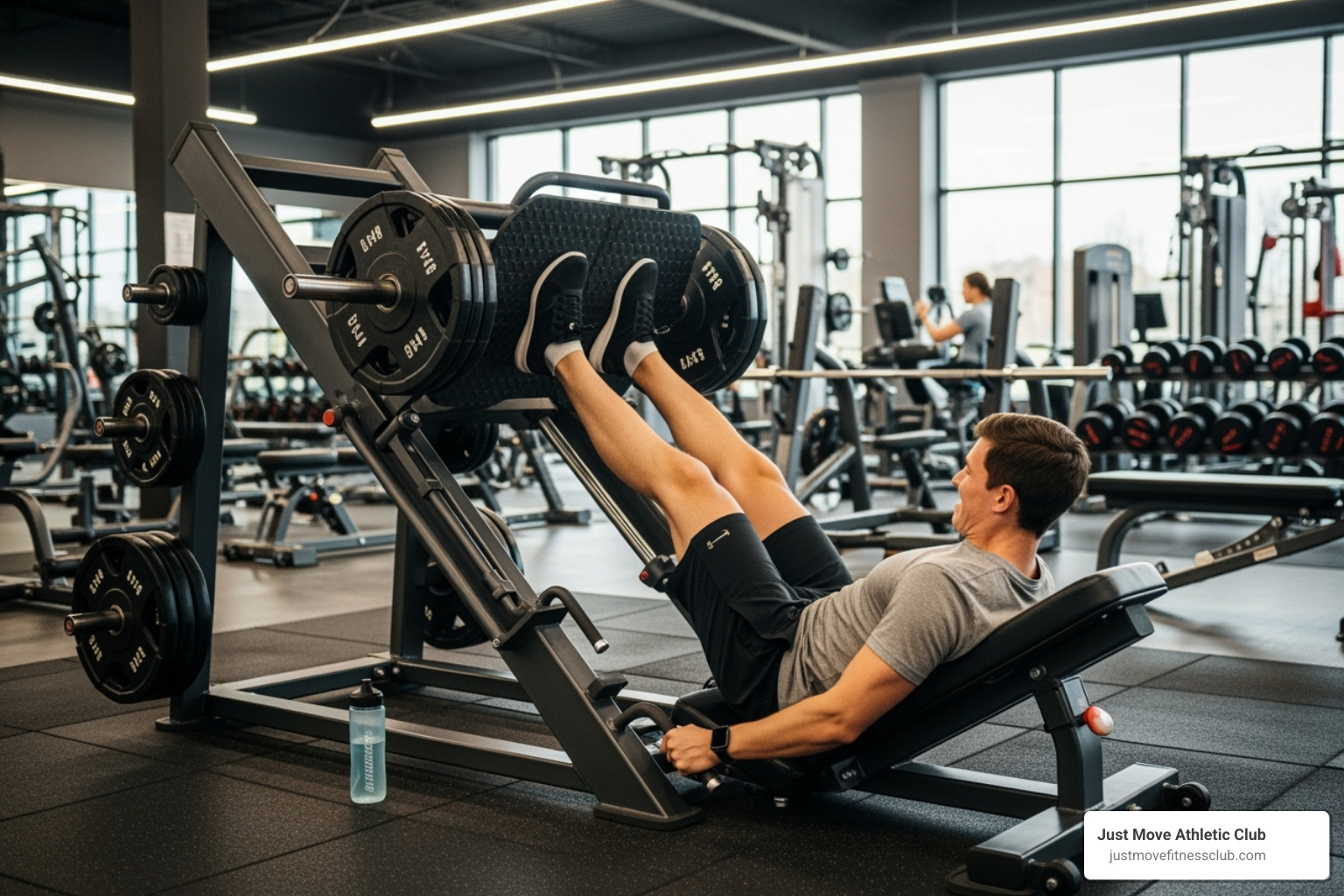
The best approach uses both. Free weights build functional strength and engage stabilizing muscles. Machines provide a controlled movement path, which is great for isolating specific muscles safely, especially when you’re fatigued.
A winning strategy is to start workouts with heavy, compound free-weight movements and finish with machine-based isolation exercises to add volume and fully exhaust the target muscles. At Just Move Athletic Club, you’ll find a full range of both free weights and machines to support this effective training style.
Fueling Your Gains: The Critical Role of Nutrition
You can have the best gym routine for muscle growth, but without proper nutrition, your progress will stall. The saying, “You can’t out-train a bad diet,” is especially true for building muscle. Your workouts create the stimulus for growth, but food provides the raw materials and energy to make it happen.

Caloric Surplus and Macronutrients
To build muscle, you must be in a caloric surplus, meaning you consume slightly more calories than your body burns. A modest surplus of 5-10% above your maintenance calories is ideal for promoting muscle gain while minimizing fat storage.
The source of these calories matters. Your macronutrients—protein, carbohydrates, and fats—each play a vital role:
- Protein: Provides the amino acids necessary to repair and build muscle tissue.
- Carbohydrates: Your body’s primary energy source, fueling intense workouts and replenishing muscle glycogen stores.
- Healthy Fats: Crucial for hormone production, including testosterone, which is essential for muscle growth.
Protein Intake for Optimal Growth
Protein is the most critical macronutrient for muscle repair. After a workout creates micro-tears in your muscle fibers, protein provides the building blocks to not only fix the damage but also make the muscle larger and stronger.
Research shows you should aim for at least 1.4 grams of protein per kg of bodyweight daily for optimal muscle growth. For a 70 kg (154 lb) person, this is about 98 grams of protein per day. Spreading this intake throughout the day provides your muscles with a steady supply of amino acids for continuous repair and growth.
Great protein sources include lean meats, fish, eggs, Greek yogurt, cottage cheese, legumes, tofu, and tempeh. Whey or plant-based protein powders are also a convenient way to meet your daily protein goals.
Frequently Asked Questions about Muscle Building
Even experienced lifters have questions about building muscle. Here are answers to some of the most common ones we hear at Just Move Athletic Club about creating the best gym routine for muscle growth.
How long does it take to see muscle gains?
Progress begins quickly, especially for new lifters (newbie gains). Most people see visible results within 6-12 weeks of consistent training and proper nutrition. Friends and family may start to notice changes around the 8-week mark.
Consistency is everything. You may also experience body recomposition—building muscle while losing fat simultaneously. This means the scale might not change much, but your body shape will. Our Fit3D Pro Body Scanner is an excellent tool for tracking these changes that scales miss.
What’s the difference between training for strength vs. hypertrophy?
While related, training for strength and hypertrophy (muscle size) have different focuses.
- Strength Training: The goal is to lift the heaviest weight possible. This involves heavy weights in the 1-6 rep range with long rest periods (3-5 minutes).
- Hypertrophy Training: The goal is to increase muscle size. This uses moderate weights in the 8-12 rep range with shorter rest periods (60-90 seconds) to maximize metabolic stress.
For the best gym routine for muscle growth, the hypertrophy approach is recommended, as it creates the ideal conditions for increasing muscle size while also building strength.
What are common mistakes to avoid on a PPL routine?
Certain mistakes can slow your progress. Avoid these common pitfalls:
- Poor form: Lifting with improper technique increases injury risk and makes the exercise less effective. Focus on form over weight.
- Ego lifting: Using too much weight often leads to poor form. Leave your ego at the door and focus on quality reps.
- Neglecting progressive overload: If you don’t consistently challenge your muscles with more weight or reps, they have no reason to grow.
- Inadequate nutrition: You cannot build muscle without sufficient calories and protein.
- Skipping leg day: Your legs contain your body’s largest muscles. Training them stimulates a hormonal response that benefits overall growth.
- Insufficient rest: Muscles grow during recovery, not in the gym. Lack of sleep and rest days leads to overtraining and plateaus.
Conclusion: Your Path to a Stronger Physique
Building muscle is a rewarding journey that improves your strength, health, and confidence. The best gym routine for muscle growth is not a secret formula but a commitment to proven principles.
We’ve covered the essentials:
- The Push/Pull/Legs split for optimal training frequency.
- Progressive overload to continuously challenge your muscles.
- Proper nutrition to fuel growth and repair.
- Sufficient rest to allow your body to rebuild.
Consistency is the ultimate factor. Showing up and applying these principles week after week is what separates those who succeed from those who don’t. Celebrate small wins—an extra rep, more weight on the bar, or just making it to the gym on a tough day. This journey builds mental toughness and proves what your body is capable of.
At Just Move Athletic Club, we’ve watched thousands of members transform their bodies and lives. Our facilities across Lakeland, North Lakeland, South Lakeland, Winter Haven, and Havendale are fully equipped to help you on your journey. With expert personal trainers and tools like our Fit3D Pro Body Scanner to track your progress precisely, we’re here to support you.
Your stronger physique is waiting. Are you ready to commit to the process? Start your muscle growth journey with us today and find what you’re truly capable of!