
Why Leg Day is Non-Negotiable for a Complete Physique
A bodybuilding leg day workout is essential for balanced muscle development, increased hormonal response, and building a foundation for overall strength. Many lifters neglect their legs, but this is a huge mistake. As one fitness expert put it: “Legs win bodybuilding competitions, period.”
Your legs contain the largest muscles in your body. Training them hard triggers a massive hormonal response that helps your entire body grow and provides the foundation for every other lift. An effective leg day must include:
Essential Components:
- Compound movements: Squats, Romanian deadlifts, lunges
- Isolation exercises: Leg extensions, leg curls, calf raises
- Progressive overload: Gradually increasing weight, reps, or sets
- Full range of motion: Deep squats and complete muscle stretches
- Balanced training: Equal focus on quads, hamstrings, glutes, and calves
Training Frequency: 1-2 times per week with 48+ hours recovery between sessions.
Because the legs consist of multiple muscle groups, you need varied exercises to stimulate them all. Your approach to leg training will determine whether you build a complete physique or remain underdeveloped.
I’m Pleasant Lewis, founder of Just Move Athletic Club. With over 40 years in fitness, I’ve seen members transform their physiques by taking their bodybuilding leg day workout seriously. Proper programming and consistent effort build legs that look impressive and support all your training goals.
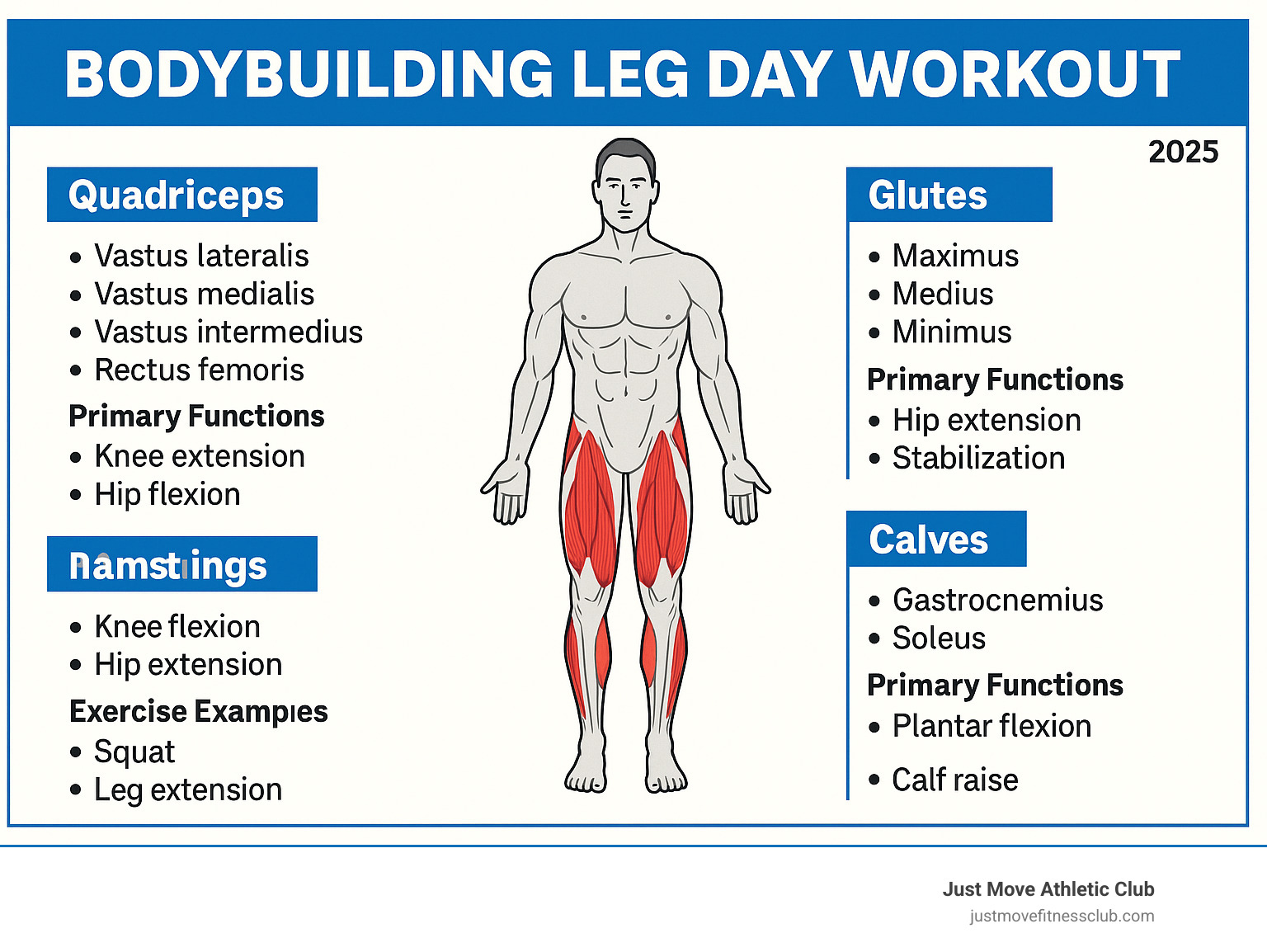
Bodybuilding leg day workout terms to remember:
The Blueprint for Massive Legs: Anatomy and Core Movements
Building impressive legs requires understanding what you’re working and how to train it effectively. A well-designed bodybuilding leg day workout must hit all major lower-body muscles through the right movement patterns.
Understanding Your Leg Muscles
Here’s a breakdown of the muscles you’re training:
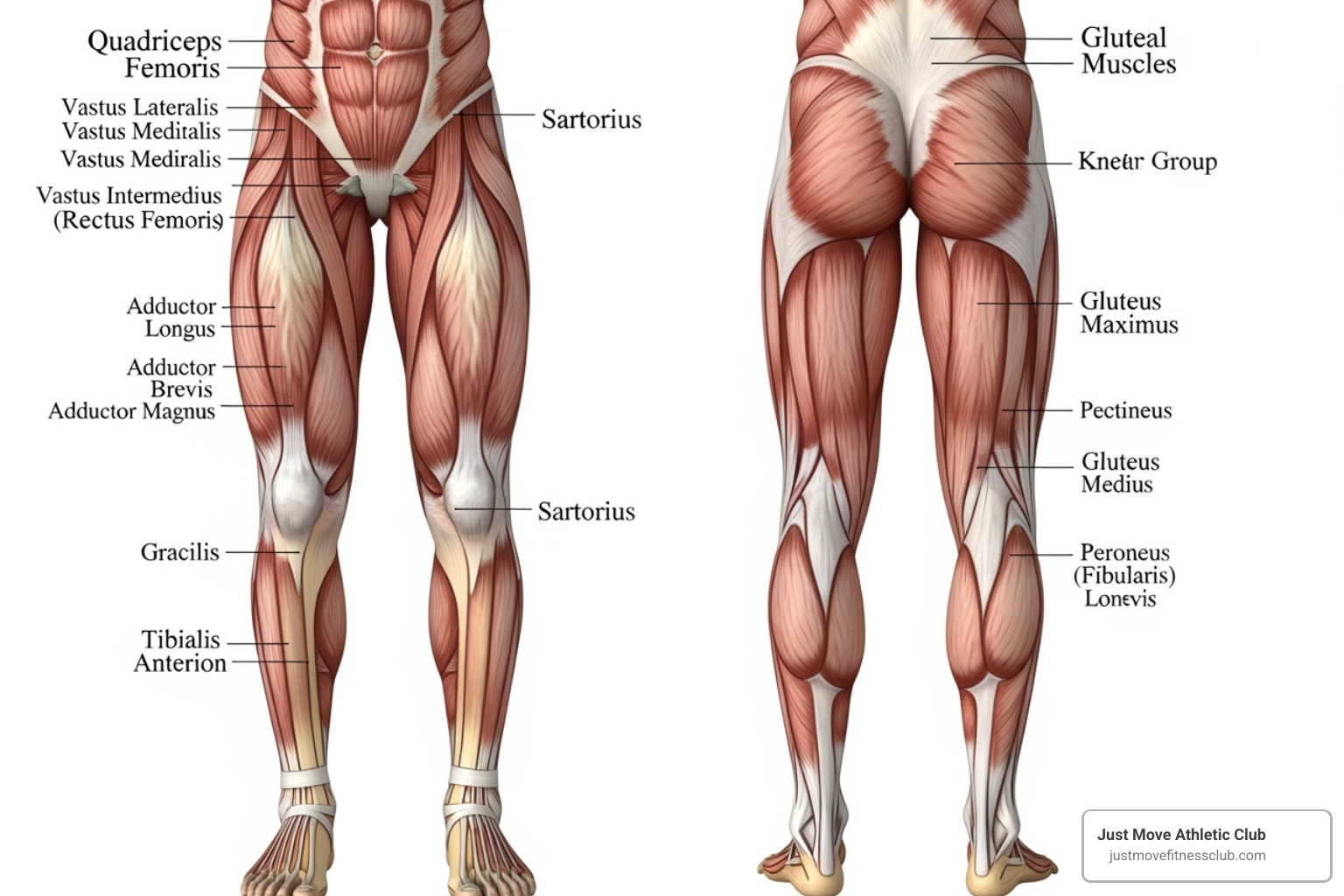
Your quadriceps are at the front of your thigh. While three of the four muscles primarily straighten your knee, the rectus femoris is unique because it also crosses the hip joint. This means regular squats don’t fully develop it, which is why exercises like leg extensions or front squats are necessary.
Your hamstrings perform two jobs: they bend your knee and extend your hip. This dual function means you need a varied approach. Romanian deadlifts work the hamstrings through hip extension, while leg curls target them through knee flexion. Neglecting either pattern will limit growth.
Your glutes (maximus, medius, and minimus) are your body’s powerhouse, controlling hip movement and stability. A strong glute complex is essential for powerful squats and deadlifts.
Your calves can be stubborn to grow. The gastrocnemius responds best to straight-knee exercises like standing calf raises, while the soleus requires bent-knee work like seated calf raises.
Mastering the Foundational Movements
Every effective leg workout revolves around three core movement patterns.
The squat pattern involves bending at the knees and hips simultaneously. Barbell back squats, front squats, and hack squats all follow this pattern. The squat is king because it works your quads, glutes, and hamstrings together. Proper form, especially a full range of motion, is crucial for maximum muscle activation.
The hinge pattern focuses on bending at the hips while keeping the knees relatively straight. Deadlifts and Romanian deadlifts are prime examples, excellent for targeting your hamstrings and glutes.
The lunge pattern introduces single-leg training. Walking lunges and Bulgarian split squats challenge each leg individually. This unilateral work improves coordination, corrects muscle imbalances, and can stimulate serious growth.
Compound exercises like squats and deadlifts let you lift heavy and stimulate multiple muscle groups. Isolation exercises like leg extensions and leg curls allow you to target specific muscles for balanced development.
The magic happens when you combine both. Compound movements build the foundation, while isolation work fills in the gaps. Getting these patterns right is crucial for safety and results. At Just Move Athletic Club, we see the difference proper coaching makes. If you want to perfect your form, check out more info about personal training to perfect your form.
The Ultimate Bodybuilding Leg Day Workout for Every Level
Building impressive legs requires a smart progression that matches your experience while consistently applying progressive overload—the golden rule of muscle growth. This means challenging your muscles with slightly more stress each week. Here are three workout plans to guide you.
Beginner Bodybuilding Leg Day Workout: Building the Foundation
If you’re new to serious leg training, your mission is to master movement patterns and build a solid foundation. Focus on form over weight.
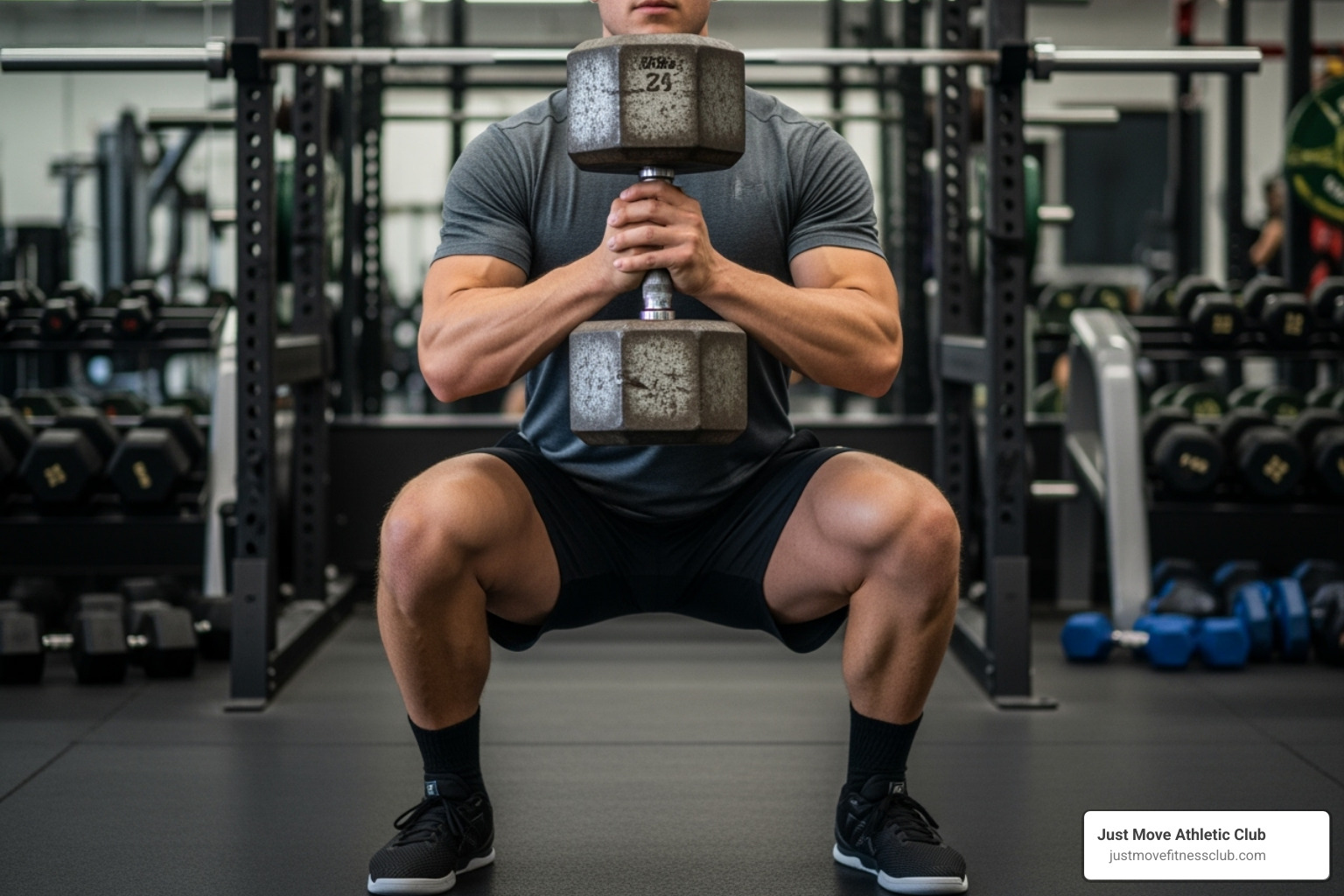
Goals: Perfect form, build consistency. Frequency: Once per week. Volume: 2-3 sets of 8-12 reps.
- Goblet Squats: 3 sets of 8-12 reps. Holding a dumbbell at chest level helps maintain an upright torso and teaches proper squat depth.
- Leg Press: 3 sets of 10-15 reps. This builds quad and glute strength. Lower until your knees form a 90-degree angle.
- Lying Leg Curls: 3 sets of 10-15 reps. Isolate your hamstrings, squeezing at the top of each rep.
- Calf Raises (Standing or Seated): 3 sets of 15-20 reps. Focus on a full stretch and a strong squeeze.
Progress by adding a small amount of weight only when you can complete all sets and reps with perfect form.
Intermediate Workout: Upping the Intensity for Hypertrophy
Once you’ve mastered the basics, it’s time to introduce heavier compound lifts to build significant muscle mass.
Goals: Build muscle mass and strength. Frequency: 1-2 sessions per week (allow 48-72 hours recovery). Volume: 3-4 sets of 6-12 reps for compounds, 8-15 for isolation.
- Back Squats or Front Squats: 3-4 sets of 6-8 reps. These are foundational for serious bodybuilders. Focus on controlled descents.
- Romanian Deadlifts (RDLs): 3-4 sets of 8-12 reps. Target your hamstrings and glutes by pushing your hips back with a flat back.
- Bulgarian Split Squats: 3 sets of 10-12 reps per leg. This unilateral exercise builds balance and exposes strength imbalances.
- Leg Extensions: 3 sets of 10-15 reps. Isolate the quads with a hard squeeze at the top.
- Seated Leg Curls: 3 sets of 10-15 reps. Research suggests seated variations can produce superior hamstring growth.
Progressive overload can include increasing weight, adding reps, shortening rest periods, or using pyramid sets.
Advanced Bodybuilding Leg Day Workout: Breaking Through Plateaus
At this level, you need advanced techniques to overcome plateaus. Drop sets, supersets, and rest-pause methods become essential.
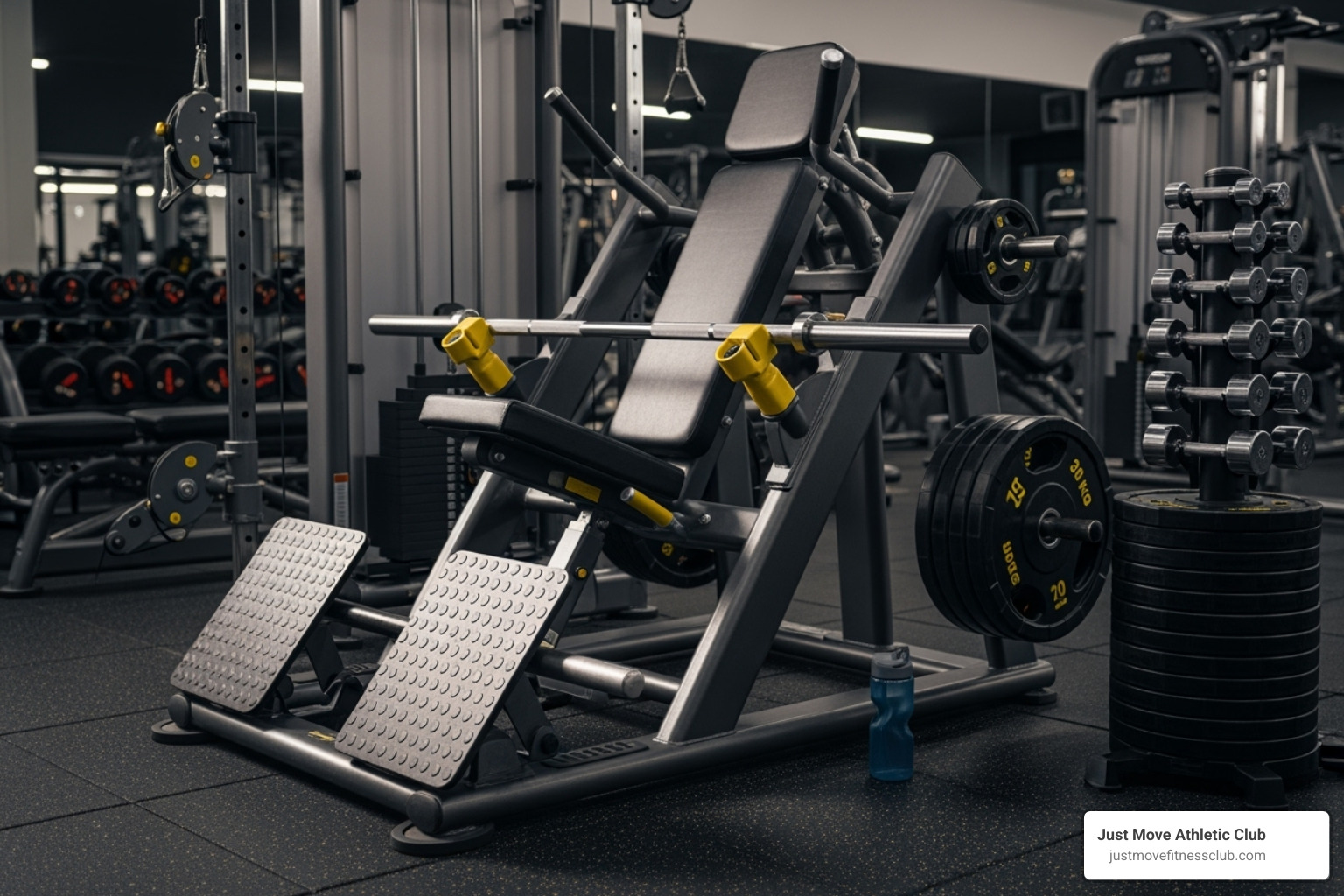
Goals: Maximize hypertrophy and break plateaus. Frequency: 1-2 weekly sessions. You’ll often train to failure.
- Front Squats or Hack Squats: Work up to a heavy 6-8 reps, then perform 3-4 sets of 10-12 reps. Hack squats allow for maximum quad tension.
- Superset: Hip Thrusts & Single-Leg RDLs: 4 sets. Perform 6-8 reps of hip thrusts immediately followed by 10-12 reps of single-leg RDLs per leg.
- Superset: Cyclist Squats & Good Mornings: 3 sets of 15 reps each. The cyclist squat targets the vastus medialis, while good mornings hit the posterior chain.
- Drop Sets: Leg Extensions & Leg Curls: For each exercise, do 3 sets. On each set, perform 8 reps, then immediately drop the weight and perform more reps to failure, twice.
- Standing Calf Raises: 4 sets of 20 reps. Research shows standing variations produce more growth.
Training to failure is a strategic tool here. Scientific research on training to failure for experienced lifters shows it can boost growth, but it requires longer recovery. Techniques like rest-pause and drop sets extend sets beyond normal failure to recruit more muscle fibers.
Advanced Techniques and Specialization
Once you’ve mastered the basics of a bodybuilding leg day workout, you can get strategic. If one muscle group is lagging, small tweaks in exercise selection and form can create big changes in muscle emphasis. This is where training becomes both an art and a science.
How to Emphasize Quads, Hamstrings, or Glutes
Use exercise selection and form adjustments as sculpting tools. A few simple changes can transform your workout’s focus.
For quad-focused training, front squats are ideal. Moving the weight to the front forces a more upright position that hammers the quads. Hack squats work similarly, as do leg extensions and narrow-stance, heels-liftd cyclist squats.
Hamstring development requires a different approach. Romanian deadlifts (RDLs) are crucial for the deep stretch they provide through hip extension. For isolation, research shows that seated leg curls produce more hamstring growth than lying leg curls. This is because the hamstrings are trained at a longer muscle length in the seated position, a key factor for hypertrophy. You can read more in the scientific research on seated vs. lying leg curls for hamstring growth.
Glute specialization is about hip extension and peak contraction. Hip thrusts are superior for this, providing maximum glute activation at the top. Deep, wide-stance back squats also emphasize the glutes.
| Quad Focus | Hamstring Focus | Glute Focus |
|---|---|---|
| Front Squats, Hack Squats, Leg Extensions | RDLs, Seated Leg Curls, Good Mornings | Hip Thrusts, Wide-Stance Squats, Lunges |
| Narrow stance, feet lower on leg press | Wider stance, feet higher on leg press | Wide stance, toes out, feet high on leg press |
Foot placement on the leg press acts like a dial for muscle emphasis. Lower placement hits more quads; higher placement shifts the focus to hamstrings and glutes.
The Role of a Lifting Belt on Leg Day
Let’s clarify the role of the lifting belt, a commonly misunderstood tool.
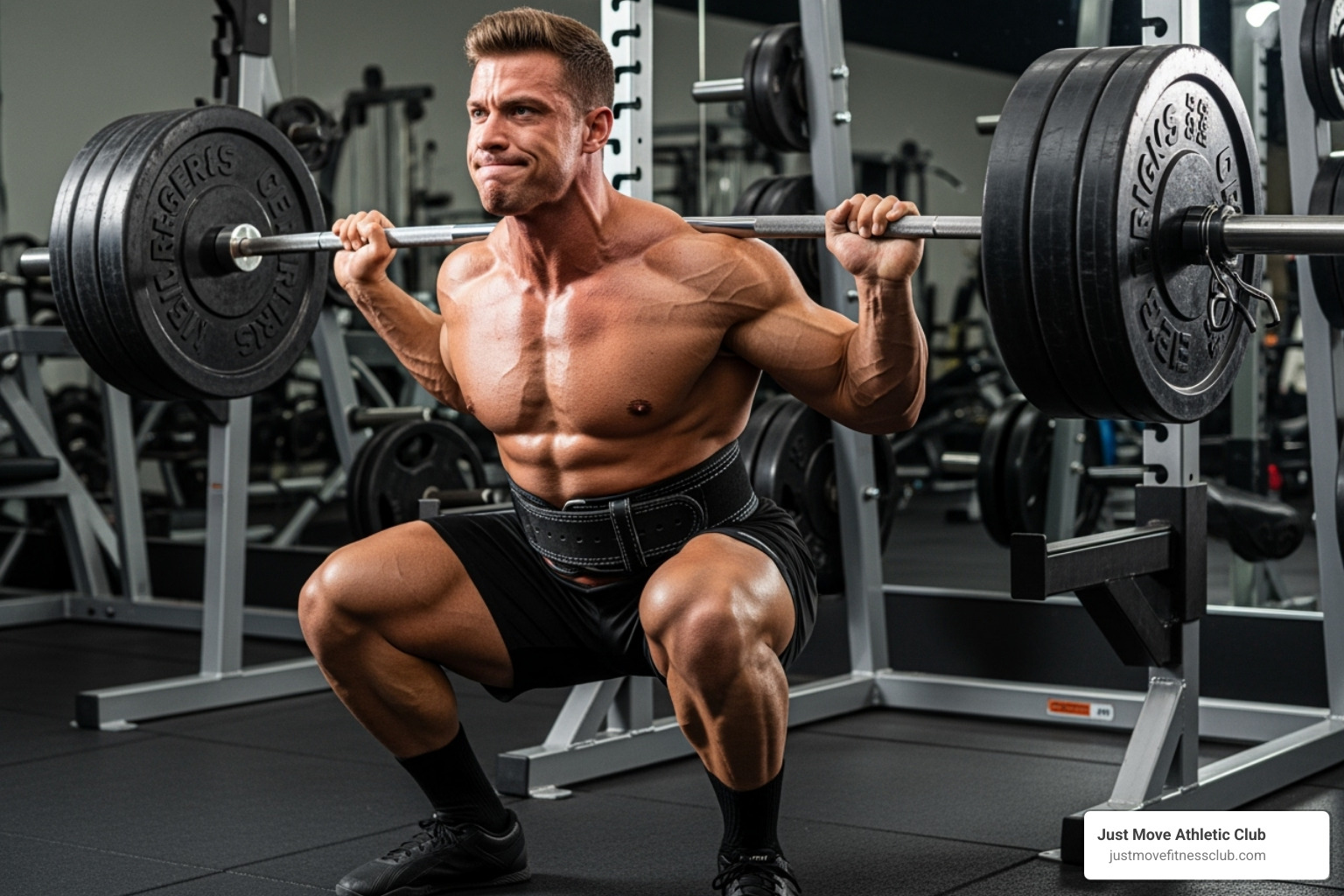
A lifting belt works by increasing intra-abdominal pressure. When you brace your core against the belt, you create internal pressure that stabilizes the spine.
Research is clear: belts help you lift heavier weights safely during demanding movements like heavy squats and deadlifts. This extra stability allows you to push harder without compromising form.
However, a belt is not a substitute for proper form. You must still actively brace your core. Think of it as a tool that amplifies good habits, not a crutch for bad ones. Use a belt for heavy loads (85% of your max or higher) or when training near failure on compound lifts. For lighter work, skip it and let your core work naturally.
For more details, see this research on how belts help you lift heavier. The goal is to use every tool available to train smarter and safer.
Fueling Growth and Avoiding Common Pitfalls
Your bodybuilding leg day workout is only as effective as your recovery. You can train intensely, but without proper fuel and rest, you’re leaving gains on the table. Your workout creates the demand for growth; nutrition and recovery actually build the muscle.
Nutrition and Recovery: The Keys to Leg Growth
Muscles grow when you’re sleeping, eating, and recovering—but only if you provide the right resources.
- Caloric Surplus: Building muscle requires energy. Consume more calories than you burn to give your body fuel for repair and growth.
- Protein Intake: Aim for about 1 gram of protein per pound of body weight daily. Muscles are made of protein, so this is non-negotiable.
- Nutrient Timing: Eat complex carbs and protein 1-2 hours before your workout for fuel. Afterward, consume fast-digesting carbs and protein to kickstart recovery.
- Sleep: This is when your body releases growth hormone and performs most of its repair work. Aim for 7-8 hours per night.
- Active Recovery: Light walking or gentle stretching on rest days improves blood flow and can help reduce soreness.
Top 5 Leg Day Mistakes and How to Fix Them
Even experienced lifters make these errors. Here are the biggest mistakes we see at Just Move Athletic Club and how to fix them:
- Ego Lifting: Using more weight than you can handle with proper form. The Fix: Check your ego. Focus on perfect form and full range of motion.
- Poor Range of Motion: Half-squats and shallow reps limit muscle activation. The Fix: Go deep. Aim for at least parallel on squats. On leg press, bring your knees close to your chest without your lower back rounding.
- Neglecting Hamstrings and Calves: An overemphasis on quads creates an imbalanced physique. The Fix: Balance your training with dedicated hamstring work (RDLs, leg curls) and consistent calf raises.
- Sloppy Form on Compound Lifts: Technique often breaks down under fatigue. The Fix: Slow down and focus on the mind-muscle connection. If form fails, lower the weight.
- Skipping the Warm-up: Your muscles and joints need preparation before heavy loading. The Fix: Always start with 5-10 minutes of light cardio, dynamic stretches, and 2-3 light warm-up sets.
Frequently Asked Questions about Leg Training
Here are answers to common questions about leg training we hear at Just Move Athletic Club.
How often should you train legs for bodybuilding?
Most bodybuilders see the best results training legs 1-2 times per week. The ideal frequency depends on your intensity and recovery. If you’re performing a truly brutal bodybuilding leg day workout, once per week may be sufficient, as your legs need at least 48-72 hours to recover.
Some experienced lifters split their training, focusing on quads one day and hamstrings/glutes another. This allows for more total volume while ensuring adequate recovery. Listen to your body: if you’re still very sore days later, you need more rest.
What’s the difference between bodybuilding and powerlifting leg training?
Both build strong legs, but their goals differ.
Bodybuilding is about hypertrophy and aesthetics. The goal is maximum muscle size, shape, and definition. Training typically involves:
- Rep Range: 6-15+ reps to maximize time under tension.
- Exercise Selection: A wide variety of exercises to hit muscles from all angles.
- Rest Periods: Shorter rests (60-120 seconds) to maintain intensity.
Powerlifting is about strength and performance. The goal is to lift the maximum weight possible in the squat. Training focuses on:
- Rep Range: 1-5 reps to build maximal strength.
- Exercise Selection: Primarily the competition squat and its direct assistance lifts.
- Rest Periods: Longer rests (3-5+ minutes) for full recovery between heavy sets.
However, bodybuilders benefit from strength phases, and powerlifters use higher-rep work to build supportive muscle mass.
Is it normal to be extremely sore after leg day?
Yes, it’s very normal. The intense soreness you feel 24-72 hours after a workout is called Delayed Onset Muscle Soreness (DOMS). It’s a sign that you’ve created the microscopic muscle damage necessary for growth.
Your legs contain your body’s largest muscles, so training them hard causes significant micro-tears. The subsequent repair process causes the soreness and leads to bigger, stronger muscles.
Distinguish between normal muscle soreness (a deep ache) and injury pain (sharp, sudden, and often localized to a joint). To manage DOMS, try light cardio, stretching, and ensuring you get enough water, protein, and sleep. While soreness indicates you worked hard, consistent progressive overload is the true driver of long-term results.
Conclusion: Build Your Unshakeable Foundation
Your journey to building powerful legs is just beginning. Every bodybuilding leg day workout is a step toward creating the foundation that supports your entire physique. Training your body’s largest muscles properly triggers a systemic hormonal response that helps your whole body grow stronger and develops functional strength.
Remember these key principles:
- Understand leg anatomy to target each muscle group.
- Master foundational movements like squats, hinges, and lunges.
- Apply progressive overload to ensure continuous growth.
Consistency is more important than perfection. Persistent, intelligent training combined with proper nutrition and recovery will deliver results. It’s better to show up with good effort than to have one perfect workout followed by weeks of inactivity.
At Just Move Athletic Club, we’ve watched countless members transform by taking leg training seriously. Our personal trainers understand the challenges of leg development, and our body composition scanner helps you track progress beyond the mirror. We’re here to support you with classes, personal training, and a motivating community.
Are you ready to build the unshakeable foundation you deserve?