
Why Your Phone is Your New Best Spotter
Finding an app to track gym progress can transform how you train. Here are the top options:
- Strong – Best overall for simplicity and analytics (4.9 stars, 5M+ users)
- Hevy – Best free option with social features (4.9 stars, 9M+ athletes)
- Lyfta – Best for beginners with 5,000+ exercises and HD videos
- PUSH – Best for science-backed, AI-generated programs
- Intensity – Best for structured strength programs (250+ pre-built plans)
Each offers workout logging and progress tracking, but they differ in complexity, features, and cost.
Gone are the days of scribbling workouts on crumpled paper or trying to remember last week’s lifts. As CNBC put it: “I’d suggest downloading the Strong app before you return to the gym. It’s that good.”
Your smartphone is now a powerful training tool. A good app to track gym progress does more than count reps; it shows your strength gains, reveals patterns you’d otherwise miss, and boosts accountability.
The numbers back this up. Apps like Strong and Hevy have helped millions of users log tens of millions of workouts. These aren’t just digital notebooks—they’re personal training assistants in your pocket.
This guide breaks down what matters in a tracking app, compares the leading options, and helps you find the right fit for your goals.
With over 40 years in the fitness industry, it’s become clear how effective tracking transforms results. Pairing digital tracking with tools like a Fit3D Pro Body Scanner can give you a complete picture of your progress.
What to Look For: Essential Features in a Modern Gym App
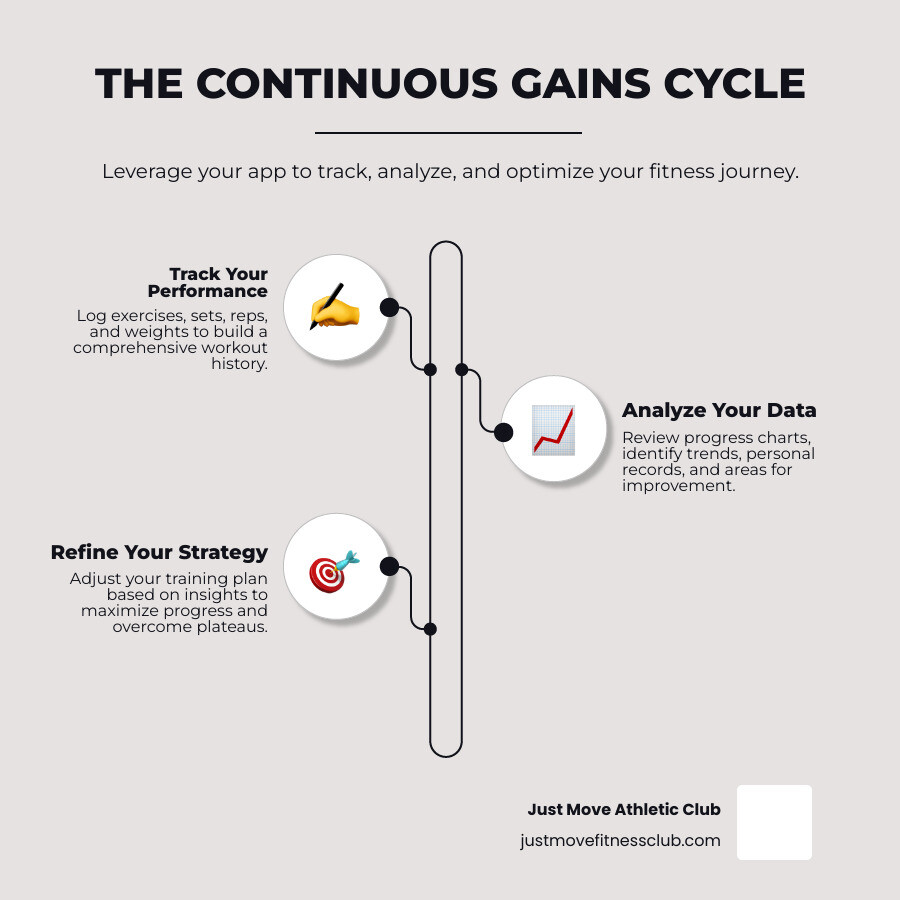
Choosing an app to track gym progress is like picking a workout partner: you need reliability and support. The best apps quickly capture workouts, provide clear insights, and adapt to your training style, all while being simple to use. They give you the tools to build a balanced workout routine based on real data.
Core Logging Capabilities
The foundation of any strength app is tracking sets, reps, and weight. Apps like Strong and Hevy offer intuitive interfaces for quick logging between sets.
A customizable rest timer keeps your workout on track. Most top apps, including Strong and Hevy, have this built-in to help you maintain intensity.
An exercise library with video demonstrations is invaluable for learning proper form. Lyfta stands out with over 5,000 HD video guides, while Hevy provides detailed demonstrations for major lifts like the squat and deadlift.
Custom exercise creation, available in Hevy and Strong, ensures you can track every unique movement in your routine.
Advanced lifters can use set tagging features to distinguish between warm-up, working, drop, or failure sets. Strong and Hevy offer this granular tracking, while Lyfta supports specialty sets like AMRAP and supersets for detailed analysis.
Powerful Analytics and Metrics
This is where an app to track gym progress becomes a personal analyst, turning logged workouts into actionable insights.
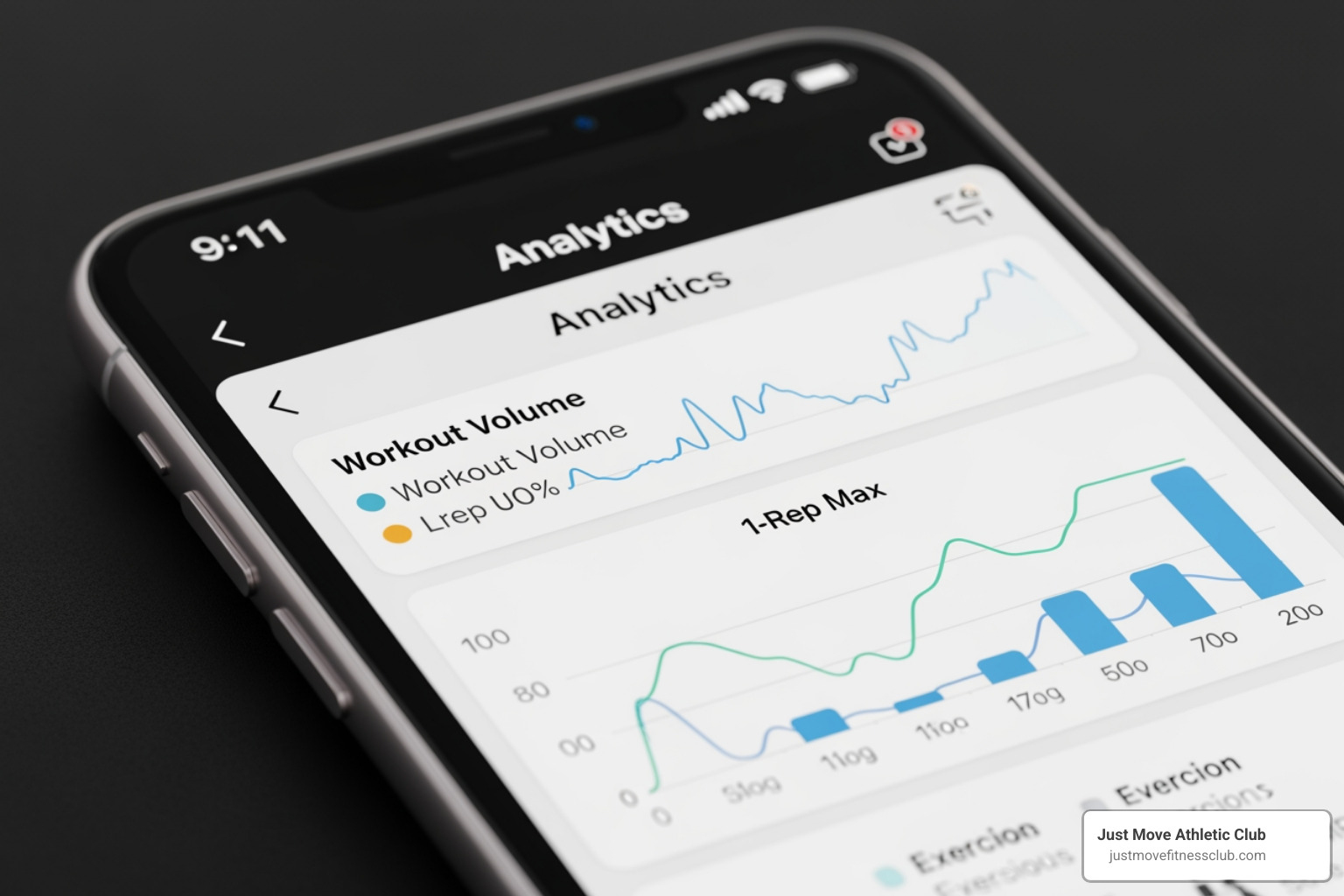
Progress graphs visualize your improvement. Hevy and Strong provide detailed charts for volume and 1RM progression, which is highly motivating.
Volume tracking (sets x reps x weight) is a crucial metric for ensuring you’re applying progressive overload consistently.
Apps celebrate personal records (PRs) to keep you motivated. Hevy awards badges for PRs, and Strong prominently highlights your best sets.
One-rep max (1RM) calculations in apps like Strong and Hevy use proven formulas to estimate your maximum strength, helping you program smarter strength cycles without attempting a risky max lift.
Body measurement tracking provides a more complete picture of your progress. While some apps offer this, you can take it a step further with a Fit3D Pro Body Scanner, which provides incredibly precise body composition data.
Progress photos offer undeniable visual proof of your change, a key feature in apps like Gains.
Customization and Planning
Your app should be flexible enough to match your unique training approach.
A solid routine builder is non-negotiable. Strong and Hevy have advanced planners, while Intensity allows you to build and share complex, multi-week programs.
Pre-built workout plans save you time. Intensity offers over 250 strength-based programs, including popular systems like 5/3/1, and Lyfta also provides pre-made plans to get you started.
The best apps empower you to follow custom training programs. Strong’s PRO version offers unlimited custom routines, and Hevy lets you save and adapt routines from friends.
Workout scheduling features in apps like Legend help turn intentions into concrete plans, keeping you accountable.
Note-taking capability in apps like Strong and Hevy lets you add context to sets or workouts, which is valuable when reviewing past performance.
Choosing the Right App to Track Gym Progress for Your Goals
The best app to track gym progress isn’t about five-star reviews; it’s about finding the one that fits your life, goals, and training style. As Zapier notes, “The best fitness app is the one that works for you.”
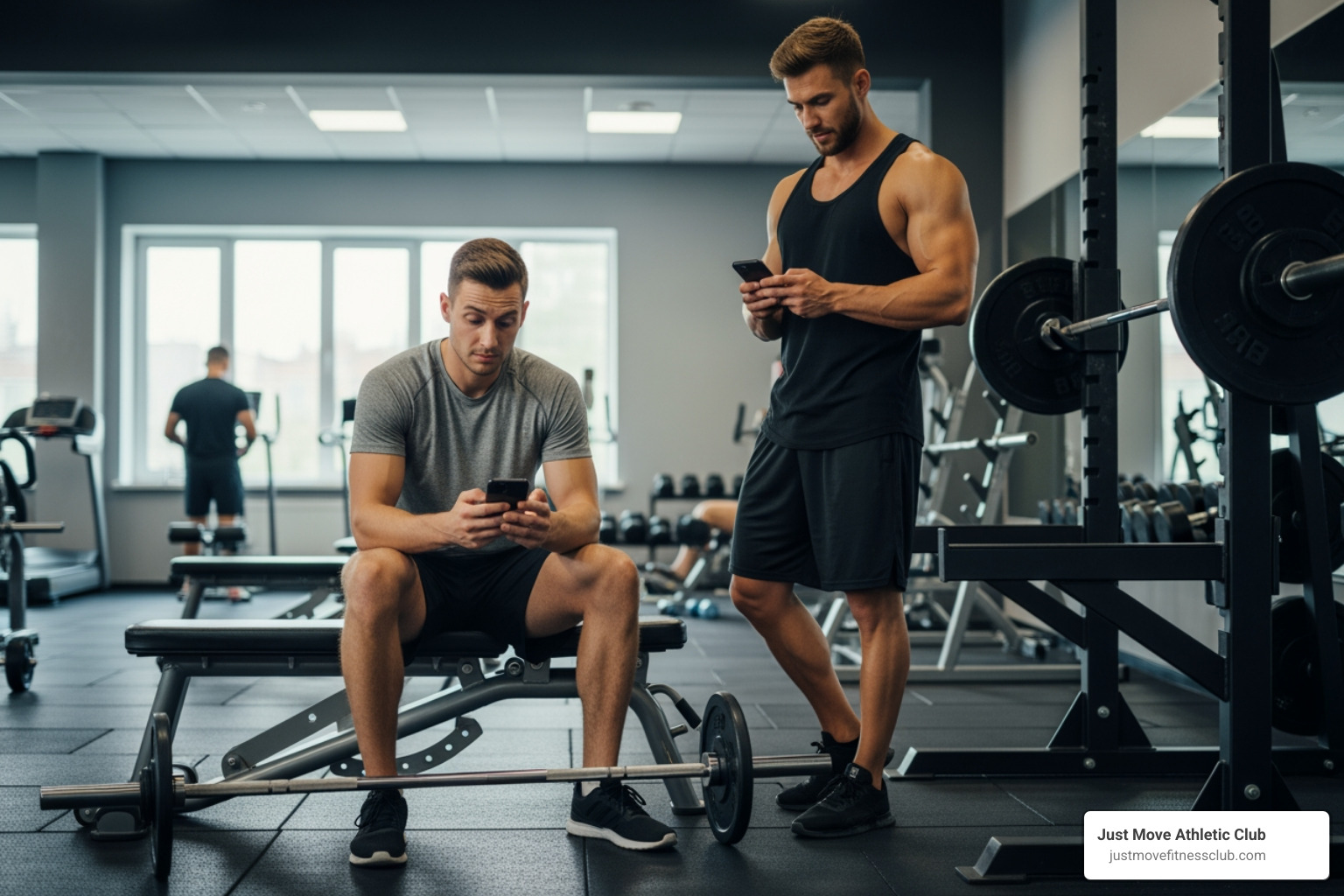
Whether you’re a beginner or an advanced lifter, there’s an app designed for you. Success starts with fitness goal setting, and the right digital tool smooths the journey.
For the Beginner: Simplicity and Guidance
If you’re new to the gym, you need simplicity, not an app that feels like a science project.
- Simple Interface: A clean design is key. Strong is praised for its intuitive layout that just works, even when you’re tired.
- Guided Workouts: Apps like Gymverse offer pre-designed workouts with video tutorials, acting like a personal trainer in your pocket.
- Large Exercise Library: This is non-negotiable for learning form. Lyfta’s library of over 5,000 HD videos helps you build confidence and execute movements safely.
- Motivational Features: Workout streaks and achievement badges keep you coming back. Apps like Fitbit and Legend use this gamification to help build consistency.
Your app should be a supportive companion, not a source of confusion.
For the Advanced Lifter: Data-Rich and Flexible
If you’re focused on volume periodization and 1RM calculations, you need a data-rich tool—a training laboratory.
- Advanced Analytics: You need detailed graphs on volume, 1RM trends, and muscle recovery. Strong PRO and Legend provide deep performance breakdowns.
- RPE and RIR Logging: For autoregulation, tracking Rate of Perceived Exertion (RPE) and Reps In Reserve (RIR) is gold. Intensity supports both, allowing you to increase strength in the gym by training based on feel, not just a fixed program.
- Detailed Progression Tracking: Legend excels here by showing your historic performance and suggesting how to progress, removing the guesswork.
- Helpful Tools: A plate calculator, included in Strong, saves time and mental math during heavy lifts.
- Complex Program Support: Apps must handle protocols like 5/3/1 or Smolov. Intensity offers over 250 pre-built programs and lets you create your own intricate plans.
- Data Export: The ability to export your data as a CSV file, a feature in Strong, gives you ultimate control for analysis.
For the All-Rounder: A Holistic Fitness Approach
If your routine includes more than just lifting, you need an app with a holistic fitness approach.
- Cardio Tracking: Many strength apps, like Hevy, also track cardio. For more dedicated tracking, Runkeeper and Strava are excellent for running and cycling.
- Health Metric Integration: The real power comes from seeing how metrics like sleep and nutrition affect performance. When you understand how poor sleep impacts your squat, you can make smarter lifestyle choices.
- Comprehensive Logging: Apps like Gains let you log calories and macros, syncing with Apple Health for a full health overview. Tracky Gym even lets you correlate training with factors like sleep quality and supplements.
This comprehensive view helps you understand your body as a complete system. This philosophy is key, pairing training with tools like a Fit3D Pro Body Scanner and emphasizing how nutrition plays a crucial role in your workout routine.
Beyond Logging: Advanced Features That Boost Your Results
An app to track gym progress is more than a digital notepad; it’s a tool that can connect us, motivate us, and integrate with our digital lives. These advanced features transform the fitness experience, helping us measure our fitness in new ways.

The Power of Wearable Integration
Wearable integration lets you track workouts from your wrist, keeping your phone safely tucked away. It’s a feature that, once you try, is hard to live without.
Leading apps to track gym progress like Hevy, Strong, and Lyfta offer dedicated apps for Apple Watch and Wear OS. This phone-free tracking is a game-changer, allowing you to log sets, reps, and weights with a few taps. It minimizes distractions and helps you stay in the zone.
Many smartwatches also provide real-time heart rate monitoring, giving you valuable data on workout intensity. Hevy’s Wear OS integration, for example, tracks your heart rate to help you gauge how hard you’re pushing. Everything syncs seamlessly, ensuring your data is always consolidated and up-to-date.
Community and Social Motivation
Friendly competition and encouragement are powerful motivators. The social features in many apps provide just the boost we need on tough days, extending the power of group fitness into the digital field.
Sharing workouts and following friends on apps like Hevy and Lyfta turns solo training into a shared journey. It provides inspiration and accountability—knowing a friend might see you skipped leg day is surprisingly effective.
For a competitive edge, leaderboards and community challenges are fantastic. Lyfta offers monthly strength challenges, while Legend lets you share progress directly with friends and coaches, creating a built-in support system.
Free vs. Paid: Is a Subscription Worth It?
Most top apps to track gym progress have a free version and a paid “PRO” subscription. Do you need to pay?
Free versions are great for getting started but usually have limitations, like a cap on the number of custom routines (Strong) or saved workouts (Hevy).
Premium features open up the app’s full potential, offering unlimited routines, more advanced analytics, and an ad-free experience. Some apps, like PUSH, reserve their personalized, science-backed training programs for premium members.
Subscription models vary. Strong PRO starts at $4.99/month, Hevy at $2.99/month, and Gains Unlimited at $1.99/month, with yearly and lifetime options available for most.
So, is it worth the money? If you’re serious about data-driven programming and love deep analytics, a subscription is a small investment that pays for itself in motivation and results. For casual tracking, a free version is often sufficient. Our advice: start free, and upgrade only if you feel the premium features will genuinely improve your training.
Frequently Asked Questions about Gym Progress Apps
Here are some of the most common questions about using technology to support fitness goals.
How does an app to track gym progress help with motivation?
An app to track gym progress becomes a personal cheerleader, keeping you going when motivation dips.
- Visual Progress: Seeing your strength gains on a graph provides tangible proof that your hard work is paying off.
- Hitting PRs: The thrill of setting and hitting personal records is addictive. Apps celebrate these milestones with you, giving you a concrete goal to chase.
- Workout Streaks: This simple feature creates a positive feedback loop that encourages consistency. No one wants to break a 30-day streak.
- Community Support: Sharing workouts with friends adds a layer of accountability. It taps into the same energy that makes group fitness so powerful and helps you stay accountable to your fitness goals.
Can I use an app to track gym progress for bodyweight exercises?
Absolutely. Most apps to track gym progress work perfectly for bodyweight exercises and calisthenics.
You can log reps and sets for exercises like push-ups and pull-ups just as you would for weighted movements. For duration-based exercises like planks or wall sits, you can track time, watching it increase as you get stronger.
If an exercise isn’t in the app’s library, the custom exercise creation feature lets you add it. This is perfect for those following a beginner bodyweight program or working on advanced skills. The app adapts to your training style, whether you’re in a gym or your living room.
How secure is my workout data in these apps?
Reputable apps to track gym progress take data security seriously. Your information is generally safe.
- Cloud Syncing: This is a standard feature that backs up your workout history online. If you get a new phone, your data is safe.
- Privacy Policy: Always review an app’s privacy policy to understand how your data is collected, used, and shared.
- Data Export: Many apps allow you to export your data (often as a CSV file), giving you ownership and control of your workout history.
- Privacy Controls: You can typically set your profile to public or private, controlling who sees your progress.
Data from tools like a Fit3D Pro Body Scanner should be handled with high standards of privacy, ensuring your personal fitness information stays personal.
Take Your Tracking to the Next Level
Finding the perfect app to track gym progress isn’t about a single “best” option, but about finding the one that clicks with your training style, supports your goals, and feels natural to use.
We’ve seen how these apps can motivate with visual progress graphs, help you hit new PRs, and connect you with a community. The right features—whether for a beginner or an advanced lifter—are key to staying consistent and seeing results.
But experience in the fitness industry shows that digital tracking is most powerful when combined with expert guidance. An app can show you a plateau, but a knowledgeable trainer can correct your form. An app can track your weight, but a tool like the Fit3D Pro Body Scanner reveals precise changes in muscle and fat that a scale can’t.
The most successful people are often those who combine app data with personalized coaching. A professional can help interpret that data to build effective programs that deliver real, visible progress. It’s the best of both worlds: digital convenience and expert accountability.
So, download an app and start logging your workouts. But remember, you don’t have to figure it all out alone. When you’re ready to turn that data into results you can see and feel, we’re here to help.
Discover a smarter way to train, where technology meets expertise, and your fitness goals become reality.