
Why Beginner Circuit Training is Your Gateway to Total-Body Fitness
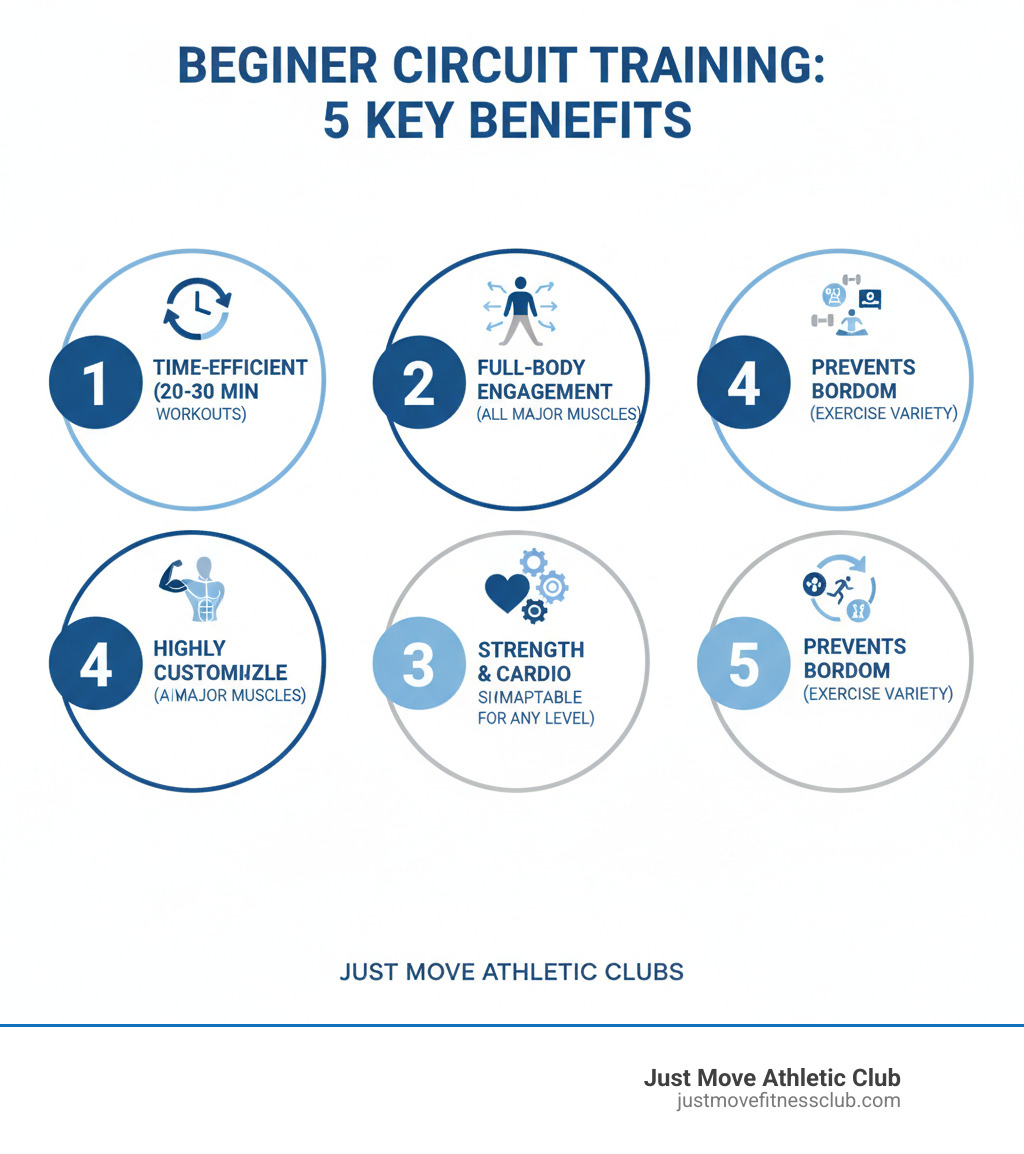
Beginner circuit training is a workout method where you move through a series of 5-10 exercises (called stations) with minimal rest in between, targeting different muscle groups to build strength, boost cardiovascular health, and burn calories—all in 20-30 minutes or less.
Quick Answer for Beginners:
- What it is: A sequence of exercises performed back-to-back with short rest periods
- Time needed: 15-30 minutes per session
- Frequency: 2-3 times per week
- Equipment: Can be done with bodyweight alone or with gym equipment
- Benefits: Builds muscle, improves heart health, burns calories efficiently, prevents workout boredom
If you’ve ever felt overwhelmed by complicated routines, circuit training is the solution. This workout style combines strength and cardio in one efficient package. You’ll move from exercise to exercise with minimal rest, keeping your heart rate up while working every major muscle group—no complicated routines or expensive equipment required.
Research backs this up. Studies show that circuit training improves strength, boosts VO2 max (your body’s ability to use oxygen), and positively impacts body composition. A 15-minute circuit can deliver the same benefits as much longer, traditional workouts.
The beauty of circuit training is its flexibility. You can do it at home with zero equipment or at a gym, adjusting it for weight loss, muscle building, or overall fitness. Because you’re constantly switching exercises, you won’t get bored.
As Pleasant Lewis, founder of Just Move Athletic Clubs, I’ve seen beginners transform their lives through circuit training. We’ve built Just Move to be a welcoming space where anyone can find effective, time-efficient workouts that fit into real life.
What is Circuit Training and Why is it Perfect for Beginners?
Beginner circuit training is a workout format where you move through a series of exercises—often called “stations”—one after another with minimal rest in between. A typical circuit includes 8-10 different exercises. You’ll perform each for 30-45 seconds, take a brief rest, and repeat. This variety keeps your mind engaged and your body working.
For beginners, circuit training is a welcoming entry point. The structure provides a clear roadmap, and the variety prevents the monotony that can derail new routines. The quick pace keeps you focused and motivated.
The efficiency is hard to beat—you can complete an effective session in 20 minutes or less. Research shows circuit training delivers strength gains, while meta-analysis data confirms improvements in VO2 max (your body’s ability to use oxygen). You’ll build muscle, burn calories, and boost your metabolism to support fat loss.
How Circuit Training Differs from HIIT
While both circuit training and High-Intensity Interval Training (HIIT) involve intense exercise, they have distinct differences.
Think of it this way: circuit training focuses on what you’re doing (the variety of exercises), while HIIT emphasizes how you’re doing it (the intensity level).
| Feature | Circuit Training | HIIT |
|---|---|---|
| Primary Focus | Variety of exercises targeting different muscle groups | Intensity levels and heart rate spikes |
| Structure | Series of stations with different exercises | Alternating high-intensity bursts with rest periods |
| Intensity | Moderate to high, sustained throughout | Very high during work intervals, lower during rest |
| Best For | Full-body fitness, building strength and endurance simultaneously | Maximum calorie burn, cardiovascular conditioning |
As exercise science professor Shawn Arent explains, circuit training is great at building both strength and cardiovascular health simultaneously, creating a solid foundation across all fitness areas.
Another key advantage is active recovery. As Darci Revier of the National Exercise Trainers Association (NETA) highlights, “Instead of rest breaks, you just work a different part of the body.” This keeps your metabolism liftd while allowing specific muscles to recover.
Circuit training also connects with functional training principles, building movement patterns that translate directly to everyday activities like lifting groceries or playing with kids.
Designing Your First Workout: The Essentials of Beginner Circuit Training
Now let’s put together your first circuit training workout. This is about making simple choices to build consistency and confidence.

A well-designed beginner circuit training workout should feel approachable. The goal is to select exercises you can do with good form, manage your work and rest periods effectively, and create a sustainable routine you enjoy. Think of it as building a foundation of good habits and learning proper movements. For more guidance, check out our guide on How to Build a Balanced Workout Routine.
Key Components of a Beginner Circuit Training Workout
Simplicity and safety are your best friends. Here’s what makes a great beginner circuit.
- Start with a proper warm-up. A 5-10 minute warm-up with light cardio and dynamic stretches (like leg swings) prepares your muscles and reduces injury risk.
- Choose 5-8 exercises total. Starting with fewer exercises lets you focus on mastering form without feeling overwhelmed.
- Balance your exercise selection. Include upper body (push-ups), lower body (squats), core (planks), and cardio (jumping jacks) movements to work your whole body.
- Work for 30-45 seconds per exercise. This allows enough time to feel the exercise working while maintaining good form. Move with control, not speed.
- Rest for 30-45 seconds between exercises. This brief break is enough to catch your breath while keeping your heart rate liftd for cardiovascular benefits.
- Complete 2-3 rounds of your circuit. Repeat the entire sequence, adjusting the number of rounds based on your stamina.
- Finish with a proper cool-down. Dedicate 5 minutes to gentle stretches to help your heart rate return to normal and improve flexibility.
How to Adapt Your Circuit for Different Goals
One of the best aspects of circuit training is its flexibility. You can easily tweak your routine to align with your goals.
- For weight loss: Emphasize cardio-focused movements like jumping jacks, burpees, or mountain climbers to lift your heart rate and burn more calories.
- For strength building: Introduce resistance with dumbbells, resistance bands, or gym machines. Machines are especially helpful for beginners as they guide your movements and help you maintain proper form. At Just Move Athletic Club, our trainers can show you how to use equipment safely. For more personalized guidance, explore our Custom Training Programs.
- As you get fitter: You can increase the number of rounds, decrease rest time, extend work periods, add heavier weights, or slow down your movements to increase time under tension and build more strength.
Beginner-Friendly Exercises for Your Circuit
Choosing the right exercises is where beginner circuit training comes to life. We’re looking for movements that are effective, safe, and simple to learn.
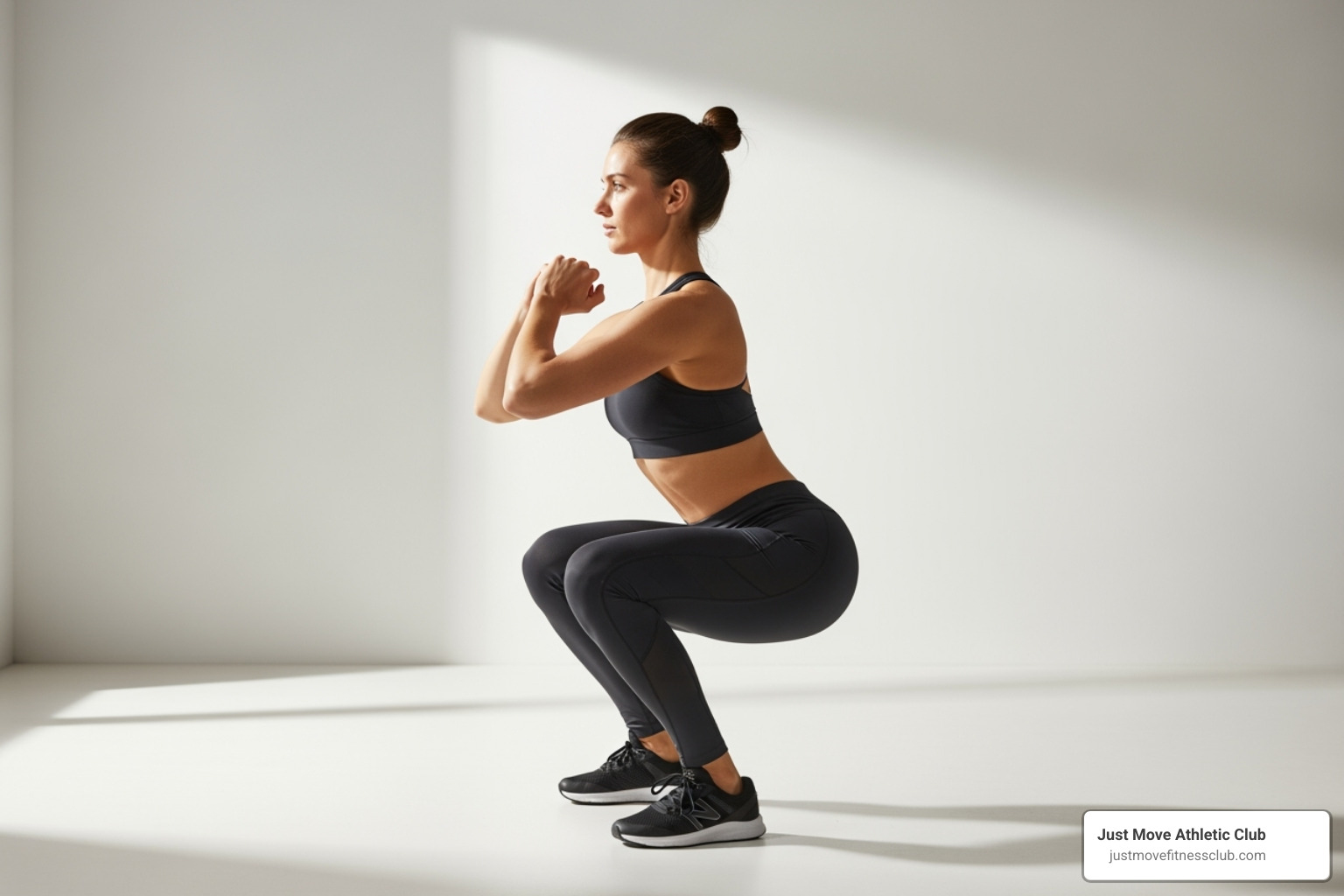
Compound exercises are your best friend. They work multiple muscle groups at once (like squats or push-ups), giving you the most benefit in the least amount of time.
Proper form always beats speed or reps. Good form prevents injury and ensures you’re working the right muscles. If you’re new to the gym, our guide on how to get started with confidence can help. Gym machines are also great for beginners as they guide your movement, making it easier to maintain form.
At-Home Exercises (No Equipment Needed)
Bodyweight exercises can be done anywhere, anytime. Just you and gravity.
- Bodyweight squats: Stand with feet shoulder-width apart. Push your hips back and lower as if sitting in a chair, keeping your chest up. Push through your heels to stand back up.
- Push-ups: Start in a plank position (on knees for a modification). Lower your chest toward the floor, keeping elbows at a 45-degree angle to your body. Push back up.
- Lunges: Step one foot forward, lowering your hips until both knees are at 90-degree angles. Your front knee should be over your ankle. Push off the front heel to return to standing and alternate legs.
- Planks: Prop yourself up on your forearms and toes (or knees). Your body should form a straight line from head to heels. Brace your core and squeeze your glutes.
- Glute bridges: Lie on your back with knees bent. Press through your heels and squeeze your glutes to lift your hips, creating a straight line from shoulders to knees. Lower with control.
- Jumping jacks: Start with feet together. Jump your feet wide while bringing your arms overhead. Jump back to the start. For a low-impact version, step one foot out at a time.
- Mountain climbers: From a high plank position, alternate driving your knees toward your chest. Keep your hips stable and core tight.
Gym-Based Exercises (Using Equipment)
When you’re ready to add resistance, gym equipment can help you build strength safely.
- Dumbbell rows: With one hand and knee on a bench, hold a dumbbell in your free hand. Keep your back flat. Pull the weight toward your hip, squeezing your shoulder blade, then lower with control.
- Dumbbell shoulder press: Sit or stand holding dumbbells at shoulder height, palms forward. Press the weights overhead, then lower with control.
- Leg press machine: Sit with feet on the platform. Push the platform away by extending your legs, stopping just before your knees lock. Slowly return to the start.
- Lat pulldown machine: Grab the bar with a wide, overhand grip. Pull the bar down to your upper chest, squeezing your shoulder blades. Control the bar as it returns to the top.
- Kettlebell swings: Hinge at your hips to grab the kettlebell. Drive through your hips and glutes to swing it to chest height. The power comes from your hips, not your arms.
For more ways to build a strong core, check out The Truth About Core Workouts: It’s Not Just Crunches.
Sample Beginner Circuit Training Workouts to Try Today
Ready to put it all together? Here are a few sample beginner circuit training workouts. Remember to warm up for 5 minutes before you start and cool down for 5 minutes when you’re done. Listen to your body and adjust as needed!

We’ve designed these circuits for different situations, whether you’re at home with no equipment or at the gym with a tight schedule.
The 15-Minute At-Home Bodyweight Circuit
This no-equipment circuit is perfect for when you’re short on time. Complete the following exercises back-to-back.
- Jumping Jacks: 45 seconds
- Bodyweight Squats: 45 seconds
- Push-ups (on knees if needed): 45 seconds
- Plank: 45 seconds
- Glute Bridges: 45 seconds
Rest for 1 minute after completing all exercises. Repeat the entire circuit for a total of 2-3 rounds.
The 20-Minute Full-Body Gym Circuit
This circuit uses gym equipment to add resistance and build strength. Complete the following exercises back-to-back.
- Leg Press Machine: 45 seconds
- Dumbbell Rows: 45 seconds
- Dumbbell Shoulder Press: 45 seconds
- Mountain Climbers: 45 seconds
- Dumbbell Lunges (alternating legs): 45 seconds
Rest for 1 minute. Repeat for a total of 3-4 rounds.
The Ultimate At-Home Beginner Circuit Training Workout
This routine uses shorter 30-second intervals to keep the pace fast and engaging.
- High Knees: 30 seconds
- Bodyweight Squats: 30 seconds
- Push-ups: 30 seconds
- Alternating Lunges: 30 seconds
- Plank: 30 seconds
- Jumping Jacks: 30 seconds
Rest for 1 minute. Repeat for a total of 4 rounds.
Safety, Frequency, and Maximizing Your Results
Starting beginner circuit training is exciting, but long-term success requires a smart approach. Avoid the common mistake of going too hard, too fast, as your body needs time to adapt.
Listening to your body is essential. Stop if you feel sharp pain, and don’t confuse it with the normal burn of a challenging workout. Pushing through pain leads to injury, not toughness. Our guide on How to Avoid Common Workout Mistakes That Could Lead to Injury can help you sidestep these pitfalls.
Consistency beats intensity every time. Three moderate workouts per week will transform your fitness far more than one brutal session that leaves you too sore to move. Proper hydration and nutrition are also key. For a deep dive, check out Fuel Your Fitness: The Role of Nutrition in Your Workout Routine.
How Often Should You Do Circuit Training?
For beginners, aim for two to three circuit training sessions per week, each lasting 20-30 minutes. This frequency allows for adequate recovery, which is when your muscles repair and grow stronger.
Circuit training efficiently meets the CDC recommendations for both moderate-intensity activity and muscle-strengthening. Use your rest days for light activities like walking or stretching.
Tips for Success
- Starting slow is starting smart. Begin with bodyweight exercises, fewer rounds, and more rest. Gradually increase the intensity as your fitness improves.
- Form always comes before speed or weight. Poor form increases injury risk and reduces effectiveness. If you’re unsure, ask a trainer for help. Gym machines are also great for guiding your movement.
- Tracking your progress is highly motivating. Note your reps, weights, or workout duration. At Just Move Athletic Club, our Fit3D Pro Body Scanner provides a comprehensive view of your body composition changes, showing you tangible results.
- Finding a workout buddy or joining group fitness classes adds accountability and fun. The community atmosphere at Just Move makes exercising enjoyable. Learn more about The Power of Group Fitness: How Community Helps You Crush Your Goals.
- Staying consistent is the most important factor. A regular 15-minute circuit is better than a sporadic hour-long session. Build the habit first.
Conclusion
You’ve made it! Now you understand why beginner circuit training is such a game-changer for anyone looking to build a healthier, stronger version of themselves. It’s efficient, effective, and honestly? It’s fun. You’re not spending hours at the gym doing endless reps on one machine—you’re moving, challenging different muscles, keeping your heart rate up, and actually enjoying the process.
The beauty of circuit training is how it packs so much into such a short time. You’re building strength, improving your cardiovascular health, and boosting your metabolism all in one session. You’re also building a foundation that will serve you for years to come, whether your goal is weight loss, getting stronger, or simply feeling better in your daily life.
We’ve walked through everything you need to know—from understanding what circuit training is and why it works so well for beginners, to designing your first workout and choosing the right exercises. We’ve given you three ready-to-go sample workouts you can start today, whether you’re at home or at the gym. And we’ve covered the safety essentials and tips for success to keep you moving forward confidently.
The best part? You don’t have to figure this out alone. At Just Move Athletic Club in Lakeland and Winter Haven, Florida, we’ve created a space where everyone—from complete beginners to seasoned athletes—feels welcome and supported. Our expert trainers are here to guide you through proper form, help you customize workouts to match your goals, and cheer you on every step of the way. Plus, with our state-of-the-art Fit3D Pro Body Scanner, you can actually see and measure your progress, which makes staying motivated so much easier.
Ready to experience what beginner circuit training can do for you? Explore our group fitness classes to find the perfect fit, or start your fitness journey with us today! We’re here to help you move, grow, and find just how strong you really are.