
Beyond the Bathroom Scale
A body composition scan measures the different components of your body—including muscle mass, body fat, bone density, and water content—providing detailed insights that go far beyond what a traditional scale can tell you.
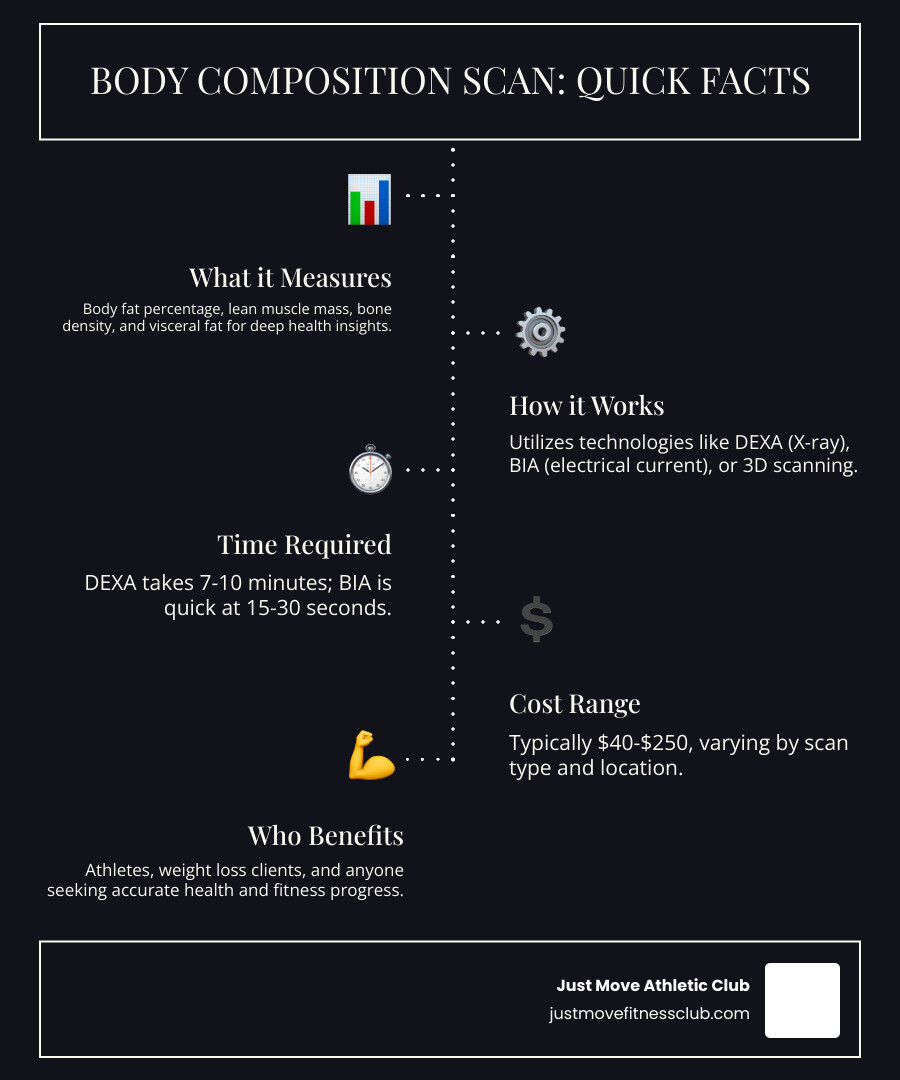
Quick Answer:
- What it measures: Body fat percentage, lean muscle mass, bone density, and visceral fat
- How it works: Uses technologies like DEXA (X-ray), BIA (electrical current), or 3D scanning
- Time required: 7-10 minutes for DEXA, 15-30 seconds for BIA
- Cost range: $40-$250 depending on scan type and location
- Who benefits: Athletes, weight loss clients, health-conscious individuals, and anyone wanting accurate progress tracking
The number on your bathroom scale is largely useless for understanding your actual health. Two people can weigh the same but have vastly different body fat percentages. That’s because muscle is denser than fat.
A regular scale only gives you your total weight. Your body, however, is made up of different tissues: muscle, fat, bone, and water. Each plays a unique role in your health, metabolism, and appearance.
A body composition scan breaks down these components with scientific precision. Instead of guessing if your workout plan is building muscle or just shedding water weight, you get actual data. You can learn whether your belly fat is just under the skin or wrapped around your organs, which is far more dangerous.
I’m Pleasant Lewis, and in my four decades of gym operations, I’ve seen how body composition scan data transforms a person’s health journey. Our members use these detailed insights to make smarter decisions about their training and nutrition, moving beyond arbitrary numbers on a scale.
What a Body Composition Scan Actually Measures
Think of a body composition scan as a detailed blueprint of your body. While a scale gives you one number, these scans break down what makes up that number, providing a complete picture of your health.
Key measurements include:
- Body Fat Percentage: The ratio of fat to your total body weight, which is a better fitness indicator than BMI.
- Lean Muscle Mass: All non-fat tissues, including muscle, organs, and water. This is crucial for metabolism and strength.
- Bone Density: An indicator of skeletal strength, which is vital for preventing fractures and osteoporosis as we age.
- Body Water Levels: Proper hydration affects energy levels and the accuracy of other measurements.
- Visceral Adipose Tissue (VAT): The dangerous fat wrapped around your internal organs.
- Subcutaneous Fat: The fat just under your skin that you can pinch.
This data is essential because BMI can be misleading, classifying a muscular bodybuilder as obese or someone with low muscle mass as “healthy.” A body composition scan provides precise, individualized data about your unique body and health risks.
Why Muscle Mass Matters More Than You Think
At Just Move Athletic Club, we emphasize building muscle over obsessing about the scale. Muscle is your body’s engine for burning calories. The more muscle you have, the higher your resting metabolic rate, meaning you burn more calories even at rest.
Strong muscles also improve daily strength and athletic performance. Scientific research on athletic performance shows that resistance training builds stronger bones, as muscle contractions stimulate bone to become denser.
Additionally, muscle helps your body manage sugar, improving insulin sensitivity and reducing the risk of type 2 diabetes. As we age, we naturally lose muscle (sarcopenia), but maintaining it helps you stay independent and feel better. Our fitness experiences focus on building functional strength for daily life.
Understanding Your Body Fat: The Good, The Bad, and The Risky
Not all body fat is bad; essential fat is necessary for hormone production and vitamin absorption. The problem arises from excess fat, especially visceral fat (VAT). Unlike subcutaneous fat, VAT wraps around your internal organs.
VAT is metabolically active and releases inflammatory compounds that can raise cholesterol, increase blood pressure, and impair insulin sensitivity. High VAT significantly increases your risk of cardiovascular disease and type 2 diabetes risk. A body composition scan measures your VAT levels precisely.
The scan also reveals your fat distribution pattern. Android distribution (apple-shaped) means fat is stored around your midsection, which carries higher health risks than gynoid distribution (pear-shaped), where fat is stored on the hips and thighs.
Understanding these details helps us at Just Move Athletic Club create a targeted plan to improve your health, not just your appearance.
How Different Types of Body Composition Scans Work
Several technologies are available for a body composition scan, each with unique strengths. Some use X-rays for precision, others use electrical currents for speed, and some create a 3D model for a visual experience.
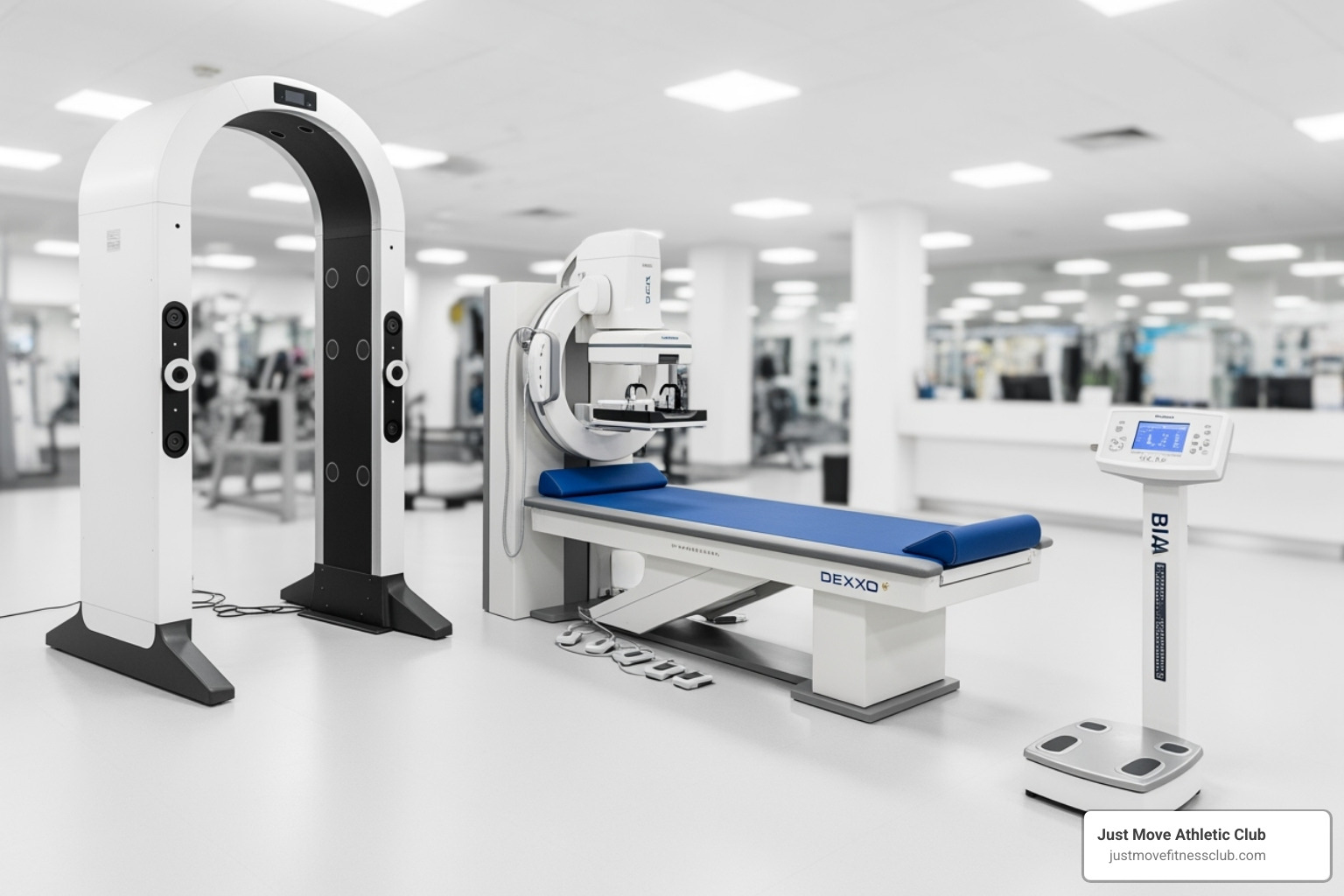
Understanding the differences in technology, accuracy, and user experience can help you choose the best option for your goals.
Dual-Energy X-ray Absorptiometry (DEXA)
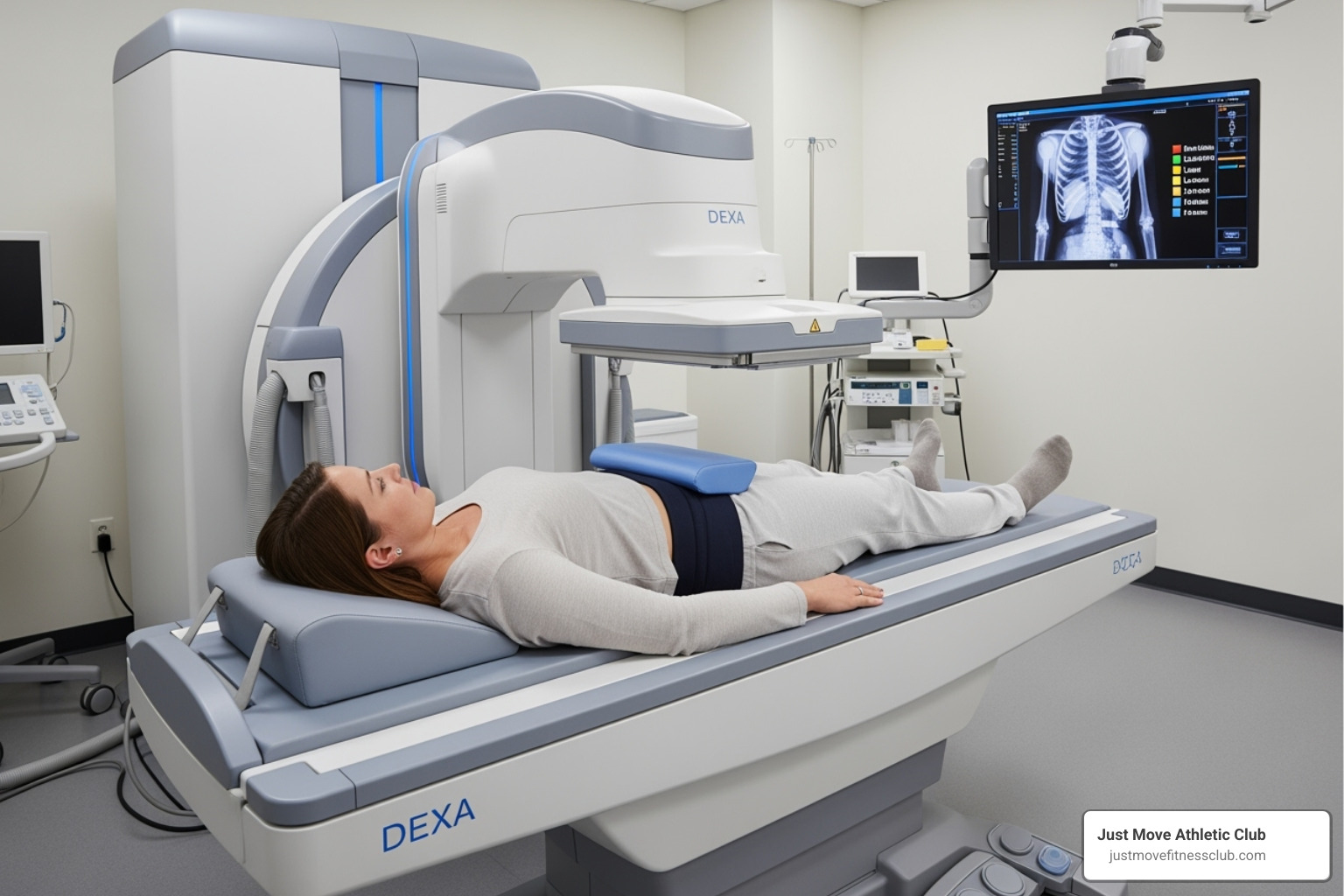
DEXA is considered the gold standard in body composition analysis due to its high precision, with an error rate of less than 1.5%. During a DEXA scan, you lie on a table as two low-dose X-ray beams pass through your body. The machine distinguishes between bone, muscle, and fat based on how these tissues absorb the X-rays.
DEXA uses a three-component model to measure bone mineral content, fat mass, and lean mass separately. Advanced machines can also detect visceral fat and muscle imbalances. The process takes about 7-10 minutes, and the radiation dose is minimal—less than what you’d get on a short flight.
Bioelectrical Impedance Analysis (BIA)
BIA is the fastest method for a body composition scan. The technology sends a small, safe electrical current through your body. Since muscle contains more water than fat and conducts electricity better, the device measures your body’s resistance to the current. From this, it estimates your body water, lean mass, and fat mass.
Advanced BIA devices deliver results in just 15-30 seconds. The main trade-off is that results can be affected by your hydration levels. However, modern BIA technology has improved significantly, with some devices providing results that correlate well with DEXA scans.
3D Body Scanners
At Just Move Athletic Club, we use the Fit3D Pro Body Scanner, which offers a unique and motivating experience. The scanner uses infrared light to create a comprehensive 3D model of your body in seconds, taking hundreds of measurements of your waist, hips, arms, and legs.
Instead of just seeing numbers, you can visually track how your body shape changes over time, which is incredibly motivating. The scanner also provides insights into your posture, highlighting imbalances that could affect your performance. The experience is quick, non-invasive, and provides immediate feedback, combining detailed measurements with visual progress tracking.
Getting Your First Body Composition Scan: Preparation, Process, and Cost
Getting your first body composition scan is a smart move for your health journey. The insights you gain are worth it, as understanding your true body composition makes your workouts, nutrition, and goals much clearer. At Just Move Athletic Club, we often hear, “I wish I’d done this sooner!”

How to Prepare for Your Body Composition Scan
To get the most accurate results, a little preparation helps. Follow these simple guidelines:
- Hydration: Be normally hydrated. Avoid chugging a large amount of water right before your appointment.
- Fasting: Do not eat for at least three hours before your scan to minimize digestive activity.
- Exercise: Avoid strenuous exercise for 12-24 hours beforehand, as heavy sweating can alter fluid distribution.
- Clothing: Wear lightweight clothing with minimal metal. You may be asked to change into a gown.
- Metal: Remove all metal and jewelry, including watches, rings, and body piercings if possible.
- Medical Conditions: Inform the technologist if you are pregnant or have any medical implants like pacemakers or prosthetics.
What Happens During the Scan?
The process is straightforward. First, we’ll take basic measurements like your height and weight. You may need to change into a gown and remove any metal objects.
For a DEXA scan, you’ll lie still on a padded bed for 7-10 minutes while a scanner arm passes over you. For our Fit3D scanner, you’ll stand on a rotating platform for a few seconds. BIA scans involve standing on a platform and holding electrodes for 15-30 seconds. All methods are painless, and you won’t feel the scan itself.
The total appointment time is usually 30-45 minutes, which includes time for us to explain your results and answer your questions.
Cost, Insurance, and Accessibility
The cost for a body composition scan typically ranges from $40 to $250, depending on the technology and location. DEXA scans might cost $60 to $150, while BIA and 3D scans vary within that range.
Most health insurance plans do not cover these scans for general fitness purposes, but many providers, including us, accept FSA and HSA funds. It’s always a good idea to check with your provider about your options.
Some facilities require a doctor’s referral for DEXA scans, but our Fit3D Pro Body Scanner at Just Move Athletic Club is non-invasive and requires no referral. We serve members across Lakeland and Winter Haven, Florida, and offer package deals or include scans in our memberships to make regular monitoring more affordable. Buying scans in bundles is often cheaper, which is ideal for tracking progress over time.
Making Sense of Your Results: A Guide to Interpretation
Once your body composition scan is complete, we’ll provide a detailed report and walk you through what the numbers mean. This is where data transforms into actionable insights for your fitness journey.
Key Metrics and What They Mean for You
Your report will include several key metrics that tell a story about your health:
- Total Body Fat %: The percentage of your total weight that is fat. Healthy ranges are typically 18-30% for women and 10-25% for men, but this depends on your age and goals.
- Fat Mass Index (FMI): Similar to BMI but focuses only on fat mass relative to your height. Optimal ranges are generally 5-9 for women and 3-6 for men.
- Visceral Adipose Tissue (VAT): The dangerous fat around your organs. A lower number is better, as high levels are linked to significant health risks.
- Skeletal Muscle Mass (SMM): The total weight of your skeletal muscles, which drives your metabolism. Low SMM may indicate age-related muscle loss (sarcopenia), which is reversible with training.
- Resting Metabolic Rate (RMR): An estimate of the calories your body burns at rest. More muscle leads to a higher RMR.
- Bone Density (T-score/Z-score): For DEXA scans, these scores compare your bone density to that of a healthy young adult (T-score) and your peers (Z-score), indicating your risk for osteoporosis.
Reports may also include segmental analysis (fat/muscle in each limb) and your Android to Gynoid ratio (waist-to-hip fat).
Using Your Scan Data to Set Smarter Goals
A body composition scan provides a detailed roadmap, allowing you to move beyond vague goals like “lose weight.” With this data, we can set precise targets, such as increasing lean muscle mass by 5 pounds or reducing visceral fat by 10%.
This baseline measurement removes the guesswork. When you get a follow-up scan in a few months, you’ll see exactly how your body has responded to your efforts. This feedback loop is incredibly powerful. At Just Move Athletic Club, we’ve seen members drop 19% of their starting body fat in a year by using this data to guide their decisions.
The scan can also reveal imbalances, like one leg having less muscle than the other, allowing us to customize your training program. It’s also highly motivating—seeing that you’ve gained muscle and lost fat is a huge win, even if the scale hasn’t moved.
Our personal trainers are experts at interpreting this data and creating a personalized plan for you. We help you make data-driven decisions for real, sustainable results. More info about personal training services and how we can help you achieve your goals.
Tracking Progress and Important Considerations
Getting your first body composition scan is a great start, but the real power comes from tracking your progress over time. Consistent scans reveal changes that a regular scale completely misses, like building muscle while losing fat. This insight is crucial for staying motivated, especially during plateaus.
At Just Move Athletic Club, we’ve seen members get discouraged by the scale, only to find from their scan that they’d gained three pounds of muscle while losing five pounds of fat. That’s progress worth celebrating.
How Often Should You Get a Body Composition Scan?
The ideal frequency for a body composition scan depends on your goals.
- For aggressive change phases, such as intensive training or major nutritional shifts, scanning every 1-3 months provides timely feedback to keep you on track.
- For general health and wellness, every 3-6 months is usually sufficient. This allows enough time for meaningful changes to occur while keeping you accountable.
We always recommend a baseline scan before starting a new fitness program to accurately measure your progress. Regular scans are also highly motivating, as they provide objective data confirming your hard work is paying off.
Are There Any Limitations or Risks?
While body composition scans are generally safe and useful, there are a few considerations:
- Pregnancy: DEXA scans use low-dose X-rays and are not recommended for anyone who is or might be pregnant.
- Medical Implants: If you have a pacemaker, internal defibrillator, or large metal prosthetics, inform the technologist. Some BIA devices may not be suitable due to the electrical current they use.
- Radiation Exposure: DEXA scans involve minimal radiation, comparable to a few days of natural background radiation. We recommend them based on your goals, not excessively.
- Hydration Levels: Dehydration can affect BIA scan accuracy, so following preparation guidelines is important for consistency.
No method is 100% perfect, but the key is consistency. Using the same machine and preparation routine for follow-up scans provides the most reliable data for tracking change.
Take Control of Your Health Journey
Your body is telling a story, and a body composition scan helps you read it clearly. It’s time to move beyond the guesswork of the bathroom scale and adopt a smarter approach to fitness. Understanding your unique composition of muscle, fat, and bone changes everything.
This knowledge empowers you to:
- Set smarter goals: Target specific metrics like reducing visceral fat or increasing lean muscle mass.
- Optimize your efforts: See how your body responds to different workouts and nutrition plans, and adjust accordingly.
- Track real progress: Stay motivated by seeing concrete evidence of your hard work, like gaining muscle and losing fat, even if your weight stays the same.
- Improve your long-term health: Address issues like low bone density or high visceral fat before they become serious problems.
At Just Move Athletic Club, we’ve made this advanced technology accessible to everyone in Lakeland, North Lakeland, South Lakeland, Winter Haven, and Havendale, Florida. Our Fit3D Pro Body Scanner, combined with our custom fitness experiences and expert personal trainers, gives you the tools you need for success.
Your health journey deserves the clarity that comes from truly understanding your body. Start your fitness journey with us today!